E-commerce Development
Storefronts built around the catalog, the checkout and the numbers behind both.
Last revised
This page is the whole picture: what we do, what it costs in the US, how long it takes, what we need from you, and every article we have written on the subject. If you already know what you want, ask for a quote or try us on a couple of files first — both are free and neither involves a sales call.
What E-commerce Development covers here
Fourteen disciplines sounds like a lot until you notice how often one job needs three of them. Within E-commerce Development specifically, this is the work:
- Checkout Optimization
- Reducing the friction between a customer deciding to buy and the order being placed.
- Product Page Design
- The page where a customer decides whether to buy, containing everything they need to be confident enough to do so.
- Payment Integration
- Connecting a store to the systems that take money, with the security and compliance obligations that come with it.
- Faceted Navigation and Filtering
- Letting customers narrow a catalog by attributes, without generating an unmanageable number of crawlable URLs.
- Inventory and Stock Management
- Keeping what the store says is available consistent with what can actually be shipped.
- Headless Commerce
- Separating the storefront from the commerce engine, so the front end is built independently of the platform that handles catalog, cart and orders.
- Product Search and Merchandising
- On-site search and the controls that decide what customers see first.
- Returns and Post-Purchase Experience
- Everything that happens after the order: confirmation, fulfillment updates, delivery, returns and support.
- E-commerce Performance
- Making a store fast, where every asset competes with every other and third-party scripts accumulate steadily.
- Subscription and Recurring Billing
- Selling on a recurring basis, with the billing, dunning and cancellation handling that requires.
- Marketplace Integration
- Selling through third-party marketplaces alongside your own store, with the catalog and inventory synchronization that requires.
- Cart Abandonment Recovery
- Contacting people who added items and left, with the consent and restraint that requires.
That is twelve of 144. The full index is further down this page.
What it costs in the US
Let's do the part everyone scrolls for. The ranges below are US market ranges, not our quote for your job — we haven't seen your files. They're here so you can tell a reasonable number from an unreasonable one.
| Type of work | Typical range | What that buys |
|---|---|---|
| Themed store on a hosted platform | $8,000 – $30,000 | Customized theme, catalog setup, payments, shipping, basic integrations. |
| Custom store build | $30,000 – $150,000 | Bespoke front end, real integrations, migration, complex catalog logic. |
| Conversion and optimization work | $2,000 – $10,000 per month | Research, testing and incremental improvement of an existing store. |
Those are wide ranges, and they're wide for a reason. Here's what moves a job from one end to the other.
What actually drives the price
- Catalog size and complexity
- Two hundred simple products is not two hundred configurable ones with option-dependent pricing.
- Integrations
- ERP, inventory, fulfillment, tax, subscriptions, loyalty. Each is another system with its own failure modes.
- Migration
- Moving products, customers, orders and URLs from an old platform is often the largest single line.
- Custom checkout
- Some platforms restrict checkout customization, and working around that is expensive. Worth knowing before you choose.
- Internationalization
- Currencies, taxes, languages, shipping rules and compliance per market.
- Design scope
- A themed build on a solid platform is a fraction of a fully custom front end.
How the money is usually structured
Separately from how much, there's the question of how. Five models cover almost everything in this industry, and the right one depends on how well the job can be described before it starts.
- Per unit
- A fixed price per image, per minute, per page, per asset. Best when the work is genuinely repeatable and you can describe one unit precisely. It is the easiest model to budget and the easiest to argue about, because everything hinges on whether your idea of one unit matches ours. Settle that on a sample before you settle it on an invoice.
- Hourly or day rate
- You buy time, and the output is whatever that time produces. Honest when nobody can scope the job yet — a rescue, an unknown archive, an exploratory phase. Ask for a not-to-exceed number anyway. An open hourly arrangement with no ceiling is a budget with no floor.
- Fixed project fee
- One number for a defined scope, usually with a stated number of revision rounds. The model most clients prefer and the one that punishes a vague brief hardest. The fee is only fixed if the scope is, so expect the scope document to be more specific than feels comfortable. That specificity is what protects you.
- Monthly retainer
- A set amount of capacity reserved for you every month. Worth it once the work is continuous rather than occasional — a catalog that refreshes, a channel that publishes weekly, a site that keeps changing. Below roughly ten to fifteen hours a month it usually costs more than buying the work as it comes.
- Value or outcome based
- Pricing tied to a business result rather than to effort. Rare, and rarely as clean as it sounds. It works where the outcome is unambiguous and attributable, and falls apart where it is neither. Treat an outcome-based proposal with the same scrutiny you would give any other claim about attribution.
If you want a real number rather than a range, the fastest route is to send us the actual brief — scope, volume, deadline, and a couple of sample files if you have them. That's usually enough for a fixed price rather than an estimate.
How long it takes
Here's roughly how long each phase runs. The totals are less useful than the shape, because the phases overlap and one of them is almost always the bottleneck.
| Phase | Usual duration |
|---|---|
| Discovery and platform choice | 2–4 weeks |
| Design | 3–6 weeks |
| Build and integrations | 6–16 weeks |
| Migration and data | 2–6 weeks, usually underestimated |
| Testing and launch | 2–4 weeks |
One thing worth saying plainly: the most common cause of a late project isn't production. It's waiting — for content, for a decision, for one person to look at something. If you want a project to move quickly, the highest-leverage thing you can do is name one person who can say yes and make sure they're available. That single change is worth more than any amount of chasing.
Rush work is possible and it's genuinely more expensive, because it means real people working real overtime or a job jumping a queue somebody else is in. We'll always tell you what a rush actually costs before you commit to it.
How the work actually runs
This is what a e-commerce development project looks like from the inside. Knowing the order matters, because almost every schedule that slips slips at the same two or three points.
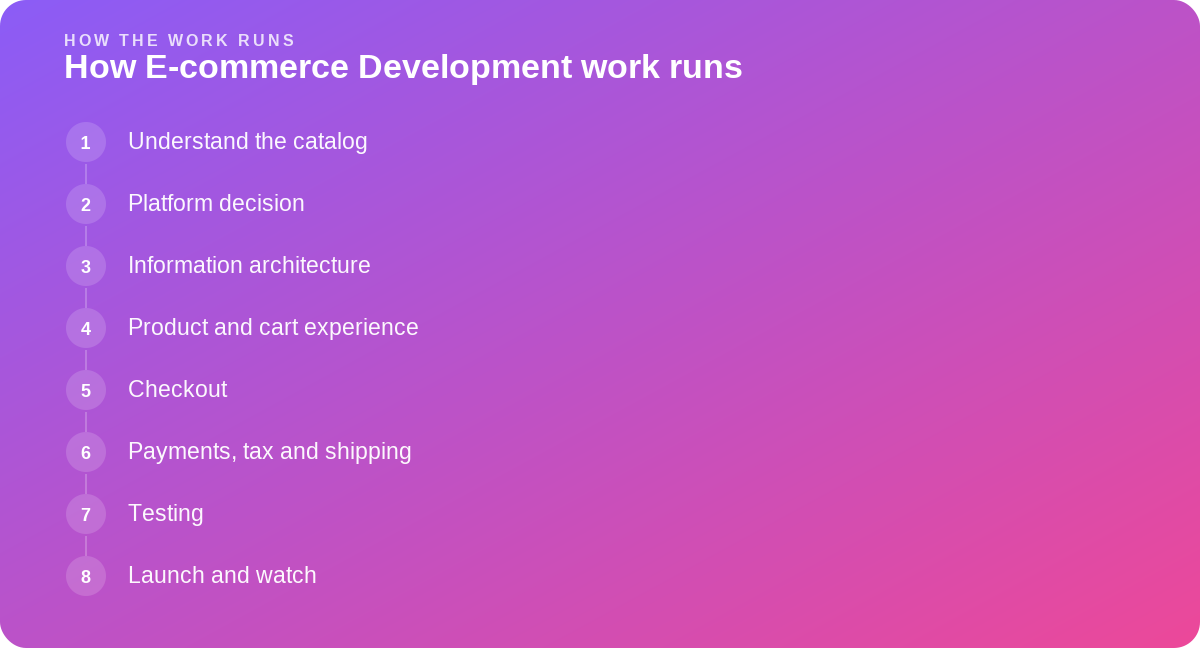
1. Understand the catalog
How many products, how they vary, where the data lives and how good it is. Product data quality determines more about an e-commerce build than the design does.
2. Platform decision
Hosted, open source or headless, chosen against your catalog, your volume and who will maintain it. This is a five-year decision made in week one.
3. Information architecture
Categories, filters and search. Getting someone from the homepage to the right product in as few decisions as possible.
4. Product and cart experience
The pages where money is actually decided. Imagery, variants, availability, shipping expectations, returns.
5. Checkout
The highest-stakes flow on the site. Every extra field costs conversions, and surprise costs lose more people than high costs.
6. Payments, tax and shipping
Gateway integration, tax calculation, shipping rules. Tedious, high-consequence, and where launches slip.
7. Testing
Real transactions, real cards, real refunds, on real devices. Including the unhappy paths: out of stock, declined card, address mismatch.
8. Launch and watch
Watching the funnel closely for the first fortnight, because real traffic finds things testing never does.
Where does E-commerce Development fit? Usually somewhere in the middle of that sequence, and it inherits every decision made before it. That's the argument for settling scope early: a change at stage two is a conversation, and the same change at stage seven is a rebuild.
What to send us
This is the part you control, and it matters more than most people expect. A good brief is worth a week.
What belongs in the brief
- Who it is for
- The audience, in one sentence, in your own words. Not a persona document — a sentence.
- What it has to do
- The action you want someone to take, or the decision you want them to be able to make.
- Where it will live
- Every placement, at every size. This is the single most common omission, and it is the one that causes reshoots and recrops.
- What already exists
- Brand guidelines, prior work, the files nobody likes. Especially the files nobody likes, and why.
- What is fixed
- Colors, typefaces, legal copy, platform requirements, anything that is not up for discussion.
- What good looks like
- Two or three references, plus one example of something you actively dislike. The dislike is more useful than the likes.
- The real deadline
- The date something has to be live, not the date you would like to see a draft. Say which one you are giving.
- Who signs off
- One name. A brief with four approvers and no decider is a brief that will cost you two extra revision rounds.
Two of those deserve emphasis, because they're the ones that cost money when they're missing. Where it will live — every placement, at every size — is the omission that causes reshoots and recrops. And who signs off is the one that quietly adds revision rounds: a project with four approvers and no decider will always cost more than one with a single name on it.
Specific to E-commerce Development
On top of the general brief, this particular job benefits from you having settled the following before anyone starts:
- Checkout tested end to end with real payment methods, including declines and refunds
- Every product image checked against the marketplace or platform spec it has to satisfy
- Tax and shipping calculations verified against real addresses in multiple states
- Core Web Vitals measured on product and category pages, which are the ones that matter commercially
If you've got files ready now, you can send them straight over — they go to private storage rather than to an inbox, and nothing is public. If you'd rather see the standard before committing to anything, try us on a couple of files first. No card, no commitment, and if it's not what you need you've lost nothing but an afternoon.
How to check what comes back
This section is worth reading even if you never hire anybody. Reviewing badly is expensive whoever does the work.
- Check it where it will live
- Approve a web asset in a browser, a print asset on paper, an audio mix on a phone speaker. Approving a deliverable in the tool that made it is how problems reach the public.
- Check the edges, not the middle
- The middle is almost always fine. Look at the corners, the smallest size, the longest string, the darkest area, the last ten seconds.
- Check one thing at a time
- Color, then type, then spacing, then content. A review that tries to see everything at once sees the loudest thing and misses the rest.
- Collect feedback before you send it
- One consolidated list beats six emails. Contradictions inside your own organization are cheaper to resolve on your side than on ours.
- Be specific about what is wrong
- "Make it pop" costs a revision round. "The headline is hard to read against the sky, can we darken the area behind it" costs ten minutes.
- Say what is right too
- Not out of politeness. If you only flag problems, the next round can lose the thing you liked without anyone knowing it mattered.
The bar we hold ourselves to
So you know what you're measuring against, here's what gets checked on our side before anything reaches you. None of it is optional, and none of it is charged as an extra.
- Checkout tested end to end with real payment methods, including declines and refunds
- Every product image checked against the marketplace or platform spec it has to satisfy
- Tax and shipping calculations verified against real addresses in multiple states
- Core Web Vitals measured on product and category pages, which are the ones that matter commercially
- Inventory and pricing sync tested under failure, not only under success
- Accessibility checked through the entire purchase path, not just the homepage
Red flags specific to E-commerce Development
If you see any of these in what comes back, say so. They're all fixable, and they're all cheaper to fix now than after it's published.
- A store losing people at shipping
- A migration that lost the category rankings
- Filters that ate the crawl budget
You can see how we present finished work — including the before and after — in the portfolio. Anything marked as a sample is our own demonstration piece rather than a client project, and it says so on the item.
In house, freelance, studio, or a model?
This is the decision underneath "how much does it cost", and it deserves a straight answer rather than a pitch. There are four ways to get e-commerce development work done, and we're only the right choice for some of them.

Keep it in house
Someone on your payroll does it.
What's good about it: Fastest feedback loop there is, deepest product knowledge, no briefing overhead for small changes.
What's not: You are buying a person, not a job: their vacation, their sick days, their ceiling, and the software. It stops making sense the moment demand is spiky, because you pay for the peak all year.
Hire a freelancer
One specialist, engaged directly.
What's good about it: Cheapest way to buy real expertise, and you get the actual person who does the work.
What's not: One person is one point of failure. No cover, limited throughput, and if they move on mid-project you inherit their files and their conventions.
Use a studio
A team with a process, a review layer and cover.
What's good about it: Handles volume and variety, carries the QC step, and does not disappear when one person is sick.
What's not: More expensive per hour than a freelancer, and you are one client among several. Worth it when consistency across a lot of output matters more than the lowest rate.
Use a model
Generative or automated tooling, with or without a person checking.
What's good about it: Genuinely fast and genuinely cheap on the parts it is good at, and it does not get tired on page four hundred.
What's not: It is confidently wrong in ways that are hard to spot at a glance, and the parts it fails at are the ones a client notices: hands, text, counts, edges, continuity. Nothing should ship without a person having looked at it, which is why our AI work is priced with the review included rather than as a discount.
The short version: if the work is constant and central to what you do, hire. If it's spiky, or it needs a range of skills you can't justify employing, use a studio. If it's one specialist thing and you've found the right specialist, use them. We'd rather tell you that up front than take on a job we're the wrong shape for.
Working with a studio you'll never meet
Most e-commerce development work now happens between people in different places and often different time zones. That's fine — it's been fine for years — but it rewards a few habits and punishes a few others.
- Overlap, not coverage
- What matters is not whether a supplier is awake at 2pm Eastern, but whether there is a predictable window when you can both talk. Ask for the window and put it in the calendar.
- Batch your feedback
- Across a time difference, three rounds of one comment cost three days. One round of twelve comments costs one. This is the single biggest lever you have on turnaround.
- Send files once, properly
- A clean handoff with originals, a written brief and named files saves more time than any amount of chasing. Half of all "slow" projects were slow at the start.
- Agree what "urgent" means
- Everyone says urgent. Agree in advance what a rush actually triggers — a different queue, a different price, a different set of hands — so the word keeps its meaning.
- Keep one thread
- A decision made in a direct message is a decision nobody else on either side can find. One channel, one thread per job.
Our hours overlap the US business day, and we'd rather agree a standing window with you than promise round-the-clock availability nobody can actually sustain. If you want to talk it through before committing to anything, get in touch — there's no pitch deck and nobody will chase you.
The US rules worth knowing
This isn't legal advice and we're not lawyers. It's a list of the American rules that come up often enough in this kind of work that not knowing about them gets expensive. If any of it applies to you, it's worth twenty minutes with someone who is a lawyer.
Sales tax and economic nexus
Since South Dakota v. Wayfair, US states may require out-of-state sellers to collect sales tax once they pass a volume or revenue threshold in that state. Thresholds differ by state and change. This is an accounting decision with an engineering consequence, and it belongs in the build plan.
PCI DSS
Any business accepting cards is subject to the Payment Card Industry Data Security Standard. Using a compliant hosted gateway rather than handling card data directly is what keeps compliance scope manageable for most stores.
FTC rules on pricing and subscriptions
The Federal Trade Commission enforces against hidden fees, misleading reference prices and negative-option billing that is hard to cancel. Subscription and auto-renewal flows in particular are an active enforcement area, and several states have their own auto-renewal statutes.
And the general commercial stuff
Whatever the discipline, buying professional services in the United States raises the same handful of questions. These are the ones clients ask us most.
- Contracts and statements of work
- A statement of work that names the deliverables, the number of revision rounds, the ownership terms and the payment schedule is worth the hour it takes to read. Most disputes in this industry are not about quality; they are about two people having understood "done" differently.
- Ownership and work made for hire
- Under US copyright law, work created by an independent contractor generally belongs to the contractor unless there is a written assignment or it falls into one of the narrow statutory work-made-for-hire categories. That surprises a lot of buyers. Get the assignment in writing; any studio that hesitates is telling you something useful.
- Paying an outside supplier
- A US business paying a US contractor normally collects a Form W-9 and may need to file a 1099-NEC; paying a non-US supplier usually means a W-8BEN or W-8BEN-E instead. Your accountant will want these before the first invoice, not after the last one.
- Sales tax on services
- Whether a creative or digital service is taxable varies by state, and several states tax some digital deliverables and not others. It is worth one question to your accountant before a large engagement rather than one letter from a state revenue department after it.
- Advertising claims
- The Federal Trade Commission holds advertisers responsible for claims made in their marketing, including claims made in images. A retouched product photo that no longer represents the product is an advertising problem before it is a design one, and the liability sits with the advertiser rather than the retoucher.
- Accessibility
- Title III of the Americans with Disabilities Act has been read by US courts to cover websites in many circumstances, and federal agencies and their contractors are bound by Section 508, which points at WCAG. Accessibility is cheaper designed in than litigated out.
Our own terms are published rather than sent on request: you can read the terms and conditions, the payment terms, the refund policy and the confidentiality and NDA position before you talk to anybody. If something in them doesn't work for you, say so early — most of it is negotiable and all of it is better settled before the work than after it.
Questions to ask anyone quoting for this
Including us. If a supplier gets cagey about any of these, that's the answer to the question you were actually asking.
- Who is actually doing the work?
- Ask whether it stays with the person you are talking to, moves to a team, or gets subcontracted. None of those is wrong. Not knowing is.
- What exactly is a revision?
- Ask what counts as a revision versus a new brief, and how many are included. This is the single most common source of a bill you did not expect.
- Who owns the output?
- Get it in writing, including the working files. "You own the final" and "you own everything" are very different positions, and the second one costs more for a reason.
- What happens if it is wrong?
- Ask what a redo costs and how fast it happens. A studio with a clear answer has had the conversation before.
- Can I see work like mine?
- Not a showreel — work in your category, at your volume, with the constraints you have. A beautiful portfolio in another category proves taste, not fit.
- How do you handle my files?
- Where they are stored, who can reach them, how long they are kept, and what happens at the end. If you are sending anything unreleased, get this in the contract.
- What do you need from me?
- A supplier who cannot answer this has not thought about your side of the job, and you will discover that at the deadline.
One more, and it's the one people are most embarrassed to ask: what would make you turn this job down? A studio that has never turned work away is a studio that takes everything, and that tells you something about how carefully it's going to be handled.
The words people will use at you
Every field has vocabulary that gets deployed as a shortcut and lands as a barrier. Here's what the common terms in e-commerce development actually mean, in plain English. You shouldn't need this to buy the work, but it makes the conversation shorter.
- SKU
- Stock keeping unit. One specific sellable thing, including its size and color.
- Variant
- A version of a product that differs in one attribute. Handling variants well is most of catalog modeling.
- Faceted navigation
- Filter-based browsing. Excellent for shoppers and a common source of crawl and duplication problems.
- Cart abandonment
- Shoppers who add to cart and do not buy. Published research consistently puts it around seven in ten.
- Headless commerce
- Separating the storefront from the commerce engine. More flexible, more expensive to build and run.
- PCI DSS
- The card industry's security standard. Using a compliant gateway rather than touching card data yourself is what keeps your scope small.
- Conversion rate
- Sessions that end in a purchase. Useful only when you know which sessions and which purchases are being counted.
- AOV
- Average order value. The other lever, and often the easier one to move.
- Payment gateway
- The service that authorizes and captures card payments.
- Chargeback
- A customer disputing a charge with their bank. Expensive, and largely preventable through clear billing descriptors and honest product pages.
There's a fuller reference library if you want to go deeper on any of these, and everything in it is written the same way — plainly, with sources.
Three situations you might recognize
Abstract advice is easy to agree with and hard to use. These are the shapes this kind of problem actually arrives in, and what we'd do about each one.
A store losing people at shipping
Costs appeared only at the final step. Showing an estimate on the product page and free-shipping progress in the cart cut abandonment noticeably, and neither change required a redesign.
A migration that lost the category rankings
The new platform generated different category URLs. Without a redirect map, years of accumulated authority pointed at 404s. Rebuilt, but six weeks of trading went with it.
Filters that ate the crawl budget
Faceted navigation generated hundreds of thousands of URLs. Canonicals, crawl rules and a decision about which facets deserved to be indexed put attention back on pages that sell.
None of those needed heroics. They needed somebody to look at the right thing early, which is most of what experience buys you in this field.
Everything we have written about E-commerce Development
One article per subject, each with the figures, what good looks like, what to avoid and where it all comes from.
- How to Get Checkout Optimization Right
- Product Page Design, Done Properly
- Payment Integration: What Actually Works
- A Practical Guide to Faceted Navigation and Filtering
- A Practical Guide to Inventory and Stock Management
- A Practical Guide to Headless Commerce
- A Practical Guide to Product Search and Merchandising
- How to Get Returns and Post-Purchase Experience Right
- E-commerce Performance: What Actually Works
- Subscription and Recurring Billing: The Decisions That Matter
- Marketplace Integration: The Decisions That Matter
- A Practical Guide to Cart Abandonment Recovery
- A Practical Guide to Product Data and Feeds
- Pricing and Promotion Mechanics, Done Properly
- How to Get Customer Accounts and Data Right
- Multi-Currency and Cross-Border Selling: The Decisions That Matter
- Reviews and User-Generated Content: What Actually Works
- Replatforming: What Actually Works
- A Practical Guide to Accessibility in E-commerce
- Fraud Prevention, Done Properly
- B2B E-commerce: What Actually Works
- PCI DSS for Online Stores: The Decisions That Matter
- Product Structured Data and Merchant Listings, Done Properly
- Shipping Times and the FTC Mail Order Rule Explained
- How to Get Gift Cards and Store Credit Right
- A Practical Guide to Transactional Email for Online Stores
- How to Get Store Policies and Legal Pages Right
- How to Get GTINs and Product Barcodes Right
- Google Merchant Center Setup, Done Properly
- How to Get Free Product Listings on Google Right
- A Practical Guide to Shipping and Return Settings in Merchant Center
- Sales Tax for Online Sellers, Done Properly
- How Buy Online, Pick Up in Store Works
- Shipping Carriers and Rates: The Decisions That Matter
- Dropshipping: The Decisions That Matter
- Product Recalls and Safety: What Actually Works
- Selling Internationally: What Actually Works
- Product Bundles and Kits, Done Properly
- Size Guides and Fit Information: The Decisions That Matter
- A Practical Guide to Discount Codes and Promotions
- Loyalty Programs: What Actually Works
- Chargebacks and Payment Disputes, Done Properly
- Order Tracking Pages: The Decisions That Matter
- A Practical Guide to Digital Wallets and Express Checkout
- A Practical Guide to Product Question and Answer Sections
- Product Descriptions That Sell: The Decisions That Matter
- How to Get Product Titles Right
- How to Get Product Videos Right
- A Practical Guide to 3D and AR Product Views
- A Practical Guide to Variant Selectors
- Stock Availability Messaging: What Actually Works
- A Practical Guide to Delivery Date Estimates
- How to Get Upsells and Cross-Sells Right
- Free Shipping Thresholds: The Decisions That Matter
- Returns Portals and Exchanges: The Decisions That Matter
- Product Recommendations, Done Properly
- How to Get Product Search Autocomplete Right
- How to Get Sorting Options on Category Pages Right
- Back-in-Stock Notifications, Done Properly
- A Practical Guide to Preorders
- A Practical Guide to Product Information Management
- Catalog Taxonomy and Categories: The Decisions That Matter
- Order Management Systems: What Actually Works
- ERP Integration for Online Stores, Done Properly
- Social Commerce: The Decisions That Matter
- How to Get Subscription Cancellation Flows Right
- Quote Requests for B2B, Done Properly
- How to Get Card Testing Attacks Right
- ACH Payments: What Actually Works
- Buy Now, Pay Later: The Decisions That Matter
- Shopify Theme Sections and Metafields: What Actually Works
- Shopify Checkout Extensibility, Done Properly
- A Practical Guide to WordPress and WooCommerce Stores
- Guest Checkout: The Decisions That Matter
- How to Get Address Forms and Validation Right
- A Practical Guide to Payment Tokenization
- A Practical Guide to 3-D Secure Authentication
- Auto-Renewal Disclosure Rules: The Decisions That Matter
- Selling Age-Restricted Products: What Actually Works
- Selling Food Online: The Decisions That Matter
- Selling Cosmetics Online, Done Properly
- Wishlists and Saved Items: What Actually Works
- How to Get Search Analytics for Online Stores Right
- How to Get Cart Page Design Right
- A Practical Guide to Webhooks for Store Integrations
- How to Get Store API Rate Limits Right
- Product Comparison Features: The Decisions That Matter
- Flash Sales and Traffic Spikes, Done Properly
- Gift Options at Checkout, Done Properly
- Tax Exemption Certificates, Done Properly
- How to Get Warranties on Product Pages Right
- All-In Pricing and Hidden Fees: What Actually Works
- Product Configurators and Custom Options: What Actually Works
- Demand Forecasting for Stock, Done Properly
- Multi-Warehouse Inventory: What Actually Works
- How to Get Print-on-Demand Stores Right
- A Practical Guide to Selling Digital Downloads
- A Practical Guide to Selling Courses and Memberships
- Booking and Appointment Commerce: What Actually Works
- A Practical Guide to EU VAT and IOSS for US Sellers
- A Practical Guide to Customs Documentation for Shipping
- Dimensional Weight Pricing, Done Properly
- Local Delivery Options: What Actually Works
- Gift Registries: The Decisions That Matter
- Personalized and Engraved Products: What Actually Works
- How to Get Managing Price Changes Right
- A Practical Guide to Minimum Advertised Price Policies
- Account Takeover Prevention: What Actually Works
- Automated Merchandising Rules: What Actually Works
- Local Payment Methods, Done Properly
- Order Edits and Cancellations: The Decisions That Matter
- A Practical Guide to Sustainability Claims in Shipping
- How to Get Selling Medical Devices Online Right
- Selling Auto Parts Online, Done Properly
- Selling Furniture Online: What Actually Works
- Selling Apparel Online, Done Properly
- Selling Pet Products Online: What Actually Works
- A Practical Guide to Selling Building Materials Online
- Selling Electronics Online, Done Properly
- Selling Jewelry Online, Done Properly
- How to Get Selling Art and Prints Online Right
- A Practical Guide to Selling Refurbished Products
- Selling Event Tickets Online, Done Properly
- Selling Software Licenses, Done Properly
- Selling to Schools and Government: The Decisions That Matter
- Selling Subscription Boxes: The Decisions That Matter
- Selling Custom Manufacturing Services: What Actually Works
- How to Get Selling Perishable Goods Right
- Selling Through Trade Accounts: What Actually Works
- A Practical Guide to Selling Seasonal Products
- Choosing an E-commerce Platform: What Actually Works
- How to Get Product Data Migration Right
- Launching an Online Store: The Decisions That Matter
- Customer Service for Online Stores: What Actually Works
- A Practical Guide to Returns Abuse
- Stock Counts and Accuracy: What Actually Works
- Packaging and Unboxing Experience: What Actually Works
- How to Get Lost and Damaged Shipments Right
- Cross-Border Returns, Done Properly
- Marketplace Account Health: The Decisions That Matter
- A Practical Guide to E-commerce Analytics Setup
- How to Get Managing Supplier Data Feeds Right
- Preparing for Peak Trading, Done Properly
- A Practical Guide to Reviewing Store Policies
Work with us on E-commerce Development
Tell us what you are working on and we will tell you honestly whether we are the right studio for it — including when we are not. There is no pitch deck and nobody will chase you.
- Try it free — we will do a free technical review of one page, written up, no card and no commitment. It is a better test than any portfolio because it is your material.
- See the prices — published rates and the US market ranges, so you can sanity-check any quote including ours.
- Ask for a fixed price — send the brief and a sample and you get a number rather than a range.
- Look at the work in this discipline specifically.
- Ask a question. That is allowed too.