About the studio
A multidisciplinary digital studio, founded in 2014.
Last revised
MediaScaleUp is a digital studio working across web, moving image, sound, stills, 3D and search. Founded in 2014, doing one of those, and we added the rest because clients kept needing them from people who already understood the project.
What we are actually like to work with
Three things, and they are the three that tend to matter.
We would rather be involved early. Not because it bills more — because almost every expensive problem in this industry is a decision that was cheap to change in week one and structural by week eight. If you bring us a brief that is the wrong shape, we will say so before we quote it.
We will tell you when we are the wrong choice. There is a section further down this page comparing hiring in house, using a freelancer, using a studio and using a model, and it is written straight rather than weighted toward us. Some work genuinely belongs on your payroll, and we would rather lose a project than take one we are the wrong shape for.
We write down what we know. The library on this site runs to several thousand entries and is built from a reviewed catalog of sourced material rather than assembled from whatever currently ranks. Where a page states a figure, it names the body that published it. Where nobody has published one, the page says so instead of inventing a number.
How we are set up
A team rather than a person, which matters more than it sounds. It means somebody being ill does not stop your project, it means a second pair of eyes on every job before it reaches you, and it means a range of skills nobody could justify employing individually. It also means we are more expensive per hour than a freelancer, which is a real trade-off and not one we are going to pretend away.
We work with clients across the United States. Hours overlap the American business day, pricing is in US dollars, and deliverables are specified against the standards that actually apply here — ATSC loudness rather than EBU, ADA and Section 508 rather than EN 301 549, FTC advertising rules, US marketplace requirements.
In house, freelance, studio, or a model?
This is the decision underneath "how much does it cost", and it deserves a straight answer rather than a pitch. There are four ways to get studio work done, and we're only the right choice for some of them.

Keep it in house
Someone on your payroll does it.
What's good about it: Fastest feedback loop there is, deepest product knowledge, no briefing overhead for small changes.
What's not: You are buying a person, not a job: their vacation, their sick days, their ceiling, and the software. It stops making sense the moment demand is spiky, because you pay for the peak all year.
Hire a freelancer
One specialist, engaged directly.
What's good about it: Cheapest way to buy real expertise, and you get the actual person who does the work.
What's not: One person is one point of failure. No cover, limited throughput, and if they move on mid-project you inherit their files and their conventions.
Use a studio
A team with a process, a review layer and cover.
What's good about it: Handles volume and variety, carries the QC step, and does not disappear when one person is sick.
What's not: More expensive per hour than a freelancer, and you are one client among several. Worth it when consistency across a lot of output matters more than the lowest rate.
Use a model
Generative or automated tooling, with or without a person checking.
What's good about it: Genuinely fast and genuinely cheap on the parts it is good at, and it does not get tired on page four hundred.
What's not: It is confidently wrong in ways that are hard to spot at a glance, and the parts it fails at are the ones a client notices: hands, text, counts, edges, continuity. Nothing should ship without a person having looked at it, which is why our AI work is priced with the review included rather than as a discount.
The short version: if the work is constant and central to what you do, hire. If it's spiky, or it needs a range of skills you can't justify employing, use a studio. If it's one specialist thing and you've found the right specialist, use them. We'd rather tell you that up front than take on a job we're the wrong shape for.
How the work actually runs
A studio job runs in stages, and the stages aren't interchangeable. Here they are in the order they have to happen.
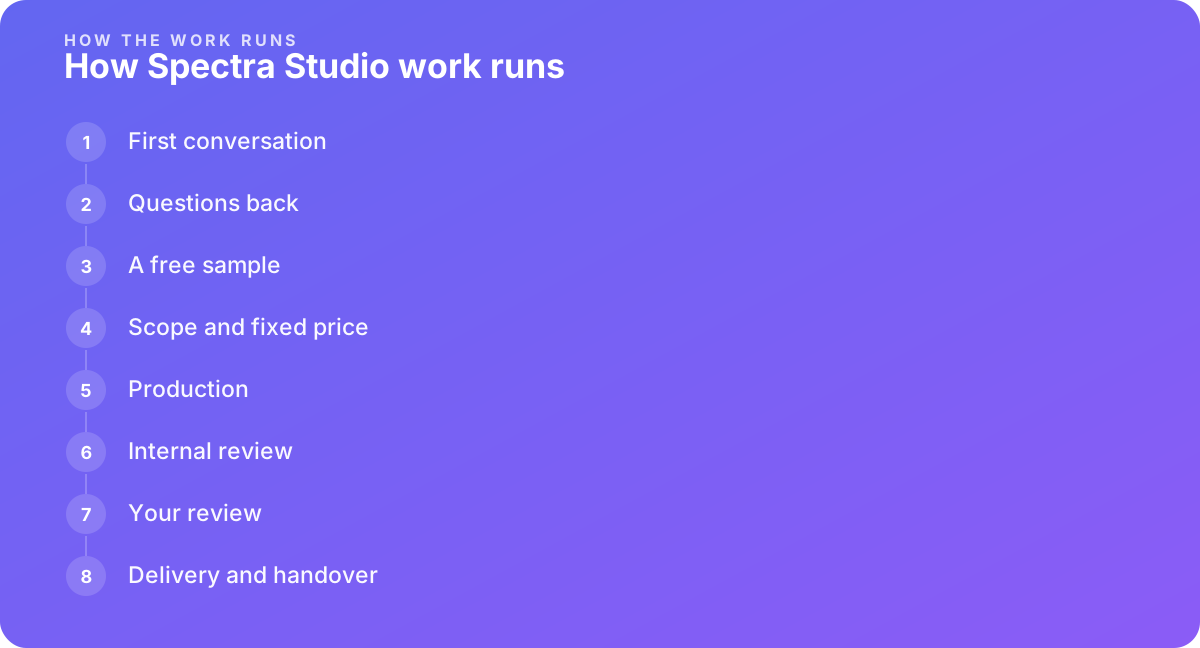
1. First conversation
You tell us the situation rather than the spec. If we are the wrong shape for it, this is where we say so — which costs you one reply rather than a month.
2. Questions back
Three or four, and at least one will be something nobody had decided yet. A supplier with no questions has not read it properly.
3. A free sample
Real work on two or three of your own files, done to your brief, at no cost. It answers the only question that actually matters, and it answers it better than any portfolio.
4. Scope and fixed price
Once the sample is approved the job is understood, so the number can be firm. Deliverables, revision rounds, ownership and payment schedule all written down.
5. Production
The work, with a named contact and an agreed check-in rhythm. No news is deliberately not our default.
6. Internal review
A second person checks every deliverable against the brief before it reaches you. Not a sample of them — all of them. This is included rather than charged.
7. Your review
One consolidated round of feedback beats six emails, especially across a time difference. There is a method for this further down, and it is worth ten minutes.
8. Delivery and handover
Final files in the formats and naming convention you asked for, plus the working files. You own it, including the sources, and it is in the terms rather than assumed.
Where does what we do fit? Usually somewhere in the middle of that sequence, and it inherits every decision made before it. That's the argument for settling scope early: a change at stage two is a conversation, and the same change at stage seven is a rebuild.
Three situations you might recognize
Abstract advice is easy to agree with and hard to use. These are the shapes this kind of problem actually arrives in, and what we'd do about each one.
A project that stalled for three weeks on one approval
Four people could comment and none of them could decide. Naming a single approver in the scope document fixed it on the next engagement, and it was the cheapest change either side made.
A quote that doubled between estimate and invoice
Not ours, but a common story. The original number covered one deliverable and the client assumed it covered six. The fix is boring: count deliverables in the scope document, in writing, before anybody starts.
A handover where nobody could open the files
The previous supplier delivered flattened output only. Every subsequent change meant paying them again. We deliver source files as standard, and it is in the terms rather than a favor.
None of those needed heroics. They needed somebody to look at the right thing early, which is most of what experience buys you in this field.
How to check what comes back
Most revision rounds exist because of how the previous round was reviewed, not because of how the work was done. Here's how to make a review count.
- Check it where it will live
- Approve a web asset in a browser, a print asset on paper, an audio mix on a phone speaker. Approving a deliverable in the tool that made it is how problems reach the public.
- Check the edges, not the middle
- The middle is almost always fine. Look at the corners, the smallest size, the longest string, the darkest area, the last ten seconds.
- Check one thing at a time
- Color, then type, then spacing, then content. A review that tries to see everything at once sees the loudest thing and misses the rest.
- Collect feedback before you send it
- One consolidated list beats six emails. Contradictions inside your own organization are cheaper to resolve on your side than on ours.
- Be specific about what is wrong
- "Make it pop" costs a revision round. "The headline is hard to read against the sky, can we darken the area behind it" costs ten minutes.
- Say what is right too
- Not out of politeness. If you only flag problems, the next round can lose the thing you liked without anyone knowing it mattered.
The bar we hold ourselves to
So you know what you're measuring against, here's what gets checked on our side before anything reaches you. None of it is optional, and none of it is charged as an extra.
- A second person reviews every deliverable against the brief before it reaches you
- Deliverables checked in the place they will actually be used, not in the tool that made them
- File names and formats matched to your convention, because a renaming pass downstream is a real cost
- Anything we could not do to the standard is flagged rather than quietly shipped
- The working files go with the finals, so you are never locked in
- Where a published standard applies, it is stated and met rather than approximated
You can see how we present finished work — including the before and after — in the portfolio. Anything marked as a sample is our own demonstration piece rather than a client project, and it says so on the item.
Working with a studio you'll never meet
Most studio work now happens between people in different places and often different time zones. That's fine — it's been fine for years — but it rewards a few habits and punishes a few others.
- Overlap, not coverage
- What matters is not whether a supplier is awake at 2pm Eastern, but whether there is a predictable window when you can both talk. Ask for the window and put it in the calendar.
- Batch your feedback
- Across a time difference, three rounds of one comment cost three days. One round of twelve comments costs one. This is the single biggest lever you have on turnaround.
- Send files once, properly
- A clean handoff with originals, a written brief and named files saves more time than any amount of chasing. Half of all "slow" projects were slow at the start.
- Agree what "urgent" means
- Everyone says urgent. Agree in advance what a rush actually triggers — a different queue, a different price, a different set of hands — so the word keeps its meaning.
- Keep one thread
- A decision made in a direct message is a decision nobody else on either side can find. One channel, one thread per job.
Our hours overlap the US business day, and we'd rather agree a standing window with you than promise round-the-clock availability nobody can actually sustain. If you want to talk it through before committing to anything, get in touch — there's no pitch deck and nobody will chase you.
What it costs in the US
Straight to the money. These are typical US market ranges for studio work. They are not a quote, because a quote needs your actual files, but they should tell you whether the number you've been given is in the right postcode.
| Type of work | Typical range | What that buys |
|---|---|---|
| Small defined job | $300 – $3,000 | A single deliverable or a small batch, scoped tightly, fixed price. |
| Project engagement | $3,000 – $40,000 | Multiple deliverables, several stages, a written scope and named revision rounds. |
| Retained capacity | $2,000 – $20,000 per month | A standing share of the studio reserved for you, for work that is continuous rather than occasional. |
Those are wide ranges, and they're wide for a reason. Here's what moves a job from one end to the other.
What actually drives the price
- How well the job can be described
- A job that can be specified precisely can be priced precisely. Vagueness does not get cheaper, it gets quoted defensively.
- Volume, and how repeatable it is
- Four hundred similar things cost far less each than four hundred different ones, because the setup amortizes.
- Revision rounds
- The single most common reason a final invoice differs from a quote. Agree the number, and agree what counts as a revision rather than a new brief.
- Turnaround
- A rush means somebody working late or a queue being jumped. Both are real costs and we will name the number before you commit.
- Number of deliverable versions
- One master and six derivatives is seven deliverables. It is the line most often left out of a brief and most often argued about later.
- How much of the decision-making sits with us
- Executing a settled brief is production. Working out what the brief should be is a different service with a different price.
How the money is usually structured
Separately from how much, there's the question of how. Five models cover almost everything in this industry, and the right one depends on how well the job can be described before it starts.
- Per unit
- A fixed price per image, per minute, per page, per asset. Best when the work is genuinely repeatable and you can describe one unit precisely. It is the easiest model to budget and the easiest to argue about, because everything hinges on whether your idea of one unit matches ours. Settle that on a sample before you settle it on an invoice.
- Hourly or day rate
- You buy time, and the output is whatever that time produces. Honest when nobody can scope the job yet — a rescue, an unknown archive, an exploratory phase. Ask for a not-to-exceed number anyway. An open hourly arrangement with no ceiling is a budget with no floor.
- Fixed project fee
- One number for a defined scope, usually with a stated number of revision rounds. The model most clients prefer and the one that punishes a vague brief hardest. The fee is only fixed if the scope is, so expect the scope document to be more specific than feels comfortable. That specificity is what protects you.
- Monthly retainer
- A set amount of capacity reserved for you every month. Worth it once the work is continuous rather than occasional — a catalog that refreshes, a channel that publishes weekly, a site that keeps changing. Below roughly ten to fifteen hours a month it usually costs more than buying the work as it comes.
- Value or outcome based
- Pricing tied to a business result rather than to effort. Rare, and rarely as clean as it sounds. It works where the outcome is unambiguous and attributable, and falls apart where it is neither. Treat an outcome-based proposal with the same scrutiny you would give any other claim about attribution.
If you want a real number rather than a range, the fastest route is to send us the actual brief — scope, volume, deadline, and a couple of sample files if you have them. That's usually enough for a fixed price rather than an estimate.
How long it takes
Timelines in this field are mostly predictable, with one exception that catches almost everybody. Here's the usual shape.
| Phase | Usual duration |
|---|---|
| First reply | Same day, and always within one business day |
| Free sample back | 1–3 business days |
| Fixed quote after approval | 1 business day |
| Production | Quoted per job, and the date is the real one rather than the hopeful one |
| Revision round | 1 business day for a normal round |
One thing worth saying plainly: the most common cause of a late project isn't production. It's waiting — for content, for a decision, for one person to look at something. If you want a project to move quickly, the highest-leverage thing you can do is name one person who can say yes and make sure they're available. That single change is worth more than any amount of chasing.
Rush work is possible and it's genuinely more expensive, because it means real people working real overtime or a job jumping a queue somebody else is in. We'll always tell you what a rush actually costs before you commit to it.
The US rules worth knowing
This isn't legal advice and we're not lawyers. It's a list of the American rules that come up often enough in this kind of work that not knowing about them gets expensive. If any of it applies to you, it's worth twenty minutes with someone who is a lawyer.
Ownership and written assignment
Under US copyright law, work created by an independent contractor generally belongs to the contractor unless there is a written assignment or it falls inside one of the narrow statutory work-made-for-hire categories. This surprises a great many buyers. Ours is assigned to you in writing, including source files.
Paying an outside supplier
A US business paying a US contractor normally collects a Form W-9 and may need to file a 1099-NEC; paying a non-US supplier usually means a W-8BEN or W-8BEN-E instead. Your accountant will want these before the first invoice rather than after the last one.
Confidentiality
We will sign your NDA or use ours, whichever you prefer. Uploaded files go to private storage rather than to an inbox, and nothing is published as portfolio work without written permission — which is a separate decision from the one you make when you hire us.
And the general commercial stuff
Whatever the discipline, buying professional services in the United States raises the same handful of questions. These are the ones clients ask us most.
- Contracts and statements of work
- A statement of work that names the deliverables, the number of revision rounds, the ownership terms and the payment schedule is worth the hour it takes to read. Most disputes in this industry are not about quality; they are about two people having understood "done" differently.
- Ownership and work made for hire
- Under US copyright law, work created by an independent contractor generally belongs to the contractor unless there is a written assignment or it falls into one of the narrow statutory work-made-for-hire categories. That surprises a lot of buyers. Get the assignment in writing; any studio that hesitates is telling you something useful.
- Paying an outside supplier
- A US business paying a US contractor normally collects a Form W-9 and may need to file a 1099-NEC; paying a non-US supplier usually means a W-8BEN or W-8BEN-E instead. Your accountant will want these before the first invoice, not after the last one.
- Sales tax on services
- Whether a creative or digital service is taxable varies by state, and several states tax some digital deliverables and not others. It is worth one question to your accountant before a large engagement rather than one letter from a state revenue department after it.
- Advertising claims
- The Federal Trade Commission holds advertisers responsible for claims made in their marketing, including claims made in images. A retouched product photo that no longer represents the product is an advertising problem before it is a design one, and the liability sits with the advertiser rather than the retoucher.
- Accessibility
- Title III of the Americans with Disabilities Act has been read by US courts to cover websites in many circumstances, and federal agencies and their contractors are bound by Section 508, which points at WCAG. Accessibility is cheaper designed in than litigated out.
Our own terms are published rather than sent on request: you can read the terms and conditions, the payment terms, the refund policy and the confidentiality and NDA position before you talk to anybody. If something in them doesn't work for you, say so early — most of it is negotiable and all of it is better settled before the work than after it.
Questions to ask anyone quoting for this
Including us. If a supplier gets cagey about any of these, that's the answer to the question you were actually asking.
- Who is actually doing the work?
- Ask whether it stays with the person you are talking to, moves to a team, or gets subcontracted. None of those is wrong. Not knowing is.
- What exactly is a revision?
- Ask what counts as a revision versus a new brief, and how many are included. This is the single most common source of a bill you did not expect.
- Who owns the output?
- Get it in writing, including the working files. "You own the final" and "you own everything" are very different positions, and the second one costs more for a reason.
- What happens if it is wrong?
- Ask what a redo costs and how fast it happens. A studio with a clear answer has had the conversation before.
- Can I see work like mine?
- Not a showreel — work in your category, at your volume, with the constraints you have. A beautiful portfolio in another category proves taste, not fit.
- How do you handle my files?
- Where they are stored, who can reach them, how long they are kept, and what happens at the end. If you are sending anything unreleased, get this in the contract.
- What do you need from me?
- A supplier who cannot answer this has not thought about your side of the job, and you will discover that at the deadline.
One more, and it's the one people are most embarrassed to ask: what would make you turn this job down? A studio that has never turned work away is a studio that takes everything, and that tells you something about how carefully it's going to be handled.
The words people will use at you
Every field has vocabulary that gets deployed as a shortcut and lands as a barrier. Here's what the common terms in studio actually mean, in plain English. You shouldn't need this to buy the work, but it makes the conversation shorter.
- Scope of work
- The written list of what is being delivered. A fixed price is only fixed if this is.
- Statement of work
- The document that names deliverables, revision rounds, ownership and payment terms. Most disputes in this industry are two people having read "done" differently.
- Revision round
- One consolidated set of changes. Agree what counts as a revision versus a new brief, in writing, before the work starts.
- Deliverable
- One finished thing you receive. A master and six crops is seven deliverables, not one.
- Retainer
- A set amount of studio capacity reserved for you each month. Worth it above roughly ten to fifteen hours a month, and not below.
- Work made for hire
- A narrow US copyright category. Outside it, work by an outside contractor does not transfer without a written assignment — which is why the assignment matters.
- Source files
- The editable originals, as opposed to the flattened output. Owning them is the difference between being able to change something later and having to pay for it again.
- Brief
- What you want, who for, where it goes and what is fixed. Two pages beats twenty, and specific beats long.
- Kickoff
- The point at which scope is agreed and production starts. Everything before it is cheap to change; everything after it is not.
- Handover
- The end of an engagement: final files, source files, and enough documentation that you are not dependent on us to make a small change.
There's a fuller reference library if you want to go deeper on any of these, and everything in it is written the same way — plainly, with sources.
Where to look next
- How a project actually runs, week by week
- Everything we do, with prices
- The work — samples are labeled as samples
- The people who would actually be on your project
- The journal, which is the best evidence of whether we know the subject
Start somewhere small
The lowest-risk way to find out whether this is useful is to send a couple of real files and see what comes back. Free, no card, no commitment, and if the standard is not what you need you have lost an afternoon rather than a budget.
If you already know the scope, ask for a fixed price. If you would rather look first, here is the work — anything marked as a sample is our own demonstration piece and says so.