Image Editing & Retouching
Cut-outs, retouching, color and composites at volume, with the detail a product page needs.
Last revised
This page is the whole picture: what we do, what it costs in the US, how long it takes, what we need from you, and every article we have written on the subject. If you already know what you want, ask for a quote or try us on a couple of files first — both are free and neither involves a sales call.
What Image Editing & Retouching covers here
Fourteen disciplines sounds like a lot until you notice how often one job needs three of them. Within Image Editing & Retouching specifically, this is the work:
- Clipping Paths and Cut-Outs
- Isolating a subject from its background with a vector path or mask so it can be placed on any background.
- Color Management
- Using profiles and a consistent working space so that a color looks the same on a screen, in a browser and in print.
- Non-Destructive Editing
- Working with layers, masks, adjustment layers and smart objects so that every decision stays reversible.
- Product Photography Retouching
- Preparing product images for catalog and listing use: cleaning, correcting, standardizing and cutting out.
- Portrait Retouching Ethics
- Deciding how far to alter a person's appearance, and being explicit about it with the subject and the audience.
- Image File Formats
- Choosing the format for a given job — editing, archiving, print or web — and understanding what each one keeps and discards.
- Image Compositing
- Combining elements from several images into one that reads as a single photograph.
- Batch Processing and Automation
- Applying the same operations across many images by script or action, rather than opening each one.
- Raw Processing
- Developing raw camera files, where exposure, white balance and tone are interpreted rather than baked in.
- Sharpening and Output Resolution
- Applying sharpening appropriate to the capture, the subject and — separately — the size and medium the image will be output at.
- Image Metadata and Rights
- The information carried inside an image file: capture data, copyright, creator, licensing terms and description.
- Background Removal at Scale
- Removing backgrounds across a large volume of images to a consistent standard, usually for e-commerce.
That is twelve of 123. The full index is further down this page.
What it costs in the US
Here's what this generally costs in the United States. Treat it as a sanity check rather than a price list: the honest number depends on the job, and anyone who gives you a firm price without looking at the work is guessing.
| Type of work | Typical range | What that buys |
|---|---|---|
| Simple cut-out and clean | $0.40 – $2.00 per image | Straight-edged products, plain backgrounds, basic dust and spot cleanup. |
| Standard e-commerce retouch | $2 – $8 per image | Complex edges, color matched to a reference, shadow work, multiple crops. |
| High-end and advertising | $25 – $250+ per image | Beauty, jewelry, compositing, liquid and fabric work — hours per image, not minutes. |
Those are wide ranges, and they're wide for a reason. Here's what moves a job from one end to the other.
What actually drives the price
- How complex the cut-out is
- A rectangular box is not a bicycle, and a bicycle is not curly hair on a busy background. Edge difficulty is the single biggest driver.
- How much retouching
- Dust removal is minutes. Rebuilding a reflection, reshaping a garment or repairing a bad capture is a different order of work.
- Volume
- Per-image rates drop with quantity, because the reference and the setup are amortized across the batch.
- Consistency requirement
- Matching four hundred images to one reference costs more than editing four hundred images well individually. It is also the thing that actually sells a range.
- Turnaround
- Overnight work is real overtime for real people and is priced that way.
- Number of output versions
- One master and five crops is six versions per image, and thirty-six files once each is exported in three formats and two color spaces, not one.
How the money is usually structured
Separately from how much, there's the question of how. Five models cover almost everything in this industry, and the right one depends on how well the job can be described before it starts.
- Per unit
- A fixed price per image, per minute, per page, per asset. Best when the work is genuinely repeatable and you can describe one unit precisely. It is the easiest model to budget and the easiest to argue about, because everything hinges on whether your idea of one unit matches ours. Settle that on a sample before you settle it on an invoice.
- Hourly or day rate
- You buy time, and the output is whatever that time produces. Honest when nobody can scope the job yet — a rescue, an unknown archive, an exploratory phase. Ask for a not-to-exceed number anyway. An open hourly arrangement with no ceiling is a budget with no floor.
- Fixed project fee
- One number for a defined scope, usually with a stated number of revision rounds. The model most clients prefer and the one that punishes a vague brief hardest. The fee is only fixed if the scope is, so expect the scope document to be more specific than feels comfortable. That specificity is what protects you.
- Monthly retainer
- A set amount of capacity reserved for you every month. Worth it once the work is continuous rather than occasional — a catalog that refreshes, a channel that publishes weekly, a site that keeps changing. Below roughly ten to fifteen hours a month it usually costs more than buying the work as it comes.
- Value or outcome based
- Pricing tied to a business result rather than to effort. Rare, and rarely as clean as it sounds. It works where the outcome is unambiguous and attributable, and falls apart where it is neither. Treat an outcome-based proposal with the same scrutiny you would give any other claim about attribution.
If you want a real number rather than a range, the fastest route is to send us the actual brief — scope, volume, deadline, and a couple of sample files if you have them. That's usually enough for a fixed price rather than an estimate.
How long it takes
How long should this take? Here are the usual durations, with the caveat that every one of them assumes decisions get made when they're asked for.
| Phase | Usual duration |
|---|---|
| Reference image approved | 1–2 business days |
| First batch back | 2–3 business days after the reference is signed off |
| Volume production | Typically 200–500 images per day once the reference is locked |
| Revisions | 1 business day for a normal round |
| Rush | Same day or overnight, priced accordingly |
One thing worth saying plainly: the most common cause of a late project isn't production. It's waiting — for content, for a decision, for one person to look at something. If you want a project to move quickly, the highest-leverage thing you can do is name one person who can say yes and make sure they're available. That single change is worth more than any amount of chasing.
Rush work is possible and it's genuinely more expensive, because it means real people working real overtime or a job jumping a queue somebody else is in. We'll always tell you what a rush actually costs before you commit to it.
How the work actually runs
A image editing & retouching job runs in stages, and the stages aren't interchangeable. Here they are in the order they have to happen.
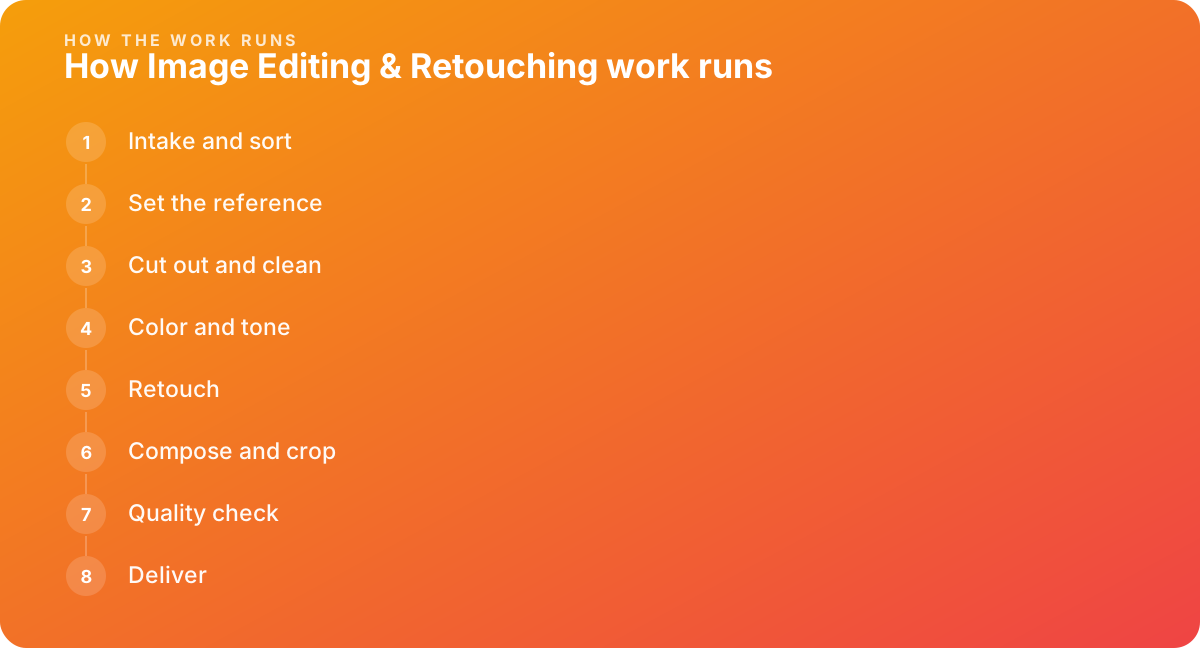
1. Intake and sort
We take your files, check them against the shot list and flag anything unusable before work starts. Finding out on image four hundred that the set was mis-shot is a bad day for everybody.
2. Set the reference
One image is edited to your brief and approved before anything else is touched. Everything after that matches the reference. This single step is what stops a batch drifting.
3. Cut out and clean
Backgrounds removed, dust and sensor spots cleaned, stray hairs and shadows handled. Where the edge is hard, a path; where it is hair or fur, masking.
4. Color and tone
Matching color to the physical product, evening exposure across the set, and holding the same look from the first frame to the last.
5. Retouch
Whatever the brief actually calls for: skin, fabric, reflections, dents, logo alignment. This is the stage where a written brief earns its keep.
6. Compose and crop
Every crop the layout needs, generated from one master rather than cropped from a JPEG that was already cropped.
7. Quality check
A second person looks at every image at full size against the reference and the brief. Not the person who edited it.
8. Deliver
Masters plus web derivatives, named to your convention, in the folder structure you asked for.
Where does Image Editing & Retouching fit? Usually somewhere in the middle of that sequence, and it inherits every decision made before it. That's the argument for settling scope early: a change at stage two is a conversation, and the same change at stage seven is a rebuild.
What to send us
A brief doesn't need to be long. It needs to be specific about a handful of things, and vague about everything else is fine.
What belongs in the brief
- Who it is for
- The audience, in one sentence, in your own words. Not a persona document — a sentence.
- What it has to do
- The action you want someone to take, or the decision you want them to be able to make.
- Where it will live
- Every placement, at every size. This is the single most common omission, and it is the one that causes reshoots and recrops.
- What already exists
- Brand guidelines, prior work, the files nobody likes. Especially the files nobody likes, and why.
- What is fixed
- Colors, typefaces, legal copy, platform requirements, anything that is not up for discussion.
- What good looks like
- Two or three references, plus one example of something you actively dislike. The dislike is more useful than the likes.
- The real deadline
- The date something has to be live, not the date you would like to see a draft. Say which one you are giving.
- Who signs off
- One name. A brief with four approvers and no decider is a brief that will cost you two extra revision rounds.
Two of those deserve emphasis, because they're the ones that cost money when they're missing. Where it will live — every placement, at every size — is the omission that causes reshoots and recrops. And who signs off is the one that quietly adds revision rounds: a project with four approvers and no decider will always cost more than one with a single name on it.
Specific to Image Editing & Retouching
On top of the general brief, this particular job benefits from you having settled the following before anyone starts:
- Every image checked at 100% zoom, not at thumbnail size
- Edges checked against a contrasting background, where halos and fringing actually show
- Color compared to the approved reference, not to the previous image in the sequence
- Delivered in sRGB for web and the working space you specified for print
If you've got files ready now, you can send them straight over — they go to private storage rather than to an inbox, and nothing is public. If you'd rather see the standard before committing to anything, try us on a couple of files first. No card, no commitment, and if it's not what you need you've lost nothing but an afternoon.
How to check what comes back
Reviewing work is a skill, and nobody is taught it. A good review saves a revision round; a vague one causes two.
- Check it where it will live
- Approve a web asset in a browser, a print asset on paper, an audio mix on a phone speaker. Approving a deliverable in the tool that made it is how problems reach the public.
- Check the edges, not the middle
- The middle is almost always fine. Look at the corners, the smallest size, the longest string, the darkest area, the last ten seconds.
- Check one thing at a time
- Color, then type, then spacing, then content. A review that tries to see everything at once sees the loudest thing and misses the rest.
- Collect feedback before you send it
- One consolidated list beats six emails. Contradictions inside your own organization are cheaper to resolve on your side than on ours.
- Be specific about what is wrong
- "Make it pop" costs a revision round. "The headline is hard to read against the sky, can we darken the area behind it" costs ten minutes.
- Say what is right too
- Not out of politeness. If you only flag problems, the next round can lose the thing you liked without anyone knowing it mattered.
The bar we hold ourselves to
So you know what you're measuring against, here's what gets checked on our side before anything reaches you. None of it is optional, and none of it is charged as an extra.
- Every image checked at 100% zoom, not at thumbnail size
- Edges checked against a contrasting background, where halos and fringing actually show
- Color compared to the approved reference, not to the previous image in the sequence
- Delivered in sRGB for web and the working space you specified for print
- File names match your convention exactly, because a renaming pass downstream is a real cost
- A second pair of eyes on the whole batch before anything ships
Red flags specific to Image Editing & Retouching
If you see any of these in what comes back, say so. They're all fixable, and they're all cheaper to fix now than after it's published.
- Four hundred SKUs that did not match
- A marketplace listing that kept getting rejected
- A rush drop with no reference
You can see how we present finished work — including the before and after — in the portfolio. Anything marked as a sample is our own demonstration piece rather than a client project, and it says so on the item.
In house, freelance, studio, or a model?
This is the decision underneath "how much does it cost", and it deserves a straight answer rather than a pitch. There are four ways to get image editing & retouching work done, and we're only the right choice for some of them.

Keep it in house
Someone on your payroll does it.
What's good about it: Fastest feedback loop there is, deepest product knowledge, no briefing overhead for small changes.
What's not: You are buying a person, not a job: their vacation, their sick days, their ceiling, and the software. It stops making sense the moment demand is spiky, because you pay for the peak all year.
Hire a freelancer
One specialist, engaged directly.
What's good about it: Cheapest way to buy real expertise, and you get the actual person who does the work.
What's not: One person is one point of failure. No cover, limited throughput, and if they move on mid-project you inherit their files and their conventions.
Use a studio
A team with a process, a review layer and cover.
What's good about it: Handles volume and variety, carries the QC step, and does not disappear when one person is sick.
What's not: More expensive per hour than a freelancer, and you are one client among several. Worth it when consistency across a lot of output matters more than the lowest rate.
Use a model
Generative or automated tooling, with or without a person checking.
What's good about it: Genuinely fast and genuinely cheap on the parts it is good at, and it does not get tired on page four hundred.
What's not: It is confidently wrong in ways that are hard to spot at a glance, and the parts it fails at are the ones a client notices: hands, text, counts, edges, continuity. Nothing should ship without a person having looked at it, which is why our AI work is priced with the review included rather than as a discount.
The short version: if the work is constant and central to what you do, hire. If it's spiky, or it needs a range of skills you can't justify employing, use a studio. If it's one specialist thing and you've found the right specialist, use them. We'd rather tell you that up front than take on a job we're the wrong shape for.
Working with a studio you'll never meet
Most image editing & retouching work now happens between people in different places and often different time zones. That's fine — it's been fine for years — but it rewards a few habits and punishes a few others.
- Overlap, not coverage
- What matters is not whether a supplier is awake at 2pm Eastern, but whether there is a predictable window when you can both talk. Ask for the window and put it in the calendar.
- Batch your feedback
- Across a time difference, three rounds of one comment cost three days. One round of twelve comments costs one. This is the single biggest lever you have on turnaround.
- Send files once, properly
- A clean handoff with originals, a written brief and named files saves more time than any amount of chasing. Half of all "slow" projects were slow at the start.
- Agree what "urgent" means
- Everyone says urgent. Agree in advance what a rush actually triggers — a different queue, a different price, a different set of hands — so the word keeps its meaning.
- Keep one thread
- A decision made in a direct message is a decision nobody else on either side can find. One channel, one thread per job.
Our hours overlap the US business day, and we'd rather agree a standing window with you than promise round-the-clock availability nobody can actually sustain. If you want to talk it through before committing to anything, get in touch — there's no pitch deck and nobody will chase you.
The US rules worth knowing
This isn't legal advice and we're not lawyers. It's a list of the American rules that come up often enough in this kind of work that not knowing about them gets expensive. If any of it applies to you, it's worth twenty minutes with someone who is a lawyer.
Marketplace image requirements
Amazon, Walmart, Target and most other US marketplaces publish strict image rules — pure white backgrounds on the main image, minimum pixel dimensions, limits on text and props. Rejection is automated, so these are engineering specs rather than guidelines.
FTC and truthful imagery
The Federal Trade Commission holds advertisers responsible for what their images imply. Retouching that makes a product look like something it is not is an advertising claim, and the liability sits with the seller.
Model and property releases
In the United States, commercial use of a recognizable person generally needs a signed release, and several states have their own right-of-publicity statutes. Retouching a face does not remove the need for the release.
And the general commercial stuff
Whatever the discipline, buying professional services in the United States raises the same handful of questions. These are the ones clients ask us most.
- Contracts and statements of work
- A statement of work that names the deliverables, the number of revision rounds, the ownership terms and the payment schedule is worth the hour it takes to read. Most disputes in this industry are not about quality; they are about two people having understood "done" differently.
- Ownership and work made for hire
- Under US copyright law, work created by an independent contractor generally belongs to the contractor unless there is a written assignment or it falls into one of the narrow statutory work-made-for-hire categories. That surprises a lot of buyers. Get the assignment in writing; any studio that hesitates is telling you something useful.
- Paying an outside supplier
- A US business paying a US contractor normally collects a Form W-9 and may need to file a 1099-NEC; paying a non-US supplier usually means a W-8BEN or W-8BEN-E instead. Your accountant will want these before the first invoice, not after the last one.
- Sales tax on services
- Whether a creative or digital service is taxable varies by state, and several states tax some digital deliverables and not others. It is worth one question to your accountant before a large engagement rather than one letter from a state revenue department after it.
- Advertising claims
- The Federal Trade Commission holds advertisers responsible for claims made in their marketing, including claims made in images. A retouched product photo that no longer represents the product is an advertising problem before it is a design one, and the liability sits with the advertiser rather than the retoucher.
- Accessibility
- Title III of the Americans with Disabilities Act has been read by US courts to cover websites in many circumstances, and federal agencies and their contractors are bound by Section 508, which points at WCAG. Accessibility is cheaper designed in than litigated out.
Our own terms are published rather than sent on request: you can read the terms and conditions, the payment terms, the refund policy and the confidentiality and NDA position before you talk to anybody. If something in them doesn't work for you, say so early — most of it is negotiable and all of it is better settled before the work than after it.
Questions to ask anyone quoting for this
Including us. If a supplier gets cagey about any of these, that's the answer to the question you were actually asking.
- Who is actually doing the work?
- Ask whether it stays with the person you are talking to, moves to a team, or gets subcontracted. None of those is wrong. Not knowing is.
- What exactly is a revision?
- Ask what counts as a revision versus a new brief, and how many are included. This is the single most common source of a bill you did not expect.
- Who owns the output?
- Get it in writing, including the working files. "You own the final" and "you own everything" are very different positions, and the second one costs more for a reason.
- What happens if it is wrong?
- Ask what a redo costs and how fast it happens. A studio with a clear answer has had the conversation before.
- Can I see work like mine?
- Not a showreel — work in your category, at your volume, with the constraints you have. A beautiful portfolio in another category proves taste, not fit.
- How do you handle my files?
- Where they are stored, who can reach them, how long they are kept, and what happens at the end. If you are sending anything unreleased, get this in the contract.
- What do you need from me?
- A supplier who cannot answer this has not thought about your side of the job, and you will discover that at the deadline.
One more, and it's the one people are most embarrassed to ask: what would make you turn this job down? A studio that has never turned work away is a studio that takes everything, and that tells you something about how carefully it's going to be handled.
The words people will use at you
Every field has vocabulary that gets deployed as a shortcut and lands as a barrier. Here's what the common terms in image editing & retouching actually mean, in plain English. You shouldn't need this to buy the work, but it makes the conversation shorter.
- Clipping path
- A hand-drawn vector outline that cuts a product out of its background. Crisp, reusable, and the right tool for hard edges.
- Masking
- A pixel-based selection used where an outline cannot work — hair, fur, smoke, glass, anything soft or semi-transparent.
- Ghost mannequin
- The technique that makes a garment look worn with no visible model, by combining an inside shot with an outside one.
- Color space
- The range of colors a file can describe. sRGB is the safe default for anything on a screen; Adobe RGB and ProPhoto hold more for print work.
- Non-destructive editing
- Working in layers and adjustments so the original pixels survive. It is what makes a revision cheap instead of a reshoot.
- Frequency separation
- A retouching technique that separates texture from tone so you can even out color without turning skin or fabric to plastic.
- Dodge and burn
- Selectively lightening and darkening to shape form. Slower than a blur, and the reason high-end retouching looks like a photograph.
- PPI
- Pixels per inch — how much detail there is at a given printed size. 300 PPI at final size is the usual print expectation.
- Bit depth
- 8-bit is fine for delivery; 16-bit holds far more tonal information and is what you want while you are still editing.
- Reference image
- The one approved edit every other image in the batch is matched to. The most important file in the job.
There's a fuller reference library if you want to go deeper on any of these, and everything in it is written the same way — plainly, with sources.
Three situations you might recognize
Abstract advice is easy to agree with and hard to use. These are the shapes this kind of problem actually arrives in, and what we'd do about each one.
Four hundred SKUs that did not match
Shot over three sessions by two photographers with no color reference in frame. We built a reference edit, matched everything to it, and flagged thirty-one images that needed reshooting rather than rescuing. The category page finally looked like one brand.
A marketplace listing that kept getting rejected
The main images had a soft gray background instead of pure white and were under the minimum pixel size. Both fixable in a batch, neither obvious from the rejection notice.
A rush drop with no reference
A client needed two hundred images in forty-eight hours with no time for an approval round. We edited twelve, sent them as a spread of interpretations, got a yes on one within the hour, and ran the rest against it.
None of those needed heroics. They needed somebody to look at the right thing early, which is most of what experience buys you in this field.
Everything we have written about Image Editing & Retouching
One article per subject, each with the figures, what good looks like, what to avoid and where it all comes from.
- A Practical Guide to Clipping Paths and Cut-Outs
- Color Management, Done Properly
- Non-Destructive Editing, Done Properly
- Product Photography Retouching: The Decisions That Matter
- Portrait Retouching Ethics Explained
- A Practical Guide to Image File Formats
- A Practical Guide to Image Compositing
- How to Get Batch Processing and Automation Right
- Raw Processing: The Decisions That Matter
- Sharpening and Output Resolution: The Decisions That Matter
- A Practical Guide to Image Metadata and Rights
- A Practical Guide to Background Removal at Scale
- Image Accessibility and Alt Text: The Decisions That Matter
- How to Get Perspective and Lens Correction Right
- How to Get Print Preparation Right
- Image SEO, Done Properly
- Retouching Workflow and Handover: The Decisions That Matter
- Responsive Image Delivery, Done Properly
- A Practical Guide to Ghost Mannequin and Apparel Imagery
- Noise Reduction in Images, Done Properly
- Vector Graphics and Logos, Done Properly
- Image Asset Management, Done Properly
- A Practical Guide to Content Credentials and C2PA
- Wide Gamut Color for the Web, Done Properly
- Copyright and Image Licensing: What Actually Works
- A Practical Guide to AI-Generated Images and Copyright
- Photo Restoration: The Decisions That Matter
- Image Compression and Quality Settings, Done Properly
- A Practical Guide to Layer Masks
- A Practical Guide to Adjustment Layers
- Smart Objects: The Decisions That Matter
- Content-Aware Fill, Done Properly
- A Practical Guide to Generative Fill
- How to Get AI Subject Selection Right
- Hair and Fine-Edge Selections: What Actually Works
- Curves and Levels: The Decisions That Matter
- Blend Modes: What Actually Works
- Dodge and Burn Retouching, Done Properly
- How to Get Healing Brush and Clone Stamp Right
- Product Color Variants: What Actually Works
- Removing Reflections and Glare: What Actually Works
- Jewelry Retouching, Done Properly
- How to Get Super Resolution and Image Upscaling Right
- A Practical Guide to Panorama Stitching
- Sky Replacement: What Actually Works
- How to Get Lightroom Masking Right
- Exporting Images for the Web: What Actually Works
- A Practical Guide to Pixels, PPI and DPI
- Frequency Separation: What Actually Works
- Liquify and Body Reshaping, Done Properly
- How to Get LUTs and Color Lookup for Photos Right
- Resampling Methods, Done Properly
- How to Get Product Shadows and Reflections Right
- Watermarks and Copyright Information: The Decisions That Matter
- Virtual Staging, Done Properly
- HDR Merging and Exposure Blending: The Decisions That Matter
- How to Get White Balance Correction Right
- How to Get Social Media Image Dimensions Right
- Optimizing SVG Files: What Actually Works
- Retouching Style Guides for Brands, Done Properly
- How to Get Dust Spot Removal Right
- Apparel Cleanup Retouching, Done Properly
- Black-and-White Conversion, Done Properly
- Duotones and Gradient Maps: The Decisions That Matter
- A Practical Guide to Scanning Photos and Artwork
- Consistent Product Image Framing: The Decisions That Matter
- A Practical Guide to Monitor Calibration for Image Editing
- A Practical Guide to Redacting Personal Information in Images
- Photoshop Neural Filters: What Actually Works
- Colorizing Black-and-White Photos, Done Properly
- Cropping for Composition, Done Properly
- Data-Driven Image Generation: What Actually Works
- A Practical Guide to Social Image Templates
- A Practical Guide to Soft Proofing for Print
- Ink Limits and Total Area Coverage, Done Properly
- A Practical Guide to Transparency in Print Files
- Trapping and Overprint: The Decisions That Matter
- Large Format Image Preparation: The Decisions That Matter
- Dielines and Packaging Artwork: What Actually Works
- How to Get Product Mockups Right
- Eye and Teeth Retouching: The Decisions That Matter
- Skin Tones in Retouching, Done Properly
- Screenshots for Documentation: The Decisions That Matter
- Technical Illustration, Done Properly
- Seamless Pattern Creation: The Decisions That Matter
- Choosing Stock Photography: What Actually Works
- How to Get Working with AI Image Generators Right
- Image Quality Control Checks, Done Properly
- Delta E and Color Accuracy: What Actually Works
- Fine Art Printing: What Actually Works
- Moire Patterns in Photos: The Decisions That Matter
- Retouching Glass and Transparent Products: What Actually Works
- Group and Family Shot Compositing: What Actually Works
- A Practical Guide to Real Estate Image Standards
- How to Get Automotive Image Editing Right
- Furniture Image Editing: The Decisions That Matter
- Food Image Editing: The Decisions That Matter
- How to Get Industrial Equipment Images Right
- How to Get Scientific Image Integrity Right
- How to Get Evidence Image Handling Right
- Fashion Lookbook Editing, Done Properly
- Art Reproduction Editing: The Decisions That Matter
- Image Editing for Print Catalogs, Done Properly
- A Practical Guide to Image Editing for Marketplaces
- How to Get Image Editing for Social Ads Right
- Sports Photo Editing: What Actually Works
- Event Photo Batch Editing, Done Properly
- Setting a Standard for Headshot Retouching
- A Practical Guide to Retouching for Packaging Artwork
- A Practical Guide to Matching Color Across Images
- Client Proofing for Image Sets, Done Properly
- How to Get Versioning Image Files Right
- A Practical Guide to Layered File Handover
- How to Get Estimating Retouching Work Right
- A Practical Guide to Outsourcing Retouching
- How to Get Finding Duplicate Images Right
- Bulk Metadata Editing: The Decisions That Matter
- Converting Legacy Image Formats: What Actually Works
- A Practical Guide to Image Briefs for Retouchers
- Checking Images Before Print, Done Properly
- Organizing Image Libraries by Product: The Decisions That Matter
- Choosing a Retouching Partner: The Decisions That Matter
- How to Get Planning Retouching Capacity Right
Work with us on Image Editing & Retouching
Tell us what you are working on and we will tell you honestly whether we are the right studio for it — including when we are not. There is no pitch deck and nobody will chase you.
- Try it free — we will do 2 images, edited to your brief, no card and no commitment. It is a better test than any portfolio because it is your material.
- See the prices — published rates and the US market ranges, so you can sanity-check any quote including ours.
- Ask for a fixed price — send the brief and a sample and you get a number rather than a range.
- Look at the work in this discipline specifically.
- Ask a question. That is allowed too.