How to Get Sound Effects and Foley Right
Follow an illustrative brand film from brief to delivery to see how sound effects and foley are spotted, recorded, layered, placed in space and licensed.
 MediaScaleUp Editorial Team
Sound effects and foley are the individual sounds a scene needs beyond its dialogue and music: footsteps, clothing movement, a cup set down on a bench, a door latch, a drawer sliding shut, the scrape of a chair. Some are performed and recorded to picture, which is foley in the strict sense. Others come from licensed libraries or dedicated field recordings. Either way, somebody has to decide which sounds a scene needs, find or create them, and place them so convincingly that the audience never thinks about them at all.
This matters to anyone commissioning video, from a brand film or product launch to a training series or a short documentary. Location recording is built to capture clean dialogue, so the microphone is aimed at mouths, not hands and feet. The result is that many of the sounds an audience expects to hear are faint, off-axis or missing entirely, and viewers notice their absence even when they cannot say what feels wrong. A scene without its small sounds reads as flat, distant or oddly artificial.
Rather than list principles in the abstract, this guide follows one illustrative project from brief to delivery and explains each decision as it comes up. The project, its client and its numbers are invented for teaching purposes; they are realistic, but they are not a case study of real work. The aim is to show how getting sound effects and foley right is less about owning a large library and more about a sequence of disciplined choices.
The Illustrative Brief: A Three-Minute Film About a Furniture Workshop
Imagine a small furniture maker commissions a three-minute brand film for its website and social channels. The picture is shot over two days in its workshop: a founder interview, close-ups of hand tools on oak, a wide shot of the showroom, a delivery van loading at dusk, and a closing scene of a family sitting down at a finished table. The production recorded the interview on a lavalier and a boom, and the rest on a camera-mounted microphone and an occasional boom pass when the crew had time.
The edit is locked when the audio work begins. That point matters: effects are placed against specific frames, so every picture change after sound work starts means re-syncing cues. The brief to the audio team is short and typical: "The workshop scenes feel empty. Can you make it sound like the real place?" It also mentions that a music track has been licensed and that the film will be delivered in a full-length version and a 45-second vertical cut.
A brief like that hides several decisions. What does "the real place" sound like, given that the real place was full of extractor fans and a radio the crew asked the team to switch off? Which sounds carry the story, and which are texture? Will the music leave room for detail, or bury it? And what exactly do the licensing terms need to cover, given that the film will run on the web, on social platforms and possibly at a trade show?
Decision: Before quoting or starting, the team asks for three things: the locked edit with timecode burned in, every original production audio file (not only the mixed guide track), and a list of every place the film will be shown. The first makes spotting precise, the second reveals what usable sound already exists, and the third defines the licensing scope and delivery loudness.
Spotting the Film: Deciding Which Sounds the Story Needs
Spotting is the session where someone watches the cut, scene by scene, and writes down every sound that needs attention, with its timecode, a description and a source plan. It is the single most important step in getting sound effects and foley right, because it turns a vague sense of emptiness into a list of specific, schedulable tasks.
In our illustrative project the editor spots the film with the director on a video call, then refines the list alone. Each cue gets a category: foley (performed to picture), library (licensed pre-recorded sound), production (usable from the location recording, possibly cleaned) or field (to be recorded specially). The spotting list also flags which sounds are story sounds, the ones that must be heard clearly because the picture draws attention to them, and which are texture, sounds that can be felt more than heard.
Story sounds versus texture
The close-up of a hand plane shaving a curl of oak is a story sound. The camera lingers on it, the founder talks about it, and the audience will expect a crisp, satisfying sound that matches the motion exactly. The general hum of a workshop in the wide shot is texture: it tells the audience where they are, but nobody should consciously listen to it. Mixing these two categories up is a common failure. Treat every sound as a story sound and the track becomes busy and tiring; treat everything as texture and the key moments lose their impact.
Reading what production already captured
Before deciding to replace anything, the editor auditions the production audio. The boom passes on the planing close-up turn out to be usable, if a little distant. The camera microphone on the wide shots is dominated by the crew moving around and is effectively unusable for effects. The van loading scene has a strong wind rumble. This audit changes the plan: the planing sound will be a blend of production audio and new foley rather than a pure replacement, which keeps a sense of the real room.
Trap avoided: Spotting from memory or from a quick watch-through. Sounds that are missing are, by definition, easy to overlook. Watching each scene at least twice, once for movement and once for objects, catches the quiet handling sounds (a sleeve brushing a bench, a pencil set down) that make a scene feel inhabited.
The finished spotting list for the three-minute film runs to 74 cues. That sounds like a lot for a short film, but it is typical once every footstep sequence, prop and surface is counted. Of those, 31 are assigned to foley, 29 to library sources, 9 to cleaned production audio and 5 to a short field recording session in the workshop itself.
The project in numbers
Every figure below belongs to this illustrative project. They are here to show the shape and scale of the work, not to set a benchmark; a different film, with more movement or fewer close-ups, would produce very different numbers.
The ratio of foley to library cues is worth noticing. Foley was chosen wherever timing and texture were specific to the picture: footsteps on the workshop's concrete floor, the founder's hands on tools, cloth movement in the interview. Library sounds were chosen where the sound was generic enough that a well-recorded, well-licensed file would do the job and performing it would add cost without adding quality: the van engine, distant traffic, birds outside the showroom windows.
Choosing Between Foley, Library Effects and Field Recording
The choice of source for each cue is a trade-off between timing, specificity, cost and licensing. There is no rule that foley is better than library sound or the reverse. The question for each cue is which source gets a convincing result with the least compromise.
| Source | Best for | Strengths | Limitations |
|---|---|---|---|
| Foley (performed to picture) | Footsteps, cloth, hand props, anything tightly synced to on-screen movement | Timing and weight match the performance; unique to the project | Needs a quiet room, props, a performer and time; less suited to large or dangerous events |
| Library effects | Vehicles, weather, crowds, animals, machinery, generic backgrounds | Fast; professionally recorded; wide choice | Licensing terms vary; well-known files may be recognized; rarely match picture timing without editing |
| Field recording | Location-specific sounds and ambiences, unusual machines | Authentic to the actual place; owned outright if recorded in-house | Requires access, travel and quiet conditions; results depend on the day |
| Cleaned production audio | Sounds the location mic caught well, especially close-ups | Perfect sync and a natural sense of the real room | Often mixed with dialogue, noise or crew sounds; may need spectral repair |
For the workshop film, the five field recording cues were the table saw, the dust extractor, the old workshop door, a specific bench vise and the room ambience itself. These are sounds of this particular place. A library table saw would be plausible, but the founder and staff would recognize that it was not their machine, and the brand film is partly for them. A 90-minute session in the empty workshop after hours captured all five, plus spare takes.
For library cues, the team works from its own curated library, the process for which is covered in detail in our guide to building a sound effects library that actually works. The key habit is metadata: files are searchable by source, perspective (close, medium, distant), space (interior, exterior, reverberant) and license. That last field turns out to matter later in this project.
Decision: The van loading scene is shot wide at dusk, with the van about 15 meters from camera. A close-miked library van door would sound wrong at that distance, so the team searches specifically for medium and distant perspective recordings, and plans to shape them further in the mix. Choosing a file with the right perspective first saves heavy processing later.
Recording Foley to Picture in a Small Room
Foley is performed sound: a foley artist watches the picture and performs the movements in sync, while an engineer records them. The workflow on this project is typical of a small studio rather than a large film stage, which is how most business video is done.
Setting up the space
The recording room needs to be quiet and fairly dead, meaning it has little reverberation of its own. Space and reverb are added later to match each scene, and it is far easier to add a room than to remove one. The team lays out surfaces to match the film: a sheet of rough concrete board for the workshop floor, an offcut of oak for bench work, a rug for the showroom and a small area of gravel for the van scene. Props come from the client where possible: the actual hand plane, chisels and a mallet, borrowed for the day.
A short or hypercardioid microphone placed roughly 40 to 80 centimeters from the action, pointed at the props, gives a close, detailed sound with manageable room pickup. Distance is itself a creative choice: closer gives intimacy and detail, further gives air. Polar pattern affects how much of the room is picked up alongside the performance; our explainer on microphone polar patterns covers why a tighter pattern helps in an untreated room.
Passes, not everything at once
Foley is recorded in passes, each focused on one layer: a footsteps pass, a cloth pass for clothing movement, and one or more props passes for hand-held objects. Recording them separately keeps each layer clean and editable. If the director later decides the footsteps are too prominent, they can be lowered without affecting the cloth. In our project, the footsteps pass covers the founder walking the workshop floor and the family arriving at the table; the cloth pass covers the whole interview; the props passes cover tools, cups, cutlery and a chair.
- Watch the scene through twice The performer learns the rhythm and weight of the movement before recording, rather than reacting to it.
- Record a rehearsal take The engineer checks level, distance and whether the prop and surface sound right for the picture.
- Record three to five takes Multiple takes give the editor choices for timing and, importantly, variation for repeated actions.
- Log the best takes immediately Notes on which take matched which moment save hours in the edit.
- Record wild extras Unsynced single hits, scrapes and handling sounds, performed in isolation, fill gaps and add variety later.
Timing is the reason foley exists. A footstep that lands two frames late is perceived as wrong even by viewers who could not explain why. At 25 frames per second, one frame is 40 milliseconds, which is enough for a heel strike to feel detached from the image. The performer gets close; the editor finishes the job by sliding each sound to the exact frame, and sometimes to a fraction of a frame.
Editing, Syncing and Varying Repeated Sounds
Once the raw material exists, the editing phase shapes it into believable events. Three disciplines dominate: sync, variation and cleanup.
Sync against the right frame
The editor lines each sound up against the frame where contact happens, not where the movement starts. A hand setting down a cup produces sound at the moment of contact; a footstep produces its main impact at the heel strike, followed by a softer roll to the toe. On the planing close-up the editor aligns the start of each shaving stroke with the frame where the blade visibly bites, then trims the tail to end as the curl leaves the blade.
Variation for repeated actions
The film has a sequence where the founder taps a chisel with a mallet eight times. A single mallet recording repeated eight times would read immediately as a loop, a mechanical tell that makes the whole scene feel fake. Instead, the editor uses different takes for each strike and makes small adjustments: slight differences in level, a small pitch shift of a fraction of a semitone on some hits, and different tail lengths. Real repeated actions are never identical, and the ear is extremely good at catching sounds that are.
Trap avoided: Copy-pasting one footstep or impact across a sequence. Even with small level changes, an identical waveform repeated in rhythm is recognizable. Use a pool of different takes and rotate through them, and keep the wild extras recorded during the foley session for exactly this purpose.
Cleaning production and field material
The cleaned production cues need repair. The boom recording of the planing close-up contains a crew member's cough during one stroke. The editor removes it with spectral repair, which displays audio as frequency over time so that a short, distinct noise can be selected and attenuated without damaging the surrounding sound. The technique needs a light touch to avoid audible artifacts; our guide to spectral editing done properly explains the method and its limits. Tools such as Adobe Audition include spectral frequency display and repair features, documented on the Adobe Help Center.
Layering Sounds Until They Feel Physical
Convincing effects are usually several sounds combined. A single recording, however good, tends to cover only part of the frequency range or only one aspect of the event. Layering builds a sound that has weight, texture and detail at the same time.
Take the workshop door in our illustrative film. The field recording of the actual door captures its character, a particular creak and latch click, but it sounds thin. The finished door is built from four layers:
- Body: the field recording of the real door, providing the recognizable character.
- Weight: a low thud from a library recording of a heavy wooden door closing, filtered so only its low end contributes.
- Detail: a close foley recording of a metal latch, adding the crisp click the picture shows in close-up.
- Space: a short burst of the workshop's own ambience, matching the room's reflections to the impact.
Each layer is filtered so it contributes only its part of the spectrum, and each is aligned precisely so their transients line up. If the layers are misaligned by even a few milliseconds, the result sounds smeared or doubled rather than solid. The editor checks the combination at low listening level too, because a layered sound that only works loud is not finished.
Layering also solves the recognizability problem. Some library effects have been used so widely in film and advertising that audiences have heard them many times. A recognizable stock sound pulls viewers out of a scene, and in brand work can make a production feel cheap. Combining a library file with foley and field layers, and processing the combination, produces a sound that belongs to this film rather than to every film.
Matching Perspective and Acoustic Space
Perspective is how near or far a sound seems, and space is the room or environment it seems to happen in. Effects should match both the distance and the space of the shot. A close-miked, bone-dry footstep laid under a wide shot of a reverberant workshop sounds pasted on, however well synced it is.
Distance cues the ear uses
Several cues tell the ear how far away a sound is. Distant sounds are quieter, have less high-frequency content because air and obstacles absorb highs, and carry a higher proportion of reflected sound compared with direct sound. To push a close recording back into a wide shot, the editor lowers its level, rolls off some of the top end and increases the reverb relative to the dry signal. For the van loading scene, the library door slams were already medium perspective, so only modest shaping was needed.
Recreating the real room
For the workshop scenes, the team uses a convolution reverb loaded with an impulse response recorded in the workshop during the field session. An impulse response is a recording of how a space responds to a short, broadband sound, often a balloon pop, clap or swept sine tone played back and deconvolved. Applied to dry foley, it gives the sounds the same reflections as the room the camera saw. Where no impulse response exists, the editor chooses an algorithmic or library reverb that matches the size and hardness of the space by ear, comparing against production audio.
Room tone and ambience complete the space. A continuous bed of the workshop's own ambience runs under every workshop scene, masking the edits between shots and giving foley a consistent acoustic floor to sit on. Our practical guide to room tone and ambience covers how to record and edit these beds.
One trap deserves emphasis: effects with a different acoustic space from the scene. The showroom scene is carpeted and soft, while the workshop is concrete and hard. Using the same reverb for both would make the family's footsteps in the showroom sound like they were walking on a workshop floor. Each location gets its own space treatment, set by comparing against production sound from that location.
Mixing Effects Under Dialogue and Music
Effects serve the story, and in most business video the story is carried by the voice. The rule is to keep effects under dialogue in level terms, and just as importantly, to keep them out of the dialogue's way in frequency terms.
Speech intelligibility depends heavily on the upper midrange, broadly the region from about 1 to 4 kilohertz where many consonants live. Workshop sounds such as sanding, planing and saws have a lot of energy in exactly that region. Played at full level during the founder's interview, they would blur her consonants and make her harder to understand even if they sounded quieter overall. The editor therefore uses three techniques:
- Level: effects are ducked under speech, and allowed to rise in the gaps between phrases where the picture features them.
- Frequency: a gentle cut in the upper midrange on busy effects while dialogue plays, so the voice has its own space.
- Timing: where possible, story sounds are placed between sentences. The editor checks with the picture editor whether a cut or a pause can be adjusted by a few frames to let a key sound land in the clear.
Music is the third competitor. The licensed track in this project has a busy acoustic guitar in the upper midrange. During the planing close-up, the music is reduced a few decibels so the shaving sound can come through, then restored. The director signs off on these moments individually, because they are editorial choices as much as technical ones.
Decision: The mix is built as separate stems: dialogue, music and effects, with foley and hard effects kept as distinct sub-groups within effects. This takes a little longer to set up, but it means a future cut, a translated version or a request to change the music can be handled without rebuilding the effects track.
Loudness is set to the delivery requirements rather than by ear alone. Broadcast delivery in many regions follows loudness recommendations such as those published by the European Broadcasting Union, while streaming services publish their own specifications; our guide to Netflix sound mix specifications shows how detailed those can be. For web and social delivery there is no single standard, so the team masters to a consistent integrated loudness with true-peak headroom and checks the result on phone speakers and earbuds as well as studio monitors.
Checking Licenses Before Delivery
Library effects carry license terms, just as music does. It is easy to treat sound effects as a free-for-all because they are short and unglamorous, but most commercial libraries grant a license with conditions, and those conditions can vary between products, between libraries and even between editions of the same library.
In the illustrative project, the metadata review turns up a problem. One of the distant traffic ambiences came from a free download site years ago, and its license field in the library says "unknown." That is not acceptable for a brand film that will run on the client's website and paid social campaigns. The team replaces it with a recording from a library with clear commercial terms, a five-minute job because the problem was caught before delivery rather than after a complaint.
| License question | Why it matters | What to check |
|---|---|---|
| Is commercial use allowed? | Some free or low-cost effects permit only personal or non-commercial use. | The license document for the specific library or file, not a general website claim. |
| Are all media and channels covered? | Broadcast, paid advertising and in-venue playback can be treated differently from web use. | Media, territory and term clauses. |
| Who is the licensee? | A license may belong to the studio, not the client, which affects future reuse. | Whether the license extends to the finished production and the client's use of it. |
| Is attribution required? | Some licenses require a credit line that may be impractical in short-form video. | Attribution clauses and any exceptions. |
| Can the sound be used standalone? | Most licenses permit effects inside a production but not resale or reuse as a separate sound, for example as a logo sound. | Restrictions on redistribution and trademark-like use. |
Foley and field recordings made by the team are owned outright, subject to the studio's agreement with the client, which is one practical reason to favor them for distinctive or brand-critical sounds. For the underlying legal concepts, our guides to sound recording and composition copyrights and music licensing for businesses explain how rights in recordings work and how licenses are structured. When licensing for effects is unclear, it is worth pausing to resolve it before publishing, because replacing a sound later means reopening the mix and re-exporting every deliverable.
Delivering the Full Cut and the Vertical Version
The 45-second vertical cut is not simply a shorter version of the same mix. It will mostly be watched on phones, often with the sound off at first and then on small speakers. Small speakers reproduce little low-frequency content, so the weight layer of the door and the low rumble of the van largely disappear. Mid-range detail, such as the latch click and the plane's shaving texture, carries the scene instead.
The editor rebalances the effects stem for the short cut: detail layers slightly louder, low layers reduced so they do not eat headroom they cannot use, and the room ambience trimmed so the fast cuts of the social edit do not feel muddy. The picture edit of the short version also changes some timings, so a handful of cues are re-synced. Having separate stems makes all of this a matter of minutes rather than a rebuild. Our practical guide to audio for short-form video goes further on mixing for phone playback.
Deliverables for the illustrative project are the full-length stereo mix, the vertical cut mix, separate stems for dialogue, music and effects for both versions, and a cue sheet recording the source and license for every library effect used. The cue sheet takes about an hour to prepare and is the document the client will need if anyone ever asks where a sound came from.
The Project Timeline From Brief to Delivery
Here is how the work falls across the illustrative schedule. Real schedules depend on how much movement a film contains, how usable the production audio is and how quickly feedback arrives, but the order of steps rarely changes.
- Day 1 Receive locked cut, production audio and usage list; audit production sound; spotting session with the director.
- Day 2 Finish the spotting list; pull and audition library candidates; plan the foley session and borrow props from the client.
- Day 3 Foley session: footsteps, cloth and props passes, plus wild extras. Evening field recording at the workshop, including impulse responses.
- Days 4–5 Edit and sync foley; spectral cleanup of production cues; build layered story sounds; set perspective and space for each location.
- Day 6 Premix of effects against dialogue and music; first review with the director.
- Day 7 Revisions from review; license audit and replacement of the unclear file; final mix of the full-length version.
- Day 8 Vertical cut re-sync and rebalance; stem exports; cue sheet; delivery and archive of session files.
Two points about this timeline are worth drawing out. First, spotting and planning take up two of the eight days. That can feel slow to a client eager to hear progress, but it is where the most expensive mistakes are prevented. Second, the review falls on day six, with a full day reserved for revisions. Directors usually want changes once they hear effects against the picture for the first time, and it is common for a request to be to make sounds quieter rather than louder.
Lessons From the Walkthrough and When to Bring In Help
Stepping back from the specific project, a handful of practices made the difference between a track that simply had sounds in it and one that felt real:
- Spot the whole film before sourcing anything, and separate story sounds from texture.
- Audit production audio first; keep what is good and blend new material with it.
- Perform foley to picture wherever timing, weight or a specific prop matters.
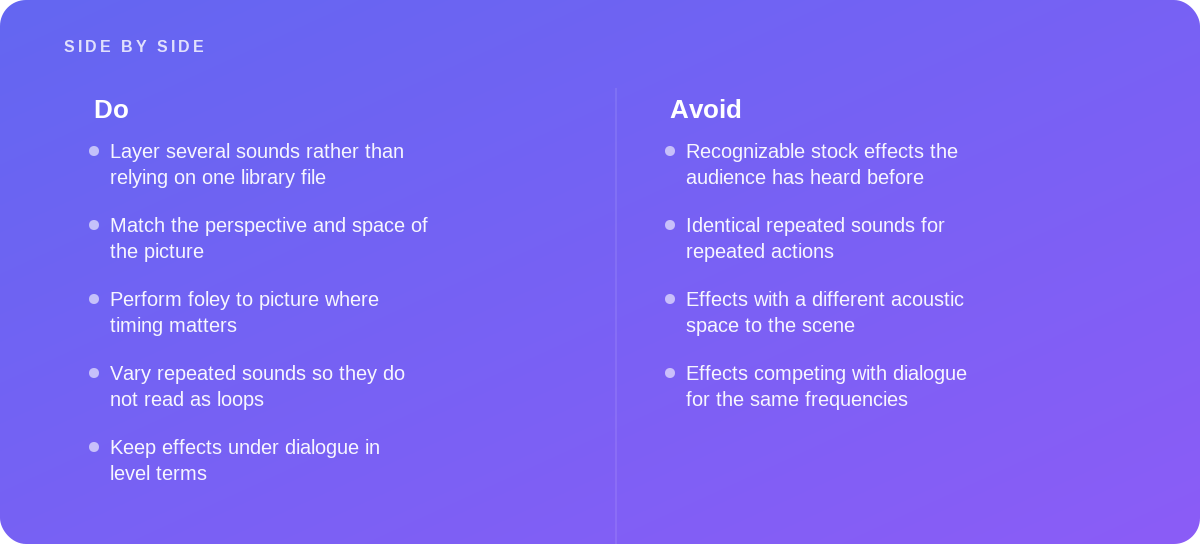
- Layer several sounds for any effect the audience will focus on, rather than relying on one library file.
- Rotate through different takes for repeated actions so nothing reads as a loop.
- Match each effect's perspective and space to the shot, using the location's own room tone and, ideally, its impulse response.
- Keep effects under dialogue in level and out of its way in the upper midrange.
- Record source and license for every library file, and replace anything with unclear terms before delivery.
- Deliver stems, so future cuts and versions do not mean rebuilding the track.
Most in-house teams can handle a few simple effects in a basic edit: a whoosh on a title, a click on a button in a screen recording, a little ambience to cover a cut. Specialist help earns its place in three situations. The first is when location sound is unusable, for example when wind, crew noise or machinery has buried everything but the dialogue, or even the dialogue. The second is when a piece needs a full effects track built from nothing, as in animation, product renders, silent drone footage or any film shot without sound. The third is when licensing for effects is unclear, or when a sound will become part of a brand and needs to be owned outright.
For those projects, our sound design and foley service covers spotting, foley recording, library sourcing with documented licenses, and delivery-ready mixes and stems. Professional bodies such as the Audio Engineering Society publish technical material on sound for picture for anyone who wants to go deeper into the engineering behind it.
The underlying lesson of the illustrative workshop film is that sound effects and foley are judged by their absence. Nobody leaves a brand film praising its footsteps. But when the steps land on the right frame, the plane sounds like oak and the room sounds like the room, the audience believes what they are seeing, and that belief is what the film was commissioned to create.
Where this comes from
- Audio Engineering Society — Sound for picture
- European Broadcasting Union — Production sound guidelines
- Adobe Help Center — Audition sound design
The figures and practices above come from the sources listed.
Working on something like this?
We take on Audio Editing & Production work for teams who want it done once, properly. Tell us what you are building and we will tell you honestly whether we are the right studio for it. Start a project.
Where to go next
Spotted something wrong? Report an error on this page. We correct on the page and say what changed.