A Practical Guide to Audio Post-Production for Advertising
Learn what to specify, what drives cost, how to compare quotes and which red flags predict rejected spots when you commission audio post for advertising.
 Tomas Lindqvist

Audio post-production for advertising is the work of finishing the sound of a commercial after the picture is locked: editing the voiceover, placing and fitting the music, designing and sweetening effects, mixing everything to a regulated loudness, and delivering a set of files that a broadcaster, platform or cinema chain will accept without question. It looks like a small job because the spots are short. In practice it is one of the most tightly specified tasks in audio, because the duration is fixed to the frame, the loudness is regulated in most broadcast markets, the approval chain runs through agency, client, legal and often a clearance body, and every usage right has to cover the exact media, territory and term the campaign will run in.
This handbook is written for the person commissioning that work: a brand or marketing manager, an agency producer, an in-house video lead, or a founder buying their first television or streaming campaign. It explains what to ask for in a brief, what actually drives the cost of a quote, how to compare suppliers on something more useful than day rate, which warning signs predict a rejected spot, and how to judge the finished mix when you are not an engineer yourself.
The underlying principle is simple. An advertising mix that misses its delivery specification does not run, however good it sounds. Everything below is organized around making sure the specification is known before the mix starts, that every version comes from one controlled source, and that the rights and the compliance checks are settled before the air date rather than on it.
What audio post-production for advertising actually covers
Suppliers use different names for the same tasks, so it helps to know the component parts before reading a quote. A complete audio post package for a commercial usually includes the following stages, and a good quote will list each one rather than rolling them into a single line.
Dialogue and voiceover editing
The voiceover is recorded (or supplied), then edited for timing, breaths, mouth noise and pacing. In advertising the edit is unusually precise: a line may need to land on a product shot to within a few frames, and a legal line or price mention may have to fit a gap of two or three seconds without sounding rushed. If on-camera dialogue was recorded on set, it is cleaned, matched between angles, and sometimes replaced with studio recording (ADR) where the location sound is unusable.
Music editing and fitting
Whether the music is a commissioned composition, a licensed commercial track or a library cue, it almost never fits the spot length as delivered. The music editor cuts it so that it starts, builds and resolves inside the exact duration, with the ending landing on the final frame or on the end card. For cutdowns the same piece is re-edited for each length, which is skilled work: a 6-second version of a 30-second cue needs its own musical logic, not just a fade.
Sound design and sweetening
Effects, ambience and designed sounds give the picture weight: the pour, the click of a closing lid, the whoosh of a transition, the room around the actor. Sweetening is the term for enhancing existing production sound with added layers so it reads clearly on small speakers. Our audio sweetening service page describes that layer of work in more detail.
The mix
The mix balances voice, music and effects against each other and against the loudness target. For advertising, the voice and any mandatory legal copy must be intelligible on a television speaker, a laptop and a phone held at arm's length, which constrains how dense the music and effects can be underneath.
Versioning, quality control and delivery
Once the master mix is approved, the supplier produces every version the media plan needs, runs compliance and technical checks, and delivers files in each outlet's format, usually with stems (separate voice, music and effects tracks) for later changes. This last stage is where most commissioning mistakes surface, and it is often underquoted.
- Duration Exact, to the frame, for every version on the media plan
- Loudness Regulated for broadcast advertising in most markets, measured with ITU-R BS.1770
- Clearance Music and voice rights must cover media, territory and term
- Versioning Multiple cutdowns and regional variants are the norm, not the exception
- Quality control Automated technical checks run before broadcast acceptance
- Stems Separate voice, music and effects files make late changes possible
The specifications to confirm before anyone mixes
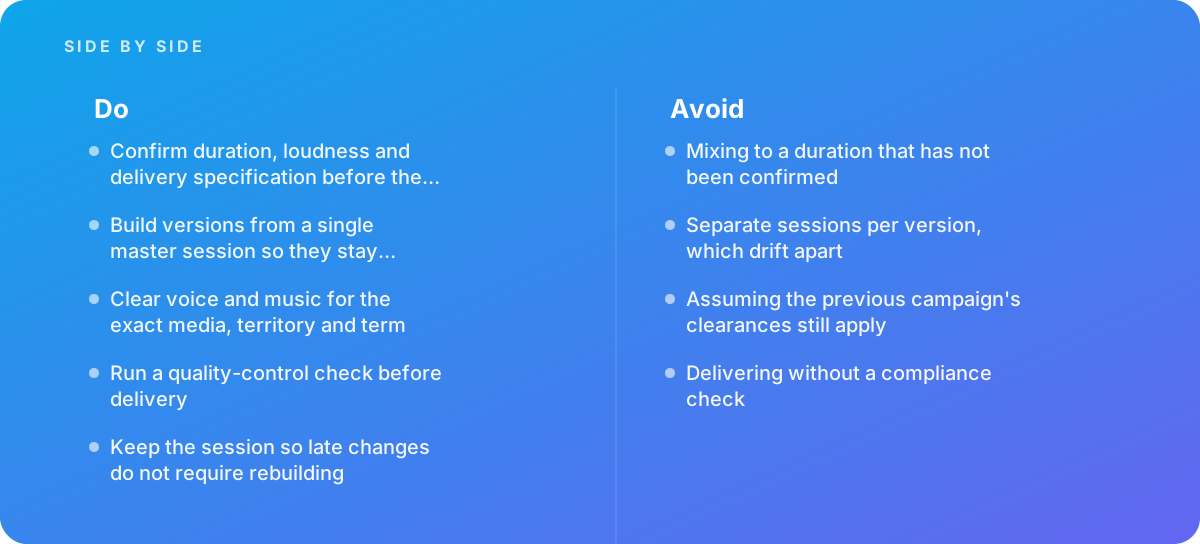
The single most expensive mistake in advertising audio is mixing to a specification that has not been confirmed. Every target below should be written into the brief, agreed by the media agency or the outlet, and repeated back by the supplier before the first mix session. If your supplier does not ask for these, that is information about the supplier.
Duration and frame rate
A 30-second spot is not "about 30 seconds." At 25 frames per second it is 750 frames; at 29.97 frames per second it is 899 or 900 frames depending on how the outlet counts, and some outlets specify drop-frame or non-drop-frame timecode. Many broadcasters also require a slate or clock, a set amount of black and silence before the program starts, and a defined silence at the end, so that automated playout systems can cut cleanly. Audio that runs even one frame beyond the program end can be clipped on air or rejected at ingest. If you want the background on timecode formats and why a mismatch causes drift, see our guide on getting timecode and audio sync right.
Loudness and true peak
Broadcast advertising loudness is regulated in most markets because viewers complained for decades that commercials were louder than the programs around them. The measurement method used almost everywhere is the loudness algorithm defined by the International Telecommunication Union in Recommendation ITU-R BS.1770, which reports integrated loudness in LUFS (or LKFS, the same unit under another name) and true peak in dBTP. The regional rules then set targets on top of that measurement. In Europe, the European Broadcasting Union's loudness work, EBU R 128, sets an integrated target of -23 LUFS with a maximum true peak of -1 dBTP, and a supplement for short-form content addresses how commercials and promos should behave within their short duration. In the United States, the ATSC A/85 recommended practice sets -24 LKFS and is referenced by the CALM Act. Other countries have their own variants, and individual broadcasters sometimes set tighter house tolerances than the national rule.
The practical point for a buyer is this: loudness regulation does not make commercials quiet, but it removes the old trick of crushing everything to sound loud. A spot mixed with deliberate dynamics, a clear voice and a strong but controlled music bed tends to sound more present at -23 LUFS than one squashed flat and then turned down to meet the number. Ask the supplier which target they are mixing to for each outlet and what tolerance the outlet allows.
Channel format and file specification
Confirm whether each outlet wants stereo, 5.1, or both; the sample rate (48 kHz is standard for video) and bit depth (typically 24-bit); the file wrapper (a broadcast WAV, audio embedded in a video file, or a specific format such as the UK's AS-11 profiles); the track layout inside a multi-track file; and whether a stereo downmix must be included alongside surround. Cinema delivery and immersive formats bring their own requirements, which our piece on surround and immersive audio decisions covers.
Online and social outlets
Streaming services, connected TV and social platforms usually publish their own delivery specifications, and many apply loudness normalization at playback. They are generally less strict about ingest than broadcasters, but they are not the same as broadcast, and a mix built for television can sound thin or too quiet when a platform normalizes it to a different target. Short vertical edits often need a separate mix decision altogether; our guides to audio for short-form video and audio for social media go into those platform differences.
Red flag: a supplier who starts mixing before duration, loudness target and delivery format are confirmed in writing.
- "We'll just make it sound good and conform later" usually means a second mix, charged or not.
- "All broadcasters are basically the same" ignores house tolerances, slate rules and track layouts that differ by outlet.
- "We normalize at the end" suggests the mix was not built around the target, which often shows up as a squashed or strangely quiet result.
Writing a brief that gets you an accurate quote
Most disagreements over cost come from briefs that describe the creative but not the deliverables. A supplier can only price what they can count. Give them the count.
A usable brief for audio post-production for advertising includes, at minimum:
- The media plan: every outlet (national TV, regional TV, cinema, video on demand, online video, social, radio, in-store), with the lengths needed for each.
- The version list: each cutdown, each language or regional variant, each end-card or offer change, and whether any versions carry different legal copy.
- Delivery specifications: the documents from each broadcaster or platform, or at least the name of the delivery house or media agency who holds them.
- Voice: whether voiceover is already recorded, needs casting, or will be recorded remotely; how many voices; and whether any languages are needed.
- Music: commissioned, licensed commercial track, or library; who is responsible for clearance; and whether an existing sonic logo must be included.
- Picture status: whether the edit is locked. Mixing to a moving edit is the second most common source of overruns.
- Approval chain: who signs off at each stage, and whether a clearance body must see the finished spot before it can air.
- Air date: the first transmission date and the outlet's delivery deadline, which is usually several working days earlier.
If the campaign uses an established sonic logo or brand voice, include the reference files and any usage notes. Consistency across spots is part of the brand asset; our article on audio branding and sonic identity explains why small inconsistencies add up across a campaign.
What drives the cost of a commercial mix
Prices for advertising audio post vary widely between markets, studio tiers and project shapes, so a single figure would mislead more than help. What a buyer can do is understand the cost drivers well enough to read a quote, spot what is missing, and control the parts that are within their power.
| Cost driver | Why it adds time | What the buyer can control |
|---|---|---|
| Number of versions | Each cutdown needs its own music edit, voice fit and mix pass; each language adds a record and a conform | Finalize the media plan before booking; group versions that share a mix |
| Voice recording | Casting, studio time, direction and edits; remote sessions add connection and sync work | Lock the script before the session; have the approver present or on the line |
| Music approach | Commissioned music takes composition time; licensed tracks need clearance and stem access | Decide early; request stems from the rights holder or library |
| Sound design depth | A dialogue-led spot needs little design; a product-hero spot may need many custom layers | Be clear about the creative ambition in the brief |
| Picture changes after the mix starts | Every picture change forces a conform and a remix of the affected section | Lock picture before booking the mix |
| Approval rounds | Each round means a new mix, a new export and often a new version set | Consolidate feedback from all approvers before sending notes |
| Delivery complexity | Different formats, track layouts and QC reports per outlet | Supply all delivery specs up front |
| Turnaround | Overnight or weekend work displaces other bookings | Build air-date deadlines backward into the schedule |
Two points are worth holding onto. First, the master mix is usually not the largest line on a big campaign; versioning and delivery are, because they multiply. Second, the largest avoidable cost is rework, and most rework comes from unconfirmed specifications, unlocked picture and fragmented feedback. A supplier can quote a lower headline number by excluding versions, QC or revisions, so compare what is included, not only the total.
A worked example: counting the deliverables on a typical campaign
The following is an illustrative project, not a real client, built to show how quickly deliverables multiply and where the hours go. Suppose a consumer brand is launching a product with a national television campaign, an online video campaign and a social flight.
- Television: one 30-second master, plus a 20-second and a 10-second cutdown.
- Online video: 30-second and 15-second versions for pre-roll, mixed for streaming playback.
- Social: a 6-second bumper and a 15-second vertical edit.
- Regional variants: the television versions need three regional end-cards, each with a different retailer mention and legal line.
Counting the deliverables: television has 3 lengths times 3 regions, which is 9 spots. Online adds 2, social adds 2. That is 13 finished versions. If each television spot must be delivered as both a stereo and a 5.1 mix with stems, and each online and social spot as a stereo mix with stems, the file count is far higher than 13: 9 television versions times two mix formats is 18 mixes, plus 4 online and social mixes, for 22 mixes, each with its own stem set and a QC report for the broadcast files.
Now the time. As an illustration, suppose the supplier estimates the master 30-second mix at a full day including voice edit, music fit and design, and each additional length at a few hours for the music re-edit and mix pass. The regional variants are much faster if they are built as alternate end sections inside the same session: perhaps under an hour each, because only the final seconds change. Online and social versions reuse the master's elements but need their own loudness targets and a listen on small speakers. QC and delivery add time per file.
The lesson from the arithmetic is that the 30-second master is perhaps a third of the work, and the rest is versioning and delivery. A quote that prices "one 30-second mix" and says nothing about the other 21 mixes is not comparable to one that prices them all. It also shows why building every version from a single master session matters: if the three regional end-cards are separate sessions, a late change to the master's voice line has to be made three times, and the versions start to drift apart in level and balance.
| Outlet | Lengths | Variants | Mixes | Notes |
|---|---|---|---|---|
| National TV | 30s, 20s, 10s | 3 regional end-cards | 18 (stereo and 5.1) | Broadcast loudness target, clock and slate, QC report per file |
| Online video | 30s, 15s | 1 | 2 (stereo) | Platform specification; check against playback normalization |
| Social | 6s, 15s vertical | 1 | 2 (stereo) | Often watched muted first; captions and voice clarity matter |
| Total | 22 mixes | Plus stems for each |
Questions to ask a supplier before you commission
The best way to compare suppliers is to ask the same questions of each and listen to how specific the answers are. Experienced advertising audio teams answer these quickly, because they deal with them on every job. Vague answers are a signal.
- Which loudness target and true-peak ceiling will you mix to for each of our outlets, and what tolerance do those outlets allow?
- How will you confirm the exact duration, frame rate and head and tail requirements for each version before mixing?
- Will every version be built from a single master session, and how do you keep cutdowns and regional variants consistent?
- What quality-control checks do you run before delivery, and will you supply a loudness report for each broadcast file?
- Who is responsible for music and voice clearance, and how do you confirm the rights cover our media, territory and term?
- How many revision rounds are included, and what counts as a revision versus a new version?
- Which files will we receive: full mixes, stems, a stereo downmix, and the project session itself?
- How long do you archive the session, and how quickly can you turn around a late change such as a new price or legal line?
- Have you delivered to these specific broadcasters or platforms before, and has a spot of yours ever been rejected? What happened?
- What monitoring do you use to check the mix on small speakers and phones as well as on studio monitors?
The last two questions deserve attention. A supplier who admits a past rejection and explains precisely what caused it and what they changed is often more reliable than one who claims never to have had one. And monitoring matters because advertising audio is heard mostly on poor speakers; a mix that only works on large studio monitors is a mix that will lose its voice on a phone. Our guide to audio metering and monitoring describes what a sound check across playback systems should include.
Comparing quotes on more than the total
Two quotes for the same campaign can differ by a large margin and both be honest, because they include different things. Before comparing totals, normalize the scope: ask each supplier to price the same version list, the same deliverables and the same number of revision rounds. Then score them on the factors that predict whether the spots will run on time.
| Criterion | What a strong quote shows | What a weak quote shows | Weight |
|---|---|---|---|
| Specification | Names the loudness target, true peak, frame rate and format per outlet | "Broadcast spec" with no detail | High |
| Versioning | Every cutdown and variant priced as a line, built from one master session | "Additional versions at cost" or not mentioned | High |
| Quality control | Automated and listening QC, with a loudness report per broadcast file | No mention of QC or reports | High |
| Clearance | States who clears music and voice, and for which media, territory and term | Assumes rights are "sorted" or silent on the subject | High |
| Revisions | Defines the number of rounds and what counts as a revision | "Unlimited changes" or no definition | Medium |
| Deliverables | Lists mixes, stems, downmixes and session archive | Mix files only | Medium |
| Schedule | Works back from the outlet's delivery deadline, not the air date | A single delivery date with no milestones | Medium |
| Late-change policy | States turnaround and cost for small changes after delivery | Not addressed | Low to medium |
A useful exercise is to score each quote 1 to 3 on each high-weight criterion and 1 to 2 on the others, then look at the price only among the quotes that score well on specification, versioning, QC and clearance. A cheap quote that scores poorly on those four is not cheap; it is deferring cost to the week before air.
Reading "unlimited revisions"
Unlimited revisions sounds generous, but it usually signals a supplier who has not thought about how revisions interact with versioning. A single note on the master can force changes to every version downstream. Defined rounds, with a clear statement that consolidated notes count as one round, protect both sides and keep the schedule honest.
Clearance: the part that stops spots after they are finished
A spot can pass every technical check and still be pulled because a right does not cover where or how long it is running. Music and voice usage rights for advertising are licensed against three dimensions: media (television, cinema, online, social, radio, in-store), territory (countries or regions), and term (a start date and duration). A right that covers national television for twelve months does not automatically cover social, a second country, or a thirteenth month.
Music
Commercial tracks usually need two licenses: one for the composition (from the publisher) and one for the specific recording (from the label or master owner). Library music is licensed through the library under its own terms, which vary by tier and use. Commissioned music is cleared through the contract with the composer, and the key question is whether the brand owns it outright or licenses it for a defined use. Whichever route, the audio supplier needs to know the terms, because they affect whether the music can be edited, whether stems are available, and whether the same track can be used in the social cutdowns.
Voice
Voice artists are usually engaged on terms that specify the media, territory and term of use, and sometimes the number of versions. Adding a new outlet or extending a campaign often requires a new fee. If the voice was generated or altered with AI tools, rights and consent questions become more complex; our article on copyright for AI-assisted audio covers the issues a buyer should raise.
The mistake to avoid
The most common clearance mistake is assuming the previous campaign's clearances still apply. A brand reuses a music bed or a voice from last year, the new media plan adds online video or a new market, and the rights no longer cover the use. The fix is simple but has to be deliberate: every campaign gets its own clearance check against its own media plan.
Quality control and compliance before delivery
Broadcasters and delivery houses run automated checks on incoming files, and a file that fails is rejected, often with only a short error code. The supplier's job is to run the same checks before delivery so nothing is discovered at ingest. The Audio Engineering Society publishes technical standards and papers on broadcast delivery and measurement practice that underpin many of these checks.
A thorough pre-delivery QC for an advertising spot typically covers:
- Loudness: integrated loudness within tolerance of the target, measured over the program only, not the slate or silence.
- True peak: no peaks above the ceiling, measured with an oversampling true-peak meter rather than a sample-peak meter.
- Duration and sync: program start and end on the correct frames, audio aligned to picture, and no sound in the specified silence at head and tail.
- Channel layout: each channel in the correct position, no phase-inverted channels, and a stereo downmix that does not lose the voice.
- Technical defects: clicks, dropouts, digital distortion, clipped peaks and unexpected silence.
- File metadata: sample rate, bit depth, wrapper, and any required identifiers or clock information.
- Content check: the correct version, with the correct legal line, end-card audio and regional mention.
The content check is easy to overlook and is the one automation catches least. With nine regional television versions, sending region A's end-card on region B's file is a real risk, and it is purely a human check. Our breakdown of audio quality control checks explains how to divide QC between tools and listening.
Red flag: delivery without a compliance check or loudness report.
- No written loudness report per broadcast file means you are relying on the broadcaster to find problems.
- Files named "final_v3_new" with no version matrix suggest the content check has not been done.
- Separate sessions for each version, rather than one master session, make drift between versions likely.
- No archived session means a late price or legal change becomes a rebuild instead of a quick edit.
Scheduling from air date backward
Advertising audio schedules fail from the end. The air date is fixed; the outlet's delivery deadline sits before it; clearance body approval, if required, sits before that; and the client approval rounds sit before that. Work backward and the mix window is often shorter than it looks.
A sensible sequence looks like this:
- Brief and specifications confirmed: media plan, version list, delivery specs, clearance status.
- Picture lock: the audio mix is booked after this, not before.
- Voice record and edit: with the approver present or listening remotely.
- Master mix: the 30-second or longest version, mixed to the tightest target in the plan.
- Consolidated approval: one set of notes from all stakeholders per round.
- Versioning: cutdowns and variants built in the master session.
- Clearance body review: where the market requires it, allowing time for a possible change request.
- QC and delivery: with loudness reports and a version matrix, several working days before air.
- Archive: session, stems and reports stored for late changes and future campaigns.
If the timeline does not have room for a second approval round and a possible clearance change, it does not have room. The practical fix is to lock picture earlier or deliver the longest-lead outlets first, not to compress QC.
How to judge the finished mix without being an engineer
You do not need to read a loudness meter to judge whether a commercial mix works. You need to listen in the conditions the audience will, and ask a few specific questions.
Listen on the wrong speakers
Play the spot on a laptop, on a phone at arm's length, and on a television at a normal living-room level. Is every word of the voiceover clear on all three? Can you hear the legal line and the price? Does the music still carry the emotion, or does it disappear? Advertising is heard mostly on small speakers, so these tests matter more than the studio playback.
Listen in context
Play the spot between two pieces of program material at the same loudness. Does it feel appropriately present, or does it sound small or harsh by comparison? A well-built spot at the regulated loudness should hold its own without sounding strained.
Compare the versions
Play the 30-second, 20-second and 10-second versions back to back, then the regional variants. Do they sound like the same campaign? Is the voice level and tone consistent? Does the music end cleanly in each length? Inconsistency here usually means the versions were not built from a single master session.
Check the paperwork
Ask for the loudness report per broadcast file and a version matrix listing each file, its length, its variant, its outlet and its measured loudness and true peak. If the supplier can produce these immediately, the delivery is under control. If they have to compile them after you ask, it probably was not.
If a problem does appear, such as a distorted voice line from an overdriven recording, raise it with the supplier immediately rather than at the final approval round. Clipped or distorted recordings can often be partly repaired in post, but re-recording a single line is usually faster and cleaner when the voice artist is still available.
When to bring in specialist help
Many brands and in-house teams can handle simple audio for online video themselves. Advertising for broadcast is different, and there are three situations where specialist help is worth the cost almost regardless of budget.
- A spot has been rejected by a broadcaster. The rejection code tells you what failed but not necessarily why. A specialist can diagnose whether it is a loudness, peak, timing, layout or metadata problem, fix it at the source, and redeliver with a report, usually faster than trial and error.
- Many versions are needed at short notice. A late media plan change that adds regions, lengths or outlets is exactly the scenario where a single-master-session workflow and a disciplined QC routine save days.
- Clearance terms are unclear close to air date. If nobody can confirm that the music and voice rights cover the new media, territory or term, the spot should not air until they do. A supplier experienced in advertising can help identify what needs clearing and, where necessary, prepare an alternative music edit.
If you are commissioning a campaign and want a team that handles the mix, versions, QC and delivery as one package, our audio post for video service is set up for exactly that workflow.
Verdict Buy advertising audio post on specification, versioning, quality control and clearance first, and on price only among the suppliers who get those four right. Confirm duration, loudness and delivery formats before the mix; insist every version comes from one master session; require a loudness report and version matrix per delivery; clear music and voice for the exact media, territory and term of this campaign; and keep the session archived so late changes are edits, not rebuilds. A spot that sounds great but misses the spec does not run, and a spot that meets the spec but loses its voice on a phone does not sell.
Where this comes from
- European Broadcasting Union — Loudness in advertising
- International Telecommunication Union — ITU-R BS.1770
- Audio Engineering Society — Broadcast delivery practice
The figures and practices above come from the sources listed.
Working on something like this?
We take on Audio Editing & Production work for teams who want it done once, properly. Tell us what you are building and we will tell you honestly whether we are the right studio for it. Start a project.
Where to go next
Spotted something wrong? Report an error on this page. We correct on the page and say what changed.