Audio Branding and Sonic Identity: What Actually Works
Learn what makes audio branding work: designing an audio logo, music palette, voice and interface sounds, owning the rights, and testing recognition properly.
 MediaScaleUp Editorial Team
Audio branding and sonic identity is the deliberate, repeated use of sound so that people recognize a brand before they see anything. In practice that means a short audio logo, a music palette that sets the emotional tone of everything the brand publishes, a consistent voice, and the small interface sounds a product makes when someone taps, pays, or finishes a task. None of these is new on its own. What makes them an identity is that they are designed together, owned outright, and applied with the same discipline a company already applies to its logo, typeface, and colors.
It matters because audio is the one brand asset that still works when nobody is looking at the screen. People listen to podcasts while driving, scroll short-form video with the phone face-up on a desk, hear ads through smart speakers, and leave apps running in the background. In those moments a visual logo does nothing at all, and a sound either identifies the brand or does not. For marketers, product owners, and in-house creative teams, the question is less whether to have a sonic identity and more whether the sounds already in circulation are helping or quietly undermining recognition.
This field guide moves from fundamentals to advanced practice: what the assets are, how each one should be designed, how rights should be handled, what files you actually need to deliver, how to write usage rules, how to test recognition, and where most sonic identity projects go wrong. It is written for people commissioning the work as much as for the audio producers doing it.
- Core assets An audio logo, a music palette, a brand voice, and interface sounds
- Audio logo length Very short by convention, typically a few seconds at most
- How recognition forms Through consistency and repetition, not musical complexity
- Rights position Core identity audio should be commissioned and owned, not licensed on a term
- Governance Written usage rules, exactly as for any visual brand asset
- Hardest test Whether the logo still reads through a phone speaker
What audio branding and sonic identity actually cover
The terms get used loosely, so it helps to separate them. Audio branding is the discipline: the strategy and ongoing practice of using sound to support a brand. Sonic identity is the system that discipline produces: the specific set of sounds, rules, and files that belong to one brand. A jingle in a single campaign is not a sonic identity. A sonic identity is what is left after the campaign ends, the sounds the brand keeps using across advertising, product, events, video, and customer service for years.
A useful way to think about scope is by where people hear the brand. Most organizations have more audio touchpoints than they realize once someone lists them:
- Paid media: broadcast and streaming radio, podcast ads, pre-roll video, connected TV, social video with sound on.
- Owned content: YouTube channels, webinars, explainer videos, podcasts, live streams, internal communications.
- Product: app and device sounds for notifications, confirmation, errors, startup, and onboarding.
- Physical spaces: retail music, trade show booths, reception areas, events, hold music on the phone line.
- Voice channels: interactive voice response menus, voice assistants, automated announcements.
An audit of these touchpoints is almost always the first real piece of work. It usually reveals the same pattern: a dozen different stock tracks, three voice actors with nothing in common, notification sounds left at their platform defaults, and hold music chosen by whoever set up the phone system. Nothing is wrong with any single choice. The problem is that together they say nothing, and repetition, which is the entire mechanism of recognition, never gets a chance to work.
Why repetition beats complexity
Recognition of a sound comes from hearing the same thing in the same context many times. That has a direct design consequence: a short, distinctive motif that can be repeated constantly will outperform a rich, complex piece of music that can only appear occasionally. Complexity also fragments under real conditions. A four-bar melody with a counter-line and a key change survives in a studio and collapses on a laptop speaker in a noisy office. Four or five notes with a clear contour survive almost anywhere.
Tip: Before commissioning anything, list every place the brand currently makes a sound and record who controls each one. The list tells you how large the rollout will be and which teams must sign off on the usage rules.
The four core assets and how they relate
Every sonic identity is built from some combination of four assets. Not every brand needs all four at once, but they should be designed as a family so that each one reinforces the others.
The audio logo
The audio logo, sometimes called a sonic logo or mnemonic, is the short signature that marks the brand, usually at the end of an ad or video, or at a moment of completion in a product. It is the equivalent of the visual logo and it carries the most weight. By convention it is very short, typically a few seconds at most, because it has to sit at the tail of a 6-second pre-roll as comfortably as at the end of a 60-second radio spot.
The music palette
The music palette is a set of tracks, or a set of musical rules, that supplies background and foreground music for everything longer than a logo: ads, explainer videos, events, podcasts, hold music. A good palette is built from the same melodic or harmonic DNA as the logo, so the logo feels like the natural ending of the music rather than a sticker placed on top of it.
The brand voice
Voice means the literal human (or synthetic) voice that speaks for the brand: the narrator on ads, the voice in the phone menu, the presenter in onboarding videos. It covers casting, delivery, pace, and pronunciation of the brand name and product terms. Voice is often the most neglected asset, and inconsistent voice casting is one of the fastest ways to make a brand sound like several different companies.
Interface sounds
Interface sounds, or UX sounds, are the short cues a product makes: notification, success, error, send, receive, startup. They are heard far more often than any ad, sometimes dozens of times a day by the same person, which makes them powerful for recognition and dangerous if they are irritating. Their design follows different rules from marketing audio, covered in its own section below.
| Asset | Typical length | Where it is heard | Main design constraint |
|---|---|---|---|
| Audio logo | A few seconds at most | End of ads and videos, product moments | Must read on a phone speaker and in noise |
| Music palette | Several seconds to several minutes | Ads, video, events, hold lines, podcasts | Must sit under voice without competing |
| Brand voice | Any length | Narration, IVR, onboarding, assistants | Consistency of casting and delivery over years |
| Interface sounds | Usually well under a second | Apps, devices, kiosks, websites | Heard repeatedly, so must never irritate |
Designing an audio logo that survives a phone speaker
The audio logo gets the most attention and deserves it. It is also where most budgets are wasted, usually on ideas that sound impressive in a review meeting on good monitors and vanish on the devices people actually use.
Start from the worst playback device
Small phone and laptop speakers reproduce very little low-frequency energy, so anything the logo relies on below a few hundred hertz, a sub-bass hit, a warm cello line, a kick drum, is effectively inaudible there. The identifying information has to live in the midrange, roughly where the human voice sits, because that is the band every speaker reproduces. Designers who test on a phone from the first sketch avoid the most common failure, which is a logo whose character comes entirely from production polish.
Give it a melodic contour people can hum
The most durable audio logos are built on a short melodic shape, often three to six notes, with a distinctive rhythm. A useful internal test is whether someone in the meeting can hum it back after hearing it twice. If they cannot, it is probably too complex to be recognized after a handful of exposures in the real world. Rhythm matters as much as pitch: a distinctive rhythmic figure is recognizable even when the pitches are played on a different instrument or tapped on a table.
Separate the idea from the arrangement
Treat the logo as a musical idea that can be dressed in different arrangements: a full orchestral version for a brand film, a clean synth version for product, a solo piano or acoustic version for sensitive contexts, a sung version if the brand name can be sung. The idea stays fixed; the orchestration flexes. This is what lets a sonic identity work across a celebratory campaign and a service outage notice without sounding wrong in either.
Design for the mix it will sit in
Audio logos almost always play at the end of something: after a voiceover tag line, over the last frames of a video, or after a product action. Leave space in the logo for a spoken line to land on or near it, and make sure its level and brightness match typical delivery standards. Broadcast and streaming platforms normalize loudness (for example, the EBU R 128 recommendation of -23 LUFS integrated in much of Europe, and ATSC A/85 at -24 LKFS in the United States), so a logo mastered to be as loud as possible gains nothing and often sounds squashed after normalization. Our guide to audio post-production for advertising covers delivery specs in more depth.
- Audio logo (sonic logo, mnemonic)
- A short, distinctive sound signature, usually a few seconds or less, that identifies the brand.
- Music palette
- A family of tracks or musical rules derived from the same identity, used for anything longer than the logo.
- Motif
- The core melodic and rhythmic idea that the logo and palette share.
- Stems
- Separate audio files for each group of instruments or elements, so editors can rebalance or remove parts in a mix.
- Cutdown
- A shorter edit of a track, such as 30, 15, or 6 seconds, built to end cleanly at that length.
- LUFS
- Loudness Units relative to Full Scale, the measure used by broadcast and streaming loudness standards.
- Buyout
- An agreement that transfers ownership or perpetual, unrestricted rights to commissioned audio, as opposed to a term license.
Building a music palette that carries the identity
Once the logo exists, the music palette extends it into every longer format. The palette is where many identities succeed or fail in daily use, because it is what editors and agencies reach for week after week.
Derive the palette from the motif
The strongest palettes quote or imply the logo's motif: the same intervals appear in a melody, the same rhythm drives a percussion pattern, the same harmonic color runs through the chords. This does not mean every track should play the logo melody on repeat, which becomes tiresome quickly. It means a listener who knows the logo feels a family resemblance, and the logo at the end of an ad sounds like the music resolving rather than a separate event.
Cover the emotional range the brand really needs
List the moods the brand genuinely communicates in a year and design palette tracks for them. A consumer brand might need energetic, warm, and reflective. A financial services brand might need confident, reassuring, and serious enough for a difficult announcement. Four to eight core tracks is a common starting range for a mid-size organization; the number is driven by how many distinct content types the brand produces, not by any rule.
Make every track editable
Music written for a brand gets cut, looped, ducked under voice, and trimmed to odd lengths by people who are not composers. Each palette track should come with cutdowns that end cleanly at standard lengths, a loopable bed without the lead melody for sitting under dialogue, and stems so an editor can drop the drums or the top line. A palette that only exists as one full-length stereo mix will be butchered in the edit or replaced with stock music, both of which defeat the purpose.
Plan for speech on top
Most brand music plays under a voice. Leave the frequency range of speech relatively clear in the beds, keep the arrangement's busiest moments away from where narration usually sits, and test every bed with a real voiceover over it. Our article on background audio and speech clarity goes through the mixing decisions that keep narration intelligible over music.
Choosing and governing a brand voice
The brand voice is heard in more places than most teams expect: ad narration, explainer videos, phone menus, hold messages, voice assistants, onboarding tutorials, and event announcements. When each of those is cast separately, the brand speaks with many voices and none of them builds recognition.
Cast against a written description
Before auditioning anyone, write a short voice description: age range, gender presentation (or a deliberate choice to vary it), accent or regional neutrality, pace, warmth, authority, and how the voice should sound when delivering bad news. Casting against a written brief produces a defensible decision and makes recasting easier if the original talent becomes unavailable.
Decide primary and secondary voices
Many brands settle on one primary voice for the audio logo tag line and major campaigns, plus one or two secondary voices for high-volume work such as tutorials and phone systems. The rules should state which voice is used where, so that the primary voice keeps its weight.
Handle availability and synthetic voices deliberately
Human voice talent gets sick, retires, or signs exclusivity with a competitor. Contracts should cover term, territories, media, and what happens when the talent is no longer available. Synthetic and cloned voices are now a practical option for high-volume or real-time use, but they raise consent, contractual, and ownership questions that must be settled in writing before production. The article on copyright for AI-assisted audio covers what to check before relying on generated or cloned voice.
Write a pronunciation guide
List the brand name, product names, executive names, and any technical terms with a phonetic spelling and a reference recording. It sounds trivial, and it prevents the single most common voice inconsistency: the brand's own name pronounced two ways in the same quarter.
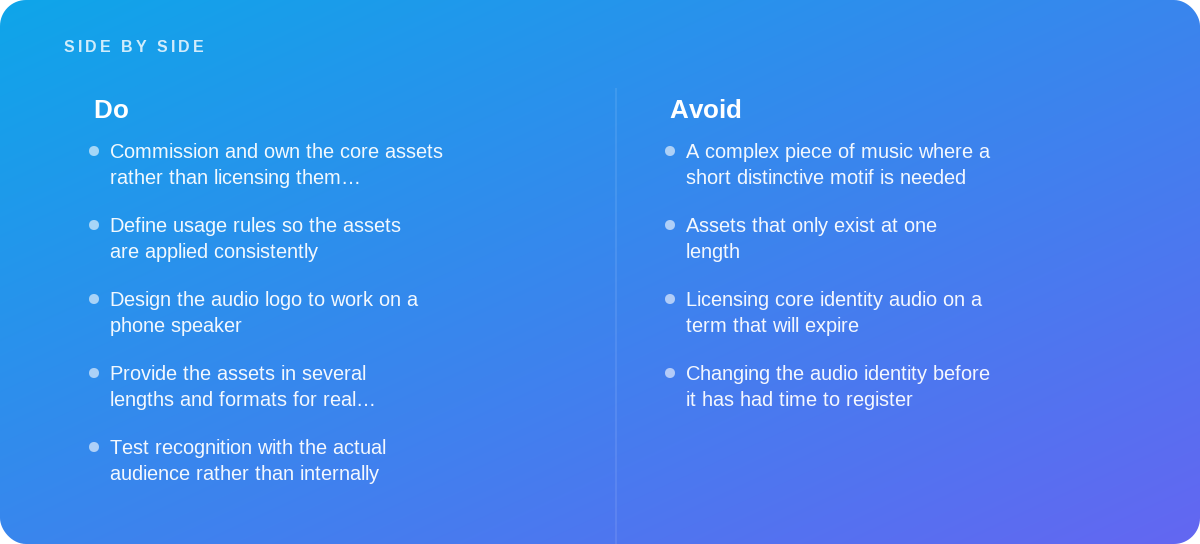
Warning: Do not license core identity audio on a term that will expire. If the audio logo or primary palette is licensed for a few years, the brand has to renegotiate, pay again, or abandon the sound just as it has started to be recognized.
- Commission core assets and take ownership, or perpetual and unrestricted rights, in writing.
- Confirm the composer owns everything they deliver, including samples and sound libraries used inside it.
- Keep signed agreements with the delivered files, not in someone's inbox.
Interface and product sounds
Interface sounds follow different rules from marketing audio because the listener hears them constantly and often has not chosen to. A notification that is charming the first time can become maddening by the fiftieth. The platform design systems are a good place to start: Apple's Human Interface Guidelines and Google's Material Design guidance both treat sound as part of the interaction design rather than decoration, and both favor restraint.
Principles that hold across platforms
- Earn every sound. Add sound only where it communicates something the screen does not, such as confirmation when the user is not looking, or an alert that needs attention.
- Keep it short. Most interface sounds are well under a second. Anything longer delays the user or overlaps the next action.
- Match weight to importance. A payment confirmation can carry a fragment of the brand motif; a keyboard click should not.
- Respect the device settings. Silent mode, system volume, and accessibility settings must win over brand preferences.
- Pair sound with haptics and visuals. Sound should never be the only signal, because many users run with sound off.
Where the brand motif belongs in a product
The most effective use of the audio logo inside a product is at moments of completion and success: a payment going through, an order confirmed, a device powering on. Those moments are positive and infrequent enough that a branded sound feels rewarding rather than repetitive. Errors and warnings should not carry the brand motif, because the brand should not be associated with failure, and frequent micro-interactions should use neutral, subtle sounds that belong to the same sonic family without quoting the logo directly.
Technical delivery for product sounds
Product teams need files that match the platform: correct sample rate and format, trimmed silence at the start so the sound fires instantly, consistent peak and loudness across the whole set so no single cue jumps out, and mono versions where the device plays mono. Games and interactive products add implementation questions, such as variation, randomization, and priority when several sounds fire at once; our piece on getting game audio implementation right covers those in detail.
Ownership, rights, and clearance
Rights are the least glamorous part of audio branding and the one that causes the most expensive problems later. A visual logo is almost always owned outright by the company. Audio identity assets often are not, because they were bought as a library track, commissioned under a limited license, or produced by an agency whose contract kept the underlying composition.
Own the core, license the periphery
A workable rule is to commission and own anything the brand intends to use for years: the audio logo, the core palette tracks, and the interface sound set. Peripheral music, such as a track for a one-off event or a seasonal campaign, can reasonably be licensed from a library, because nobody expects it to become part of the identity. The trouble starts when a licensed library track becomes the de facto brand theme because it was used in the first successful campaign and nobody replaced it.
What the agreement should cover
- Ownership of both the composition and the sound recordings, or perpetual, worldwide, all-media rights if full ownership is not possible.
- The right to edit, rearrange, re-record, and create new versions without further approval or payment.
- Warranties that the work is original and that any samples or library elements are cleared for this use.
- Delivery of source sessions and stems, not just final mixes, so future producers can extend the identity.
- Any performing rights registration, and who collects public performance income, if the music will be broadcast.
- Voice talent terms: media, term, territories, exclusivity, and any restrictions on synthetic reproduction.
Keep a clearance record
Rights knowledge decays quickly as people leave. Record the rights position for every asset alongside the files: who created it, what agreement covers it, what it may and may not be used for, and when anything expires. Our article on audio rights and clearance records sets out a record format that works for brand audio.
Deliverables: lengths, versions, and formats for real placements
An identity that exists at only one length is an identity that will be used badly. Editors will fade it abruptly, loop it awkwardly, or replace it. The deliverables list should be built from the real placements the brand uses, not from a composer's default package.
Building the asset matrix
List each placement with its duration, playback device, and technical spec, then derive the files. For short-form social, the logo may need to land inside the last second of a 6-second video with captions and no voiceover; for radio, it follows a spoken tag line; for a podcast, it may open an episode under a host's introduction. Our practical guide to audio for short-form video covers the specific constraints of those formats.
| Deliverable | Versions to supply | Typical technical spec |
|---|---|---|
| Audio logo | Full, short, with and without tag line space, alternate arrangements | 48 kHz / 24-bit WAV masters; compressed copies for web and product |
| Palette tracks | Full length plus clean-ending 60, 30, 15, and 6-second cutdowns | 48 kHz / 24-bit WAV for video; 44.1 kHz where the destination is music-first |
| Beds | Loopable versions without the lead melody for use under voice | Seamless loop points documented in the file name or notes |
| Stems | Drums, bass, harmony, melody, effects as separate files | Same length and start point as the full mix |
| Interface sounds | Each cue in stereo and mono, with silence trimmed | Platform-specific formats agreed with the product team |
| Voice | Reference reads, pronunciation guide, tag line recordings | Dry recordings plus processed versions |
Loudness and naming
Deliver versions normalized for the main destinations rather than one file mastered for everything. Broadcast work follows the regional loudness recommendation; streaming music services commonly normalize playback to around -14 LUFS; online video and social platforms vary, so a sensible practice is to supply a broadcast-compliant master and a web master, each with true peak held below -1 dBTP to survive lossy encoding. Name files so an editor can tell what they are without opening them, for example brand, asset, version, length, loudness target, and date. Every file should pass the kind of review described in our article on audio quality control checks before it goes into the library.
Writing sonic guidelines people will follow
Usage rules are what turn a set of sound files into an identity. Without them, each agency and editor makes a reasonable local decision, and the result is inconsistency. The guidelines should be as specific and practical as the visual brand guidelines, and ideally live in the same place.
What to include
- Purpose and character: one paragraph on what the brand should sound like and why, in plain language editors can apply.
- Audio logo rules: where it must appear, where it must not, minimum gap after a voiceover line, whether it may be shortened or rearranged, and what happens in sound-off placements.
- Palette rules: which track suits which content type, when library music is allowed, and how to request a new track.
- Voice rules: primary and secondary voices, where each is used, the pronunciation guide, and the process for booking talent.
- Interface rules: which events have sounds, which carry the motif, and the loudness relationship between cues.
- Technical specs: formats, loudness targets, naming, and where the master files live.
- Don'ts: examples of misuse, such as speeding up the logo, layering it with a competing sound effect, or pitching it to fit a track in a different key.
Make the rules easy to obey
Guidelines fail when the right file is harder to find than a stock track. Put the approved files in a single shared library with clear names, give agencies access on day one, and include a short set of example edits showing the logo and palette used correctly in a 30-second spot, a 6-second social video, and a product flow. Assign an owner for the identity, usually in brand or marketing, who approves exceptions and new assets. Keep the master sessions archived properly as well, with the plugins and versions noted, so sessions stay usable years later.
- Audio logo tested on a phone speaker, a laptop, earbuds, and a car system
- Logo recognizable in at least two different arrangements
- Palette tracks delivered with cutdowns, beds, and stems
- Ownership or perpetual rights confirmed in signed agreements for every core asset
- Pronunciation guide and voice casting brief written and approved
- Interface sound set checked against platform guidance and device silent modes
- Loudness-compliant masters for broadcast and web
- Written usage rules published alongside the visual brand guidelines
- Recognition tested with the real audience, not only internally
- A named owner who approves new uses and exceptions
Testing recognition with the audience that matters
Internal reviews are a poor predictor of recognition. The people in the room have heard every draft dozens of times, listen on good equipment, and know exactly what the sound is supposed to mean. The real audience hears it a handful of times, partially, over road noise or a crowded feed. Testing has to reflect that.
Test the right things at the right stage
At the concept stage, test candidate motifs for distinctiveness and fit: play short clips to people from the target audience and ask which ones feel like the brand, which remind them of another company, and which they could hum back. Confusion with an existing brand is a serious finding at this stage, because it will only get worse with exposure. After launch, test recognition over time: whether people can associate the sound with the brand without visual cues, and whether that improves as spend and exposure accumulate. The Audio Engineering Society publishes research on perception and listening tests that is useful background for anyone designing these studies properly.
Practical methods
- Blind association: play the logo with no visuals among a set of other brand sounds and ask respondents to name or choose the brand.
- Fit rating: ask how well a sound matches the brand's intended attributes, using the same attributes as the visual brand research.
- Device realism: run at least part of the test on phones, with typical background noise, rather than on studio headphones.
- Repeat measurement: measure at launch and again at intervals, because recognition is built over repeated exposure and a single snapshot says little.
Give it time before judging
The most expensive mistake after launch is changing the audio identity before it has had time to register. Recognition depends on repetition, and a new marketing lead who hears the logo a hundred times in internal reviews in the first month may get tired of it long before customers have heard it enough to notice. Decide the evaluation period and the measures up front, and hold to them.
Worked example: rolling out a sonic identity
The following is an illustrative scenario, not a client project, with numbers chosen to show how the planning works. A regional home-services company runs radio and streaming audio ads, posts short videos on social platforms, has a booking app, and handles a high volume of phone calls. It currently uses five different stock tracks, two voice actors, default app sounds, and generic hold music.
Scope from the audit
The audit finds 11 recurring placements: 30-second radio, 15-second streaming audio, 30-second and 15-second pre-roll, 6-second bumper, vertical social video, a monthly webinar, the app's booking confirmation and notifications, the phone menu, hold music, and a trade show booth twice a year. That list drives every decision that follows.
Asset plan
- Audio logo: one motif of five notes, around two seconds, in three arrangements (full, clean synth for the app, acoustic for hold and webinars).
- Palette: four tracks (energetic, warm, reassuring, neutral bed), each with full length plus 60, 30, 15, and 6-second cutdowns, a melody-free bed, and five stems.
- Voice: one primary voice for ads and tag lines, one secondary voice for the phone menu and app tutorials, with a pronunciation guide.
- Interface sounds: a set of seven cues, with only the booking confirmation carrying a fragment of the motif.
Counting the files
The palette alone produces 4 tracks multiplied by 5 lengths, which is 20 edited mixes, plus 4 beds and 20 stems, for 44 files. Each is delivered as a broadcast master and a web master, bringing the palette to 88 files. The logo adds 3 arrangements, each in a full and a short version with and without space for a tag line, which is 12 files, doubled for two loudness targets to 24. The seven interface cues in stereo and mono add 14. Voice reference reads and tag lines add roughly a dozen more. The total is around 140 files, which is why naming conventions and a shared library are not optional extras.
Timeline
A realistic schedule for a project of this size might run like this: two to three weeks for the audit, strategy, and voice description; three to four weeks for motif development, including one round of audience testing on three candidate motifs; three to five weeks for palette composition, arrangement, and voice casting; two weeks for interface sounds, delivery masters, and quality control; and a week to publish guidelines and brief agencies. That is roughly 11 to 15 weeks. The main drivers of variation are the number of approval rounds, whether audience testing is done in-house or through a research partner, and how quickly rights agreements are signed.
After launch
The company measures blind association at launch and again after six and twelve months, holds the identity unchanged through that period, and reviews the placement list each quarter to catch new uses. The trade show booth, which was easy to forget, gets a looping ambient version of the warm track at a level that does not fight conversation; our article on trade show booth audio covers that setting specifically.
Tip: Budget for the second year, not just the launch. New formats, new product features, and new campaigns will need additional cutdowns and arrangements, and having the original composer on a simple ongoing agreement keeps the identity consistent.
Common mistakes and when to bring in help
Most failed sonic identities fail for the same few reasons. They are worth checking against before any work is commissioned.
- A complex piece of music where a motif is needed. A full composition cannot be repeated often enough to register and does not survive small speakers. The fix is to extract or write a short, distinctive motif and let longer music carry it.
- Assets at only one length. If the logo and music exist only as a single mix, every editor improvises, and consistency disappears within months.
- Core audio licensed on an expiring term. The brand ends up renegotiating from a weak position or abandoning the sound just as recognition builds.
- Changing the identity too soon. Internal fatigue is not audience fatigue. Changing before the sound has registered throws away the investment.
- Testing only internally. The team is the least representative audience possible.
- Ignoring the product. The app and devices may be the most frequent brand touchpoint, and leaving them on default sounds wastes that exposure.
When outside help makes sense
A small team can manage a simple audio logo and a handful of licensed tracks for a single channel. Outside help is worth bringing in when the identity has to work across advertising, product, and interface at the same time; when existing audio assets are applied inconsistently and someone needs to rationalize them; or when the rights to current audio are unclear and need to be untangled before anything new is built. A specialist will also bring the testing discipline and delivery infrastructure that are hard to assemble for a one-off project. If you are at that point, our audio logo and sonic identity service covers strategy, composition, rights handover, and guidelines, and the wider audio editing and production team can handle the ongoing edits and cutdowns once the identity is live.
Verdict What actually works in audio branding and sonic identity is simple to describe and requires discipline to do: a short, hummable motif that survives a phone speaker, a music palette and voice built from the same idea, interface sounds used with restraint, full ownership of the core assets, deliverables at every length real placements need, written rules, and enough patience to let repetition do its work. Brands that get those basics right rarely need anything cleverer.
Where this comes from
- Audio Engineering Society — Audio branding research
- Apple Human Interface Guidelines — Sound design
- Material Design — Sound guidelines
The figures and practices above come from the sources listed.
Working on something like this?
We take on Audio Editing & Production work for teams who want it done once, properly. Tell us what you are building and we will tell you honestly whether we are the right studio for it. Start a project.
Where to go next
Spotted something wrong? Report an error on this page. We correct on the page and say what changed.