Audio Archiving and Preservation: What Actually Works
Digitizing and storing audio recordings, such as tapes, interviews and brand archives, so they survive and remain usable.
 MediaScaleUp Editorial Team

What is at stake
Old tapes degrade and formats become obsolete, and archiving with good metadata protects valuable recordings.
The playbook
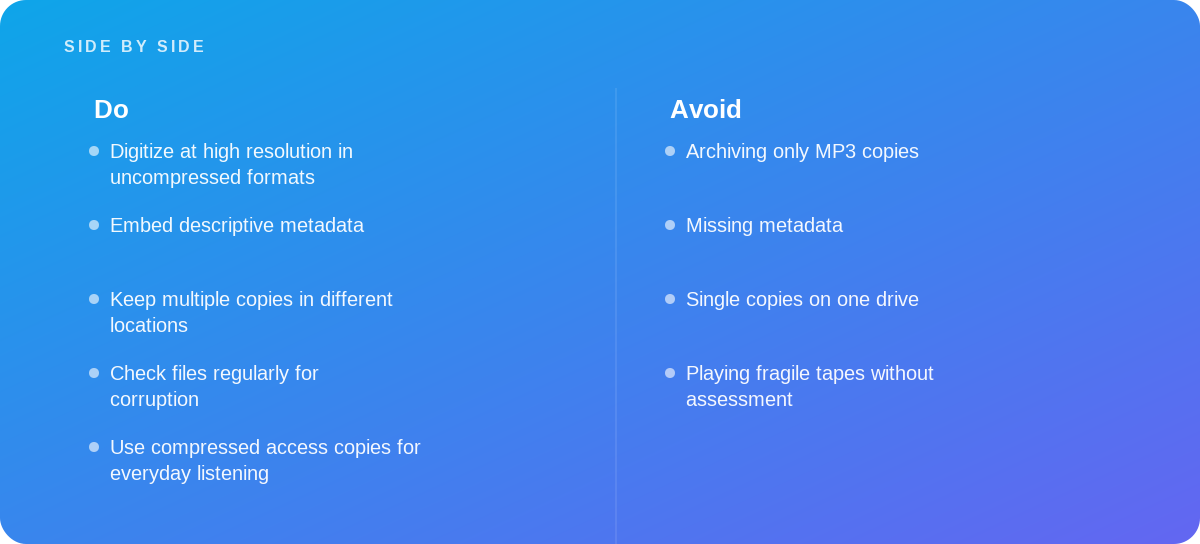
- Digitize at high resolution in uncompressed formats
- Embed descriptive metadata
- Keep multiple copies in different locations
- Check files regularly for corruption
- Use compressed access copies for everyday listening
Where it goes wrong
Avoid:
- Archiving only MP3 copies
- Missing metadata
- Single copies on one drive
- Playing fragile tapes without assessment
The numbers behind it
| Measure | Figure |
|---|---|
| FADGI | the Federal Agencies Digital Guidelines Initiative publishes audio digitization guidance |
| Broadcast Wave | BWF files carry metadata inside WAV files |
| Uncompressed files | WAV and BWF are common preservation formats |
| Tape decay | some magnetic tapes suffer from sticky-shed syndrome |
Getting outside help
When to hand it over: Bring in help when digitizing irreplaceable recordings.
Where this comes from
- Federal Agencies Digital Guidelines Initiative — Embedding Metadata in Broadcast WAVE Files
- European Broadcasting Union — Tech 3285 Specification of the Broadcast Wave Format
The figures and practices above come from the sources listed.
Working on something like this?
We take on Audio Editing & Production work for teams who want it done once, properly. Tell us what you are building and we will tell you honestly whether we are the right studio for it. Start a project.
Where to go next
Spotted something wrong? Report an error on this page. We correct on the page and say what changed.