Surround and Immersive Audio: The Decisions That Matter
The six most common myths about surround and immersive audio, why each one fails in practice, and what to do instead, from fold-downs to calibrated rooms.
 MediaScaleUp Editorial Team
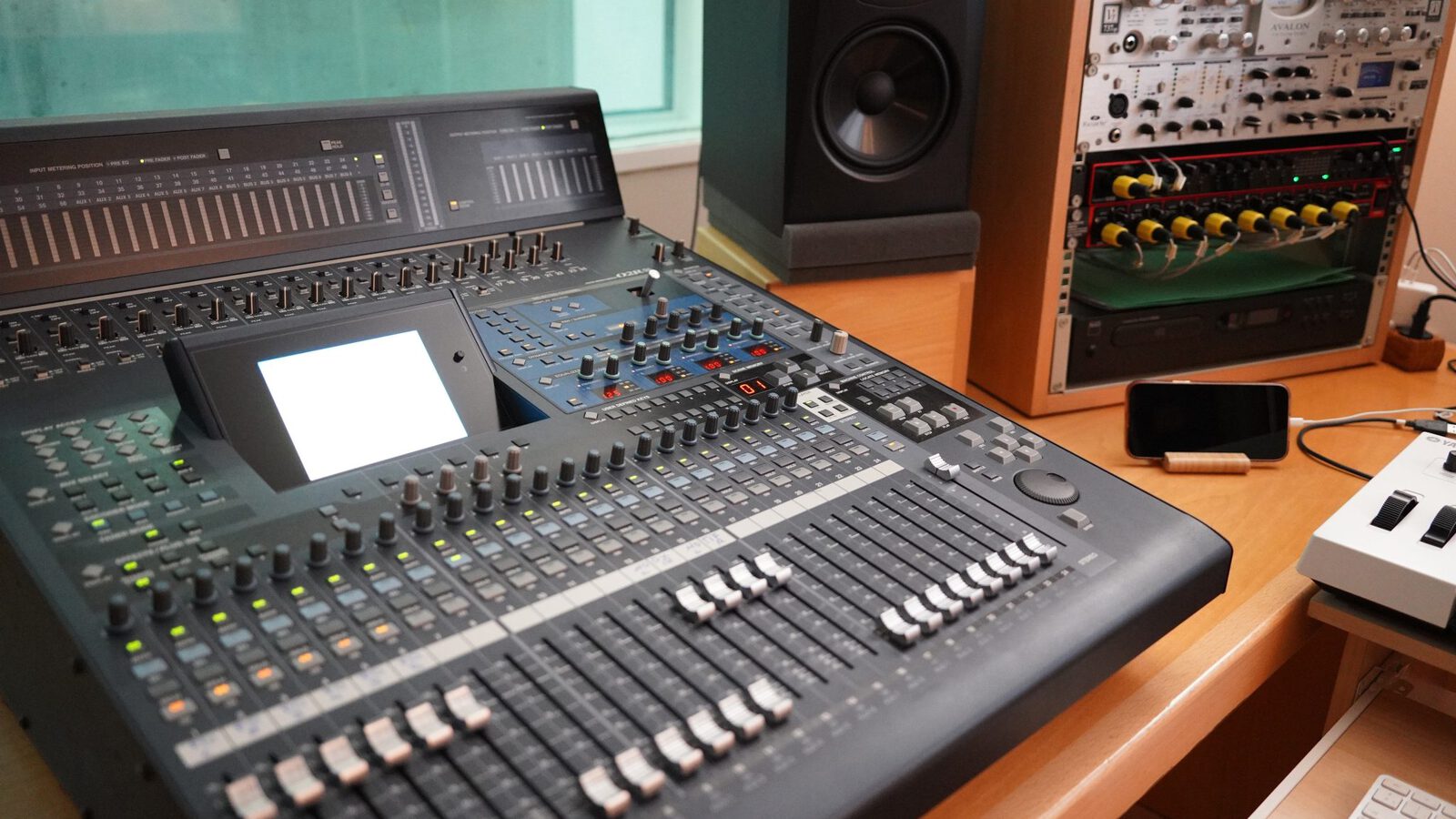
Surround and immersive audio covers every mix built for more than two channels: classic 5.1 and 7.1 layouts, and object-based formats that place sounds in three-dimensional space and render them to whatever system the listener owns, from a cinema to a soundbar to a pair of earbuds. For a documentary producer, a brand team commissioning a streaming series, or a music label weighing an immersive re-release, it is no longer an exotic extra. Streaming platforms routinely list immersive versions, and some commissioners now write them into delivery contracts.
That visibility has produced a set of assumptions that sound reasonable and cost real money when they turn out to be wrong. More speakers must mean a better mix. The format lets you fly a sound overhead, so you should. The platform will handle the stereo version. A pair of headphones and a binaural plug-in are enough to sign off a deliverable. Each of these has a grain of truth, and each has sunk projects at the review stage, when fixing it is most expensive.
This guide works through the most common misconceptions about surround and immersive audio, explains why each one fails in practice, and sets out what experienced mixers do instead. It is written for the people who commission, budget and approve this work as much as for the engineers who do it, because most of the costly decisions are made before anyone opens a session.
What Surround and Immersive Audio Actually Includes
Before the myths, it helps to be precise about terms, because "surround," "spatial" and "immersive" get used interchangeably in marketing copy and mean different things on a delivery spec. There are three families of format, and a single project can touch all three.
Channel-based formats: 5.1 and 7.1
In a channel-based mix, every track is routed to a fixed speaker feed. A 5.1 mix has left, center, right, left surround, right surround and a low-frequency effects (LFE) channel, the ".1," which carries band-limited low-frequency content, conventionally below about 120 Hz. A 7.1 mix splits the surrounds into side and rear pairs. What you print is exactly what each speaker plays. That makes channel-based mixes predictable, easy to check and still the backbone of broadcast and many streaming deliverables. The reference layout for 5.1 listening, including the placement of the surround speakers at roughly 110 degrees either side of center, comes from ITU-R BS.775, which is also the source of the standard downmix equations discussed later.
Object-based formats
Object-based formats separate the sound from the speaker. A mix consists of a channel "bed" for ambiences and music plus a number of audio objects, each carrying metadata that describes where it sits in three-dimensional space and how large it is. A renderer on the playback device reads that metadata and decides which speakers, or which headphone filters, reproduce each object. The same master can play on a large cinema array, a home theater with ceiling speakers, a soundbar that reflects sound off the ceiling, or headphones. Dolby's professional resources on immersive audio production describe this bed-plus-objects model and the renderer workflow in detail, and they are the practical reference for the most widely used format.
Binaural rendering
Binaural rendering takes an immersive mix and processes it through filters that model how sound reaches the two ears from different directions, so a headphone listener perceives height and surround cues from a two-channel signal. It is how most immersive content is actually experienced on phones. It is a rendering of the mix, not a substitute for the mix, and how convincing it sounds varies considerably from listener to listener.
| Format family | How sound is placed | Typical uses | Main practical risk |
|---|---|---|---|
| Channel-based (5.1, 7.1) | Fixed routing to named speakers | Broadcast, streaming series, corporate and event video | Poor downmix behavior if the center and surrounds are not balanced with fold-down in mind |
| Object-based | Bed channels plus positioned objects, rendered on playback | Feature film, premium streaming, immersive music | Mix sounds different on every system; requires disciplined monitoring and renders |
| Binaural | Headphone filters applied to an immersive mix | Mobile listening, podcasts, headphone releases | Individual differences in perception; overconfidence from headphone-only mixing |
| Stereo fold-down | Derived from the multichannel mix by coefficients or a renderer | Every platform, every phone, every laptop | Treated as an afterthought although it is what most people hear |
The last row is the thread that runs through this whole article. Whatever the headline format, most listening is still stereo, so the stereo version is the deliverable most of the audience will judge you on.
Myth 1: More Channels Automatically Make a Better Mix
The logic seems unassailable: if two speakers are good and twelve are better, an immersive mix must be an upgrade on any project. In practice, the number of channels is a canvas size, not a quality level. A carefully balanced stereo mix of a talking-head documentary will serve its audience better than a rushed 5.1 mix in which the surrounds carry little more than reverb spill and the center channel is fighting the left and right for the dialogue.
Myth: Delivering in surround or immersive will make any production sound more premium, so it is always worth choosing the biggest format available.
Reality: Extra channels only help when the material has spatial content worth spreading out, and they add mixing time, monitoring requirements, QC passes and deliverables. Choose the format that the content and the distribution actually call for, and put the saved budget into a better stereo or 5.1 mix.
Where extra channels earn their cost
Immersive formats pay off when there is real spatial information to reproduce: a live concert recorded with ambient microphones, a nature documentary with rich multi-microphone field recordings, a drama with designed environments, or music produced with space in mind from the start. They also pay off when the commissioning platform requires them, which settles the question regardless of creative preference.
They earn much less on content that is essentially mono at heart: interviews, explainer videos, webinars, most corporate training, and short social cuts. For short-form work in particular, the vast majority of plays happen on phone speakers and earbuds, which is why audio for short-form video is usually best finished as a strong stereo mix that survives mono playback.
A quick way to decide
Ask three questions before committing. Is an immersive or 5.1 deliverable required by the platform, broadcaster or contract? Was the material recorded with spatial content, or can it be designed convincingly? Will a meaningful share of the audience hear it on a multichannel system? If the answer to all three is no, a well-made stereo mix is the professional choice, not the cheap one.
Myth 2: If the Format Can Move Sound, You Should Move It
Object-based formats make movement trivially easy. Draw a path, and a helicopter crosses the ceiling; automate a pan, and a character's voice walks from the front left to the rear right. The temptation is to use that capability because it is there, especially in the first immersive project a team takes on, when demonstrating the format feels like part of the brief.
Myth: An immersive mix should use the whole sound field constantly, with dialogue and key elements moving around the listener to show off the format.
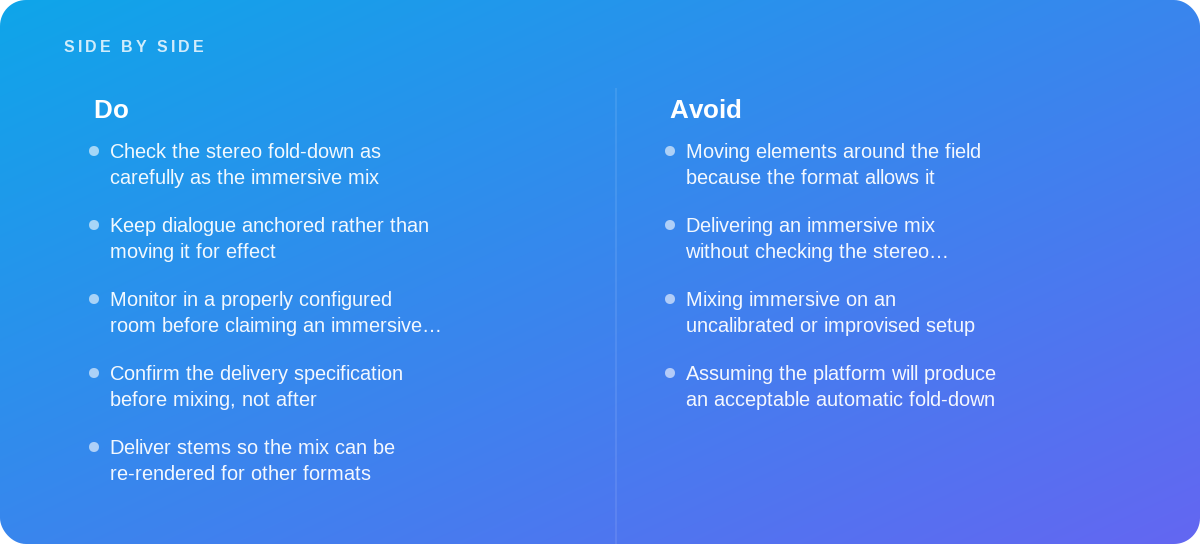
Reality: Good immersive mixes keep dialogue anchored, usually in the center, and reserve movement for moments where it serves the story. Gratuitous motion distracts, pulls attention off screen, and behaves unpredictably when the mix is rendered to smaller systems or folded down to stereo.
Why dialogue stays put
The picture is at the front. When a voice leaves the front of the room while the speaker stays on screen, the listener's attention splits between what they see and what they hear. In a home setting, where speakers are rarely placed exactly to spec, a voice panned into the surrounds can also land at a very different level in each viewer's room. Keeping dialogue in the center channel, or as a center-anchored object, also protects intelligibility in the fold-down, because the center is the element the downmix equations handle most predictably. It also matters for accessibility: viewers who rely on dialogue enhancement features or who have hearing loss depend on a stable, clear dialogue path, a point covered further in our guide to transcription and audio accessibility.
When movement is right
Movement is justified when it tracks something the viewer can see or infer: a vehicle passing, an aircraft overhead, a door opening behind the camera. It is also justified in music when the arrangement was written for it. The discipline is to motivate every move, make it smooth enough that it does not "jump" between speakers on sparse home systems, and check how it collapses in stereo, where a sweep from front to back may simply become a level dip.
Height channels are not a special effects channel
Overhead speakers and height objects are most useful for subtle environmental cues: rain on a roof, the reverb tail of a large space, birds in a canopy, the reflections of a concert hall. Constant hard-panned content in the heights tends to feel artificial. Many experienced mixers use height content sparingly and at lower levels than a first-time immersive mixer expects, and they test it on a render with height speakers muted to confirm nothing essential lives only overhead.
Myth 3: The Platform Will Take Care of the Stereo Fold-Down
This is the most expensive myth on the list, because it fails silently. Most streaming services and many playback devices can generate a stereo version from a multichannel or object-based master. Because that step is automatic, teams assume it is also acceptable, and nobody listens to it until a client plays the finished film on a laptop and asks why the dialogue has disappeared under the music.
Myth: Once the immersive master is approved, the stereo version the audience hears is the platform's problem, and an automatic downmix will sound fine.
Reality: Automatic fold-downs apply fixed coefficients or renderer settings that know nothing about your balance. Center dialogue, surround music and LFE content can all shift in level. The stereo version has to be checked, and often adjusted or delivered separately, with the same care as the immersive mix.
What happens mathematically in a fold-down
The standard ITU downmix for 5.1 to stereo adds the center channel to both left and right at about 3 dB lower, adds each surround channel to its side at about 3 dB lower, and commonly discards the LFE channel entirely. Three consequences follow. First, anything that relied on the LFE for its weight, such as an explosion or a sub-heavy music cue, loses impact in stereo unless it was also present in the main channels. Second, content that was spread across front and surround channels sums, and correlated content can build up in level or produce comb filtering. Third, the relationship between dialogue in the center and music across the front and surrounds changes, so a balance that felt right in the room can bury the voice in stereo.
Object-based formats add another layer. The renderer's downmix behavior depends on settings in the metadata and on the playback device, and binaural renders depend on per-object distance settings. The European Broadcasting Union's technical guidance on multichannel audio is a useful reference for how broadcasters approach downmix behavior and loudness across formats, including why downmix metadata needs deliberate attention rather than defaults.
How professionals handle it
The practical approach is to monitor the fold-down throughout the mix, not just at the end. Most immersive monitoring setups let the mixer switch instantly between the full layout, a 5.1 render, a stereo downmix and a binaural render. Checking the stereo fold-down after every major balance decision catches problems while they are cheap. Where the automatic downmix cannot be made acceptable, the answer is a dedicated stereo mix, delivered alongside the immersive master, derived from the same stems but balanced for two speakers. Loudness also needs to be measured on each version separately, because a stereo downmix of a compliant 5.1 master is not guaranteed to be compliant itself.
Fold-down listening should also be part of a formal QC pass. Our guide to audio quality control checks covers how to structure those passes so each deliverable is listened to, not just metered.
Myth 4: Headphones and a Binaural Plug-In Are Enough to Mix Immersive
Binaural monitoring has improved enormously, and every major immersive toolchain offers a headphone render. It is genuinely useful for editing, for rough balancing, and for checking what the mobile audience will hear. It is also tempting as a way to avoid the cost of a properly configured room. The problem is that a headphone render can only tell you how the mix sounds through one set of filters on one pair of ears; it cannot tell you how the mix will translate to speakers.
Myth: A good pair of headphones and a binaural renderer, or a few extra speakers added around an existing stereo desk, are enough to mix and approve an immersive deliverable.
Reality: An immersive deliverable should be mixed or at least verified in a correctly configured and calibrated room: speakers at the positions the format specifies, level-matched, time-aligned and bass-managed. Headphone renders are a check, not a reference, and improvised speaker rigs produce mixes that fall apart on real systems.
What "correctly configured and calibrated" means
A room ready for surround or immersive mixing has several properties that improvised setups usually lack:
- Speaker positions that follow the format's layout. Angles and heights relative to the listening position matter more than the brand of speaker. Surrounds placed too far forward or height speakers mounted at the wrong elevation distort every panning decision.
- Level calibration. Each speaker is set, with pink noise and an SPL meter, to a reference level appropriate to the room size and the format's guidance, so that a sound panned anywhere arrives at the same perceived level.
- Delay alignment. Speakers at different distances are delayed so their sound arrives at the listening position together; otherwise, panned images smear toward the nearest speaker.
- Bass management. Low frequencies from the main speakers are routed to one or more subwoofers with a defined crossover, and the LFE channel is calibrated separately with its conventional gain offset.
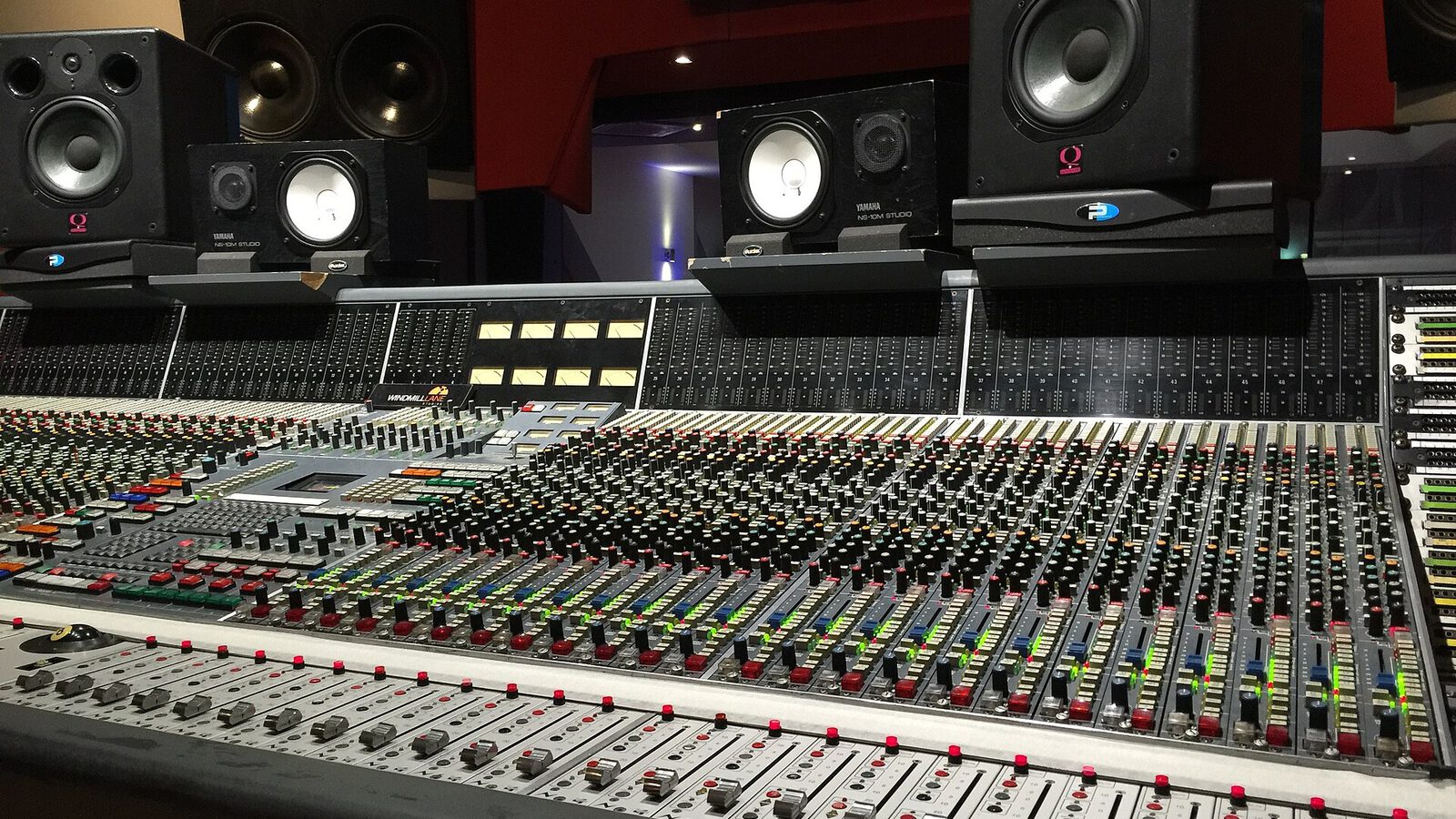
- Acoustic treatment. Early reflections and room modes are controlled well enough that what the mixer hears is the mix, not the room.
The Audio Engineering Society's work on spatial audio is a sound starting point for the research and recommended practices behind loudspeaker layouts, room design and spatial perception.
Where headphones belong in the workflow
Headphones remain valuable at specific points. Editors can prepare objects and clean dialogue on headphones. The mixer should listen to the binaural render on several pairs of consumer headphones and earbuds before sign-off, because that is how much of the audience will hear it. What headphones should not do is replace the speaker reference for the final balance. If no calibrated room is available, that is a strong signal to bring in a facility or studio that has one rather than claiming an immersive deliverable you have never heard on speakers.
Why the monitoring gap is hard to see from outside
A client listening to a draft on their own headphones will usually hear something that sounds spacious and impressive. The problems surface later: the center-channel dialogue that was actually sitting too low, the ambience that vanished on a soundbar, the LFE-dependent cue that lost its punch. Commissioning teams should ask where and on what system a mix was approved, in the same way they would ask a colorist whether the grade was done on a calibrated display.
Myth 5: The Delivery Spec Can Be Sorted Out at the End
Stereo projects can often get away with confirming deliverables late, because the output is simple. Surround and immersive projects cannot. The layout of the session, the bed configuration, the number of objects, the loudness target, the file format and the set of stems all depend on the delivery specification, and changing any of them after the mix is built means rework.
Myth: You can mix in whatever layout the studio has and convert to the required format once the client confirms what the platform wants.
Reality: Delivery specifications dictate the session structure from day one. Confirm the channel layout, object limits, loudness targets, file formats, stem breakdown and fold-down requirements before mixing starts, and build the session around them.
What a surround or immersive spec typically defines
A delivery specification from a broadcaster, streaming platform or distributor will usually cover most of the following. If yours does not, get written answers before the mix is booked:
- The primary format and layout: 5.1, 7.1, or an object-based master with a specified bed configuration.
- Required secondary deliverables: a stereo mix, a 5.1 fold-down, a binaural version, or a mono-compatible version.
- Loudness targets and the measurement method for each deliverable, together with true-peak limits.
- File format, sample rate, bit depth and channel order, including whether multichannel audio is delivered as interleaved files or discrete mono files.
- Stems: which groups are required (typically dialogue, music, effects, and sometimes a music-and-effects version for international dubbing) and in which layout.
- Metadata: downmix coefficients, dialogue normalization values, and for object-based masters the renderer and master file type expected.
Channel order alone causes a surprising number of rejections, because different systems expect the six channels of a 5.1 file in different sequences. Our guide to audio file formats and delivery covers how to document and verify channel order, naming and metadata so files arrive in a form the receiving system accepts.
How late spec changes cost time
Consider a mix built in 7.1 because the studio was set up that way, where the spec turns out to require 5.1 plus a stereo mix and a music-and-effects version. The 7.1 to 5.1 conversion is straightforward in principle, but any balance that depended on the side and rear separation needs revisiting. If dialogue and effects were not kept on separate buses, the music-and-effects version may be impossible without rebuilding the session. None of that work is difficult; all of it is avoidable. Structuring the session around the deliverables from the outset, as described in our guide to audio workflow and session organization, is what prevents it.
Myth 6: Once the Immersive Master Exists, You Have Everything You Need
The immersive master feels like the most complete version of the mix, so it is natural to treat it as the archive. But a rendered master is a finished output, not a working asset. Formats change, platforms add new requirements, and content gets repurposed years after it was made: a trailer needs a new music cue, a territory needs a dubbed version, a catalog needs a different loudness target.
Myth: The final immersive master is the definitive version, so there is no need to deliver or archive stems.
Reality: Stems are what let a mix be re-rendered for other formats, re-balanced for new platforms, localized, or recut. Deliver and archive properly labeled stems in the mix layout alongside every master.
What a useful stem set looks like
A practical stem set splits the final mix into groups that sum back to the master exactly, with all processing on the master bus either printed into each stem or documented. Typical groups are dialogue, music, effects and ambiences, with separate stems for narration or foreign-language-sensitive elements where relevant. For object-based projects, the equivalent is the master file with its objects and metadata intact, plus channel-based stems rendered to the principal layout, so the content can be rebuilt without the original session if necessary.
The test of a stem set is simple: sum the stems, null them against the master, and confirm the result is silence or very close to it. If it is not, something on the master bus was left out, and the stems will not rebuild the mix faithfully.
Stems and rights go together
Stems are also where rights questions surface. A music stem licensed for one territory or one term may not be reusable in a recut, and separating it out makes that visible. Keeping stem documentation linked to your licensing records, as outlined in our guide to audio rights and clearance records, saves a great deal of reconstruction when a piece is repurposed years later.
A Worked Example: Budgeting a Documentary With a 5.1 and Stereo Deliverable
To show how these decisions translate into time and scope, here is an illustrative example. It is not a real project, and the day counts are planning ranges rather than quotes; actual time depends on the condition of the edit, the amount of sound design, and the number of review rounds.
A producer is finishing a 52-minute documentary for a streaming platform. The spec requires a 5.1 master, a separate stereo mix, dialogue, music and effects stems in 5.1, and a music-and-effects version for international sales. The film is mostly interviews with some location sequences recorded with a stereo ambience pair and a few archival music cues.
| Stage | Illustrative time | Why it is there |
|---|---|---|
| Spec review and session setup | 0.5 day | Build buses for dialogue, music, effects and ambience; set channel order, loudness targets and fold-down monitoring before mixing |
| Dialogue edit and cleanup | 2 to 3 days | Interview-driven films live or die on dialogue; this does not change with the format |
| Ambience and effects preparation for surround | 1 to 1.5 days | Upmixing or re-recording stereo ambiences so surrounds carry real, decorrelated content |
| 5.1 mix | 2 to 3 days | Balance in a calibrated room, with regular checks of the stereo fold-down |
| Dedicated stereo mix | 0.5 to 1 day | Rebalanced from the same stems because the automatic downmix pushes music over dialogue in several scenes |
| M&E version and fill | 0.5 to 1 day | Replace effects and ambience that were only captured on dialogue tracks |
| QC, loudness checks and delivery | 0.5 to 1 day | Measure each deliverable separately, null stems against masters, verify channel order and metadata |
In this illustrative plan, the surround-specific work, meaning the ambience preparation, the extra mixing time for five full-range channels, and the dedicated stereo mix, adds roughly two to four days over a stereo-only finish. Most of that increase comes not from the 5.1 mix itself but from making the other deliverables hold up. That is the pattern to expect on almost every project: the immersive version is the headline, and the stereo and stem deliverables are where the hidden work lives.
Where the plan changes
If the platform required an object-based immersive master instead of 5.1, the setup stage would grow to include renderer configuration, and the mix would need a room with height speakers. The binaural render would join the review list. If no suitable room were available locally, the sensible approach would be to do dialogue editing and preparation in the existing studio and book a calibrated immersive room for the final mix and review, which is often more economical than improvising and remixing later.
What to Do Instead: A Working Checklist for Surround and Immersive Projects
Each of the myths above has a matching habit that prevents it. Taken together, they form a routine that works for a 5.1 corporate film and a full object-based music release alike. The checklist below is the version we would hand to a producer or a mixer at the start of a project.
- Confirm the full delivery specification in writing before mixing: primary format, secondary deliverables, loudness targets, file format, channel order, stems and metadata.
- Choose the format for the content and the audience, not for the prestige; default to a strong stereo mix unless multichannel is required or genuinely justified.
- Build the session around the deliverables, with dialogue, music, effects and ambience on separate buses from the first day.
- Keep dialogue anchored in the center and motivate every movement of sound around the field.
- Mix and approve in a correctly configured and calibrated room; use headphones for binaural checks, not as the reference.
- Listen to the stereo fold-down after every major balance change, and deliver a dedicated stereo mix when the automatic one does not hold up.
- Check what disappears when the LFE is discarded and when height speakers are muted.
- Measure loudness and true peak on every deliverable separately.
- Deliver and archive stems that null against the master, with documentation of layout, channel order and any master-bus processing.
- Review the binaural render on several consumer headphones before sign-off.
Applying the checklist to smaller formats
Not every multichannel job is a film. Event and installation audio frequently uses surround layouts that do not match any consumer format: a museum gallery with speakers in the ceiling, a trade show stand with an overhead array, a fitness studio with speakers around the room. The same principles apply, especially anchoring speech and confirming the playback system before mixing. Our guides to museum audio guides and trade show booth audio look at those environments specifically.
When to Bring In Specialist Help
Many teams can handle a straightforward 5.1 deliverable in house if they have a properly set-up room and a mixer who has done it before. There are three situations where specialist help is usually the better decision.
When an immersive deliverable is contractually required
If a broadcaster, platform or distributor requires an immersive master, the deliverable will be checked against a specification, and rejections cost time close to release. A studio that delivers to that spec regularly will know the renderer settings, the metadata expectations and the QC points that trip up first-time submissions.
When there is no calibrated room available
This is the clearest trigger. Without a correctly configured and calibrated room, you cannot honestly claim an immersive or surround deliverable has been verified. Booking a suitable room for the final mix and review, while keeping the editing and preparation in house, is a common and cost-effective split.
When a stereo catalog must be upmixed
Upmixing an existing stereo catalog to surround or immersive is a craft of its own. Automatic upmixers can produce acceptable ambience spread, but they struggle to extract clean dialogue or instruments, and they can introduce artifacts that only become audible on a full speaker system. Where the original multitracks or stems exist, remixing from them is usually far better than upmixing the stereo master; where they do not, a specialist can judge which titles can be upmixed convincingly and which should stay in stereo.
For productions that want to hand off the whole finish, our audio post for video service covers dialogue editing, surround and stereo mixing, stems and delivery to specification, and the wider audio editing and production team handles music, podcast and catalog work, including assessing whether an upmix is worth doing at all.
The format is the easy part. What separates a good surround or immersive deliverable from a disappointing one is the discipline around it: a confirmed spec, a calibrated room, anchored dialogue, a stereo version that has actually been heard, and stems that let the mix live on after delivery.
Where this comes from
- Dolby Professional — Immersive audio production
- European Broadcasting Union — Multichannel audio guidelines
- Audio Engineering Society — Spatial audio
The figures and practices above come from the sources listed.
Working on something like this?
We take on Audio Editing & Production work for teams who want it done once, properly. Tell us what you are building and we will tell you honestly whether we are the right studio for it. Start a project.
Where to go next
Spotted something wrong? Report an error on this page. We correct on the page and say what changed.