On-Page Optimization: The Decisions That Matter
A buyer's guide to on-page optimization: what to include in scope, what drives cost, questions to ask suppliers, how to compare quotes and how to judge results.
 MediaScaleUp Editorial Team

On-page optimization is the work of making each page on a website clearly describe what it is about: its title element, its headings, the structure of its content, its internal links, its URL and its metadata. It is the part of search engine optimization most directly under your control. You do not need anyone else's permission to write a better title or fix a heading hierarchy, and for most sites the basics done consistently still matter more than anything advanced.
That makes it an odd thing to buy. The individual changes look small, and many business owners wonder why they should pay a specialist to rewrite titles and meta descriptions. Yet on-page optimization done badly is common and expensive: thousands of product pages sharing one templated title, headings used as a styling tool, URLs changed during a redesign without redirects, and internal links that all say "learn more". Done well at scale, it is a mix of editorial judgment, template engineering and careful measurement.
This handbook is written for the person commissioning the work, whether that is a marketing lead, an ecommerce manager or a business owner. It covers what on-page optimization should include, which decisions carry the most weight, what drives cost, which questions to ask a supplier, how to compare quotes, the red flags that should make you walk away, and how to judge the result once the work is live.
What on-page optimization includes, and what it does not
A clear scope is the first thing to agree, because "on-page SEO" is used loosely and suppliers quote very different bundles of work under the same name. At its core, on-page optimization covers the elements that describe a page to readers and search engines:
- The title element. The strongest on-page description of a page's subject, and the main source for the clickable headline in search results.
- The meta description. Not a ranking factor, but it can influence whether a searcher clicks a result, since search engines often show it as the snippet.
- Heading structure. The H1 to H6 hierarchy, which communicates the document's structure to readers, assistive technology and crawlers.
- Content structure. How the page is organized, whether it answers the question the searcher had, and whether the important information is easy to find.
- Internal links. Links between your own pages, which distribute signals and establish relationships between pages, and the anchor text that describes them.
- URLs. Addresses that are readable and stable, and that do not change without redirects.
- Supporting elements. Image alt text, structured data where it applies, and canonical tags that tell search engines which version of a page to treat as primary.
What on-page optimization usually does not include is equally important to pin down. Technical SEO such as crawling, indexing, site speed and server configuration is a separate discipline, although the two overlap. If your problem is that pages are not being indexed at all, better titles will not fix it; you need to look at something like the Search Console page indexing report first. Link building, content strategy and new content production are also separate lines of work. A supplier may bundle them, which is fine, but each should be priced and described separately so you can see what you are paying for.
The other boundary to understand is between optimizing a page and rewriting it. Adjusting a title, a heading and a few internal links is optimization. Restructuring a thin page into a genuinely useful one is content work, and it is often what the page really needs. Our guide to helpful, people-first content covers that side. A good supplier will tell you when a page's problem is its substance rather than its tags.
The on-page decisions that carry the most weight
Not every on-page element deserves equal attention. When you review a proposal, check that effort is concentrated where it matters. The table below summarizes the main elements, what they do and the common failure for each.
| Element | What it does | Common failure | What good looks like |
|---|---|---|---|
| Title element | Describes the page's subject; main source of the search result headline | Identical or templated titles across many pages | Distinct, specific and accurate for every indexable page |
| Meta description | Often used as the result snippet; influences clicks, not rankings | Missing, duplicated or stuffed with keywords | A specific summary that earns the click, accepting it may be replaced |
| Headings | Communicate document structure | Used to style text; skipped levels; multiple competing H1s | One clear main heading and a logical hierarchy beneath it |
| Internal links | Distribute signals and define page relationships | "Click here" anchors; important pages with few or no links | Descriptive anchors; key pages linked from relevant context |
| URL | Identifies the page; readable URLs help users | Changed without redirects; parameter-heavy or opaque | Readable, stable and redirected with 301s if they must change |
| Alt text | Describes images for accessibility and image search | Keyword lists; empty on meaningful images | Plain description of what the image shows |
Titles come first
The title element is the single most important on-page element, and it is where most large sites have systematic problems. Google's documentation on controlling title links explains that search engines may display a different title than the one you supply, drawing on headings, anchor text and other content when the title element is missing, repetitive, boilerplate or does not describe the page well. That is useful for a buyer to know: if your results are showing rewritten titles, it is often a sign that your titles are not doing their job, not a reason to ignore them.
Meta descriptions are about clicks
Meta descriptions do not affect rankings, but a specific, accurate description can make a result more appealing. Search engines frequently replace them with text taken from the page when they judge it more relevant to the query. Good practice is to write descriptions that earn the click anyway, on the pages where it matters most, and to accept that they will sometimes be replaced. Paying for handwritten descriptions on thousands of low-traffic pages is rarely a good use of budget.
Headings and internal links shape understanding
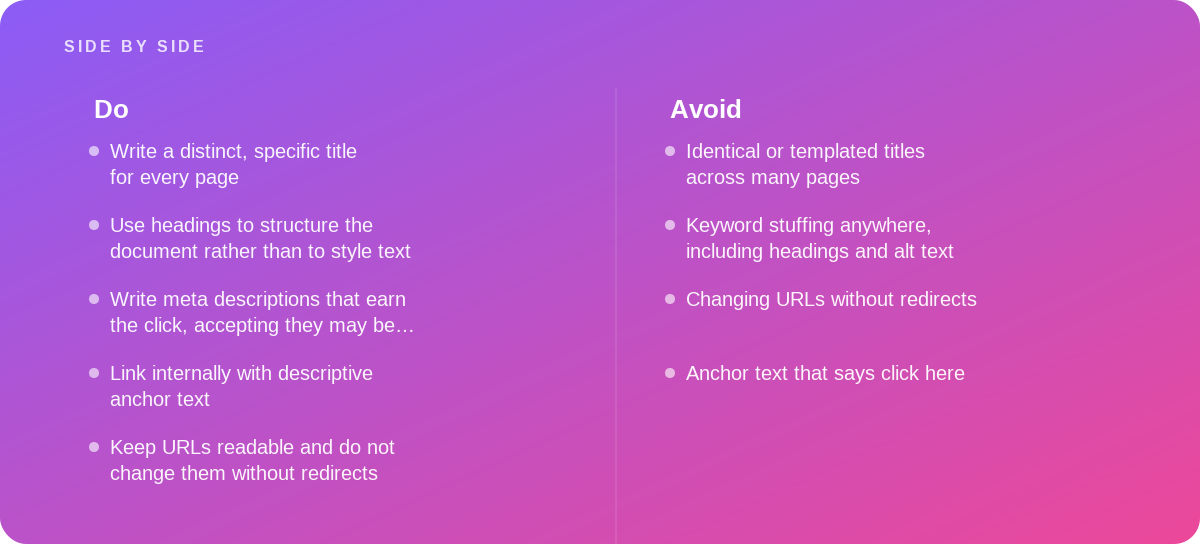
Headings should structure the document rather than style text. Using an H2 because it happens to be the right font size is a template problem, and it will often need a developer rather than a copywriter to fix. Internal links matter because they tell both users and crawlers which pages are related and which are important. Pages that no internal link points to at all, covered in our guide to orphan pages, are a common finding in audits and one of the more valuable things to fix.
What to ask for in the brief
The quality of on-page work depends heavily on the brief you give. A supplier who is told "optimize our site" will make assumptions about scope, priorities and access, and those assumptions will shape the quote. A good brief gives them what they need to price accurately and removes the guesswork.
Information to supply
- The site's size and structure. Approximate counts of each page type: product pages, category pages, articles, location pages, landing pages. Ten handwritten service pages and five thousand templated product pages are completely different jobs.
- Your platform and who controls templates. Whether titles and headings are edited per page in a CMS, generated by templates, or both, and whether changing a template needs a developer.
- Access. Search Console and Bing Webmaster Tools access, analytics, and a staging environment if one exists.
- Priorities. The pages or sections that matter commercially. Optimization effort should follow value, not page count.
- History. Any recent redesign, migration, URL change or content restructure, especially if traffic changed around the same time.
- Constraints. Brand rules for titles, legal requirements on product naming, and anything that cannot be changed.
Deliverables to ask for
Ask for deliverables that you can check and reuse. Useful ones include an audit with findings ranked by impact and effort; a spreadsheet of recommended titles, descriptions and headings for priority pages, showing the current and proposed version side by side; template rules for page types that are generated automatically; an internal linking plan; a redirect map for any URL changes; and a measurement plan that says how success will be judged. If content briefs are part of the scope, our guide to content briefs for SEO covers what a usable one contains.
Make sure recommendations come with reasons. A recommendation to change a title from one version to another is only useful if it explains what problem the change solves, whether that is duplication, vagueness, a mismatch with search intent or a missing qualifier such as a location or product type.
What drives the cost of on-page optimization
The cost of on-page work is driven by the number of distinct decisions it involves, not the number of pages. A site with 10,000 pages built from four templates may need less work than a site with 300 individually written pages, because the first is largely a template problem and the second is an editorial one. When you compare quotes, look for how the supplier has accounted for these drivers.
- Handwritten pages Each page needs individual research and writing, so effort scales with the number of priority pages.
- Templated pages Effort goes into rules and data fields; one good template rule can fix thousands of pages at once.
- Platform access If template changes need a development team, their time and release cycle become part of the cost and the timeline.
- Data quality Templates can only produce distinct titles if the product or location data behind them is clean and complete.
- Site history A recent migration or restructure adds investigation work, including redirect checks and comparisons of old and new pages.
- Measurement Controlled testing and reporting add effort, but they are what tell you whether the work paid off.
Beyond these, the pricing model matters. Suppliers typically quote in one of three ways: a fixed fee for a defined audit and set of recommendations; a project fee for audit plus implementation; or a monthly retainer that covers ongoing optimization. Rates vary widely by market, supplier size and experience, so compare what each quote includes rather than the headline number. A cheap audit that produces a generic list of issues from a crawling tool is not comparable to a more expensive one that includes prioritized, page-specific recommendations and template rules.
Implementation is the line item most often underestimated. An audit that recommends new titles for 400 pages is only valuable if someone updates those 400 pages, and that someone may be your own team, the supplier or your developers. Be explicit about who does the implementation and include it in the comparison.
Questions to ask an on-page optimization supplier
The conversation before you sign tells you most of what you need to know about how a supplier will work. The questions below are designed to reveal whether they understand your site, whether they prioritize sensibly and whether they will measure honestly.
- How will you decide which pages to prioritize, and what data will you use?
- For our templated pages, will you write rules for the template or rewrite pages one by one?
- What will you need from our developers, and roughly how much of their time?
- How do you handle pages where the problem is thin content rather than weak tags?
- Will you change any URLs, and if so, how will you plan and test redirects?
- How will you check whether search engines are rewriting our titles, and what will you do about it?
- What does a finished recommendation look like? Can we see an anonymized example?
- How will you measure the effect of the changes, and over what period?
- What will you not do, and what would you recommend we handle elsewhere?
- Who will actually do the work, and who reviews it before it reaches us?
Listen for specific answers. "We'll optimize your key pages" is a non-answer. "We'll rank your pages by organic impressions and revenue, take the top 150, and write titles and descriptions for those by hand; the 6,000 product pages will get a template rule based on product name, brand and type" is a real plan you can evaluate. Pay particular attention to the question about measurement. A supplier who cannot explain how they will know whether their work helped is asking you to take the result on trust.
How to compare on-page optimization quotes
Comparing quotes is difficult because suppliers package work differently. The most reliable approach is to score each quote against the same criteria, weighted by what matters to your site, rather than comparing prices directly.
A scorecard for comparing quotes
| Criterion | What to look for | Weak answer | Strong answer |
|---|---|---|---|
| Prioritization | Work ordered by business value and search opportunity | Every page treated equally | A ranked list of pages with the data behind it |
| Template handling | Rules for generated page types | Manual rewrites of templated pages | Template rules plus a plan for exceptions |
| Implementation | Who makes the changes and when | Recommendations only, not stated | Named owner, timeline and developer effort estimate |
| URL safety | How URL changes are handled | URLs changed for keywords | URLs kept stable; any changes mapped with 301 redirects |
| Measurement | How impact will be judged | "Rankings will improve" | Baseline, comparison groups and a defined review period |
| Transparency | Visibility of what was changed | A summary report | A change log with before and after for every page |
Score each quote from 1 to 5 on each criterion and weight the criteria to suit your situation. A site with thousands of templated product pages should weight template handling heavily; a small service business with twenty pages may weight prioritization and writing quality more.
Worked example: three quotes for an online retailer
Consider a hypothetical online homewares retailer with roughly 4,200 indexable pages: 3,800 product pages, 250 category pages, 120 blog articles and about 30 core pages such as the homepage and service pages. Product titles are generated by a template that outputs the product name followed by the brand name of the store, so hundreds of products with similar names end up with near-identical titles. Category pages have handwritten titles, but many are vague. The retailer asks three suppliers to quote.
- Supplier A proposes to rewrite titles and meta descriptions for all 4,200 pages by hand over six months. Their estimate is large, driven by the page count.
- Supplier B proposes an automated audit using a crawling tool, delivering a report listing duplicate titles, missing descriptions and heading issues, with generic guidance on how to fix them. Their price is the lowest.
- Supplier C proposes to write a new product title template using product type, key attribute and brand, with a data cleanup step for products missing attributes; to handwrite titles, descriptions and headings for the 250 category pages and 30 core pages; to add internal links from blog articles to relevant categories; and to measure results by comparing a changed group of categories against an unchanged group over eight weeks before rolling out the rest.
Using the scorecard with template handling weighted double, the comparison looks roughly like this. Supplier A scores well on transparency but poorly on template handling and prioritization, since it spends most of its effort on low-value product pages that a template would fix more reliably. Supplier B scores poorly on almost everything except price, because it leaves the retailer to interpret and implement the findings. Supplier C scores highest: it concentrates handwritten effort on the 280 pages where editorial judgment matters, fixes 3,800 pages with one template rule, and builds in a way to tell whether the changes worked.
The lesson is not that the middle-priced quote always wins. It is that Supplier C's quote describes a plan tied to how this particular site is built, and the other two describe a quantity of activity. That distinction is what the scorecard is designed to expose.
Red flags when buying on-page optimization
Some proposals and practices should make you cautious. The following warnings cover the most common ones, and each links back to a principle that good on-page work depends on.
Red flag: keyword stuffing presented as optimization. Proposals that recommend repeating a keyword in every heading, packing alt text with phrases, or writing titles as lists of search terms. Keyword stuffing anywhere, including headings and alt text, runs against search engine guidelines and makes pages worse for readers.
- Ask for sample titles and headings before signing.
- Reject alt text that does not describe the image.
Other warning signs are subtler. A supplier who guarantees specific rankings or positions is promising something no one controls; search engines decide rankings, and on-page work improves the odds rather than dictating the outcome. A proposal that treats every page identically, regardless of traffic or value, suggests the supplier is selling time rather than judgment. And a supplier who cannot explain why a change will help, beyond "it is best practice", may be applying a checklist without understanding your site.
Red flag: URL changes without a redirect plan. Some suppliers recommend rewriting URLs to include keywords. Changing URLs without redirects breaks inbound links, bookmarks and search engine signals, and can cause significant traffic loss. Keep URLs stable unless there is a strong reason to change them, and require a complete redirect map, tested before and after launch, for any change.
Also be wary of suppliers who want to make changes directly on your live site without a change log, or who describe their method as proprietary and will not say what they changed. On-page optimization is not secret. Every change should be visible, reversible and recorded, so that if traffic moves you can see why. The same applies to anchor text: a plan that leaves "click here" or "read more" as the anchor on important internal links is missing one of the simplest improvements available.
A related misconception is that if search engines rewrite titles anyway, there is no point in writing good ones. In fact, search engines rewrite titles most often when the supplied title is missing, repetitive, boilerplate or inaccurate. A distinct, specific title that describes the page well is the best way to have your own title shown, and it still describes the page's subject even when a different title link appears.
How to judge the result of on-page optimization
Judging on-page work fairly means measuring the right things over the right period, and separating the effect of the work from everything else that changes on a site. Rankings fluctuate, seasons change demand and search engines update their systems, so a before-and-after comparison of total traffic tells you very little on its own.
What to measure
The most useful data comes from Google Search Console and Bing Webmaster Tools, which report impressions, clicks, click-through rate and average position per page and per query. For on-page changes, look at:
- Impressions for the target queries. A better description of the page's subject can help it appear for more relevant searches.
- Click-through rate at similar positions. Better titles and descriptions can increase the share of searchers who click, even if position does not change.
- Displayed titles. Spot-check whether your supplied titles are now being shown, or whether search engines are still rewriting them.
- Engagement and conversions. Whether visitors from search now do what the page is meant to help them do.
How to measure it
The strongest approach is to compare a group of pages that were changed with a similar group that was not, over the same period. That way, seasonal shifts and search engine updates affect both groups, and the difference between them is more likely to reflect your changes. Our guide to SEO testing explains how to set this up and what sample sizes make a comparison meaningful. Where a controlled comparison is not possible, at least record a baseline for the changed pages and compare the same weeks year on year.
Allow enough time. Search engines need to recrawl pages and reprocess them before changes can show up, and for pages that are crawled infrequently, this can take weeks. A review at around four to eight weeks after changes are live is a reasonable first checkpoint for most sites, with a longer view after that. If nothing has changed in the displayed titles by then, check that the changes actually went live and were crawled before concluding they failed.
On-page optimization for large and templated sites
On large sites, on-page optimization is mostly a template and data problem, and it needs a different approach from optimizing a handful of pages by hand. This is also where the most value tends to be, because a single fix can improve thousands of pages at once.
Designing template rules
A title template should combine the fields that make each page distinct and that searchers actually use. For a product page, that might be product name, a key attribute such as size or material, and product type; for a location page, the service and the place; for a category page, the category name plus a qualifier. The rule should put the most distinctive information first, since titles can be truncated in results, and it should have a fallback when a field is empty so the template never produces a broken or duplicate title.
Test template rules on a sample before rolling them out. Export the proposed titles for every page of that type and look for duplicates, awkward phrasing and missing data. Duplicates in the output usually reveal duplicate or incomplete data in the product catalog, which needs fixing at the source. Category and listing pages bring their own considerations, covered in our category page optimization service.
When templates cannot be changed
Some platforms make templated metadata hard or impossible to customize without significant development work. That is one of the clearest cases for bringing in help, because the choice between a workaround, a plugin or a platform change has consequences well beyond SEO. It also belongs in the wider prioritization of technical work, discussed in our guide to prioritizing technical SEO fixes.
After a content restructure
When rankings fall after a redesign or content restructure, on-page elements are often part of the cause: titles replaced by templates, headings lost in a new design, internal links removed from navigation, or URLs changed without redirects. The investigation compares old and new versions of affected pages element by element, checks redirects, and restores what was lost. This is diagnostic work that benefits from someone who has done it before.
A practical way to scope that investigation is to pull a list of the pages whose clicks fell most between comparable periods, then check each one against an archived copy or an old crawl. For every page, record whether the URL changed and redirects correctly, whether the title and main heading changed, whether the body content was shortened or merged into another page, and how many internal links now point to it compared with before. Patterns usually appear quickly: a whole template losing its descriptive titles, a navigation change that orphaned a section, or a batch of merged pages whose redirects point to the homepage rather than to the closest equivalent. Fixing the pattern restores far more than fixing pages one at a time.
When to bring in help, and when to keep on-page work in-house
Bring in help when a large site has systematic title and metadata problems, when templated pages cannot be given distinct metadata, or when rankings fell after a content restructure. Those situations need a mix of diagnosis, template engineering and careful measurement that most in-house teams do not do often enough to have routines for.
Keep the work in-house when the site is small, the pages are handwritten, and your team knows the business and its customers better than any supplier could. Writing distinct titles, fixing headings and adding descriptive internal links on a 30-page service site is well within the reach of a capable marketer with guidance, and the knowledge stays in the business. A common middle path is to commission an audit and a set of template rules and standards from a specialist, then implement and maintain them internally.
Pros
- A specialist brings routines for auditing, prioritizing and measuring at scale.
- Template fixes on large sites deliver value across thousands of pages at once.
- An outside view catches problems an in-house team has stopped noticing.
Cons
- Suppliers need time to learn your products, customers and language.
- Implementation still depends on your developers and publishing process.
- Without clear scope and measurement, it is hard to tell what you paid for.
Whichever route you choose, the standards are the same: a distinct, specific title for every page, headings that structure the document, meta descriptions written to earn the click, descriptive internal links and stable URLs. If you want a specialist to take on part or all of that, our on-page SEO service covers audits, template rules and implementation support.
Verdict Buy on-page optimization as a plan, not a volume of activity. The best proposals prioritize pages by value, fix templated pages with rules rather than rewrites, keep URLs stable, record every change and measure the result against a baseline. If a quote cannot explain which pages it will change, why, and how you will know it worked, keep looking.
Where this comes from
- Google Search Central — SEO starter guide
- Google Search Central — Control your title links
- Bing Webmaster Tools — On-page guidance
The figures and practices above come from the sources listed.
Working on something like this?
We take on SEO Services work for teams who want it done once, properly. Tell us what you are building and we will tell you honestly whether we are the right studio for it. Start a project.
Where to go next
Spotted something wrong? Report an error on this page. We correct on the page and say what changed.