Cannibalization and Keyword Overlap, Done Properly
Learn how to confirm cannibalization in Search Console and choose between consolidating, differentiating, subordinating or leaving competing pages alone.
 MediaScaleUp Editorial Team

Cannibalization and keyword overlap describe what happens when several pages on one site compete for the same query, so none of them establishes itself. Search engines see two, three or sometimes a dozen URLs that look like reasonable answers, rotate between them, and never settle on one strongly enough for it to rank the way a single focused page would. The site has done the work several times over and gets less for it than if it had done it once.
This matters to anyone who publishes regularly: content teams working to a calendar, businesses with years of blog posts, multi-location companies with near-identical local pages, and ecommerce sites whose category and filter pages drift into one another. It is usually created by publishing on a schedule rather than to a plan, and the fix is consolidation rather than more content. That second point is the one teams find hardest, because the instinct when a topic underperforms is to write another article about it.
This guide is a decision framework. It explains how to confirm that overlap is actually cannibalization, sets out the options for dealing with it, gives the criteria that decide between them, scores the options against those criteria and ends with a recommendation for each common situation. The aim is that you can take any pair or cluster of competing pages and reach a defensible decision about what to do with them.
What Cannibalization and Keyword Overlap Actually Mean
The two terms are often used interchangeably, but they describe different things, and the difference decides whether you need to act at all.
Keyword overlap is simply the observation that more than one page on your site appears in search results for the same query, or targets similar terms. It is common, and on a site of any size it is inevitable. A guide to choosing running shoes and a review of a specific shoe will both show up for some shoe-related searches. That is overlap, and it may be perfectly healthy.
Cannibalization is the harmful case: multiple pages addressing the same intent, so that search engines cannot tell which one is the best answer, and the pages split signals such as links, engagement and relevance between them. The telltale symptom is that the ranking URL for a query changes repeatedly. One week the search engine shows your 2022 article, the next week the 2024 update, then a category page, and none of them holds a strong position.
The distinction comes down to intent. Pages serving genuinely different intents can coexist, even when they share words. Pages serving the same intent compete, even when their titles look different. Most of the work in this area is judging intent correctly, and most of the mistakes come from judging it by keywords alone.
Why it happens
Cannibalization is almost always a process problem rather than a technical one. The usual causes are predictable:
- A content calendar that assigns topics by week without checking what already exists.
- Several writers or agencies over several years, each producing "the definitive guide" to the same subject.
- Annual update posts published as new URLs ("best tools for 2023," "best tools for 2024") instead of refreshing one page.
- Location or service pages generated from a template with only the place name changed.
- Category pages, tag pages and filtered listings that end up describing the same set of products or posts.
- Landing pages created for campaigns that were never retired or connected to the main page on the subject.
Our guide to the decisions that matter in keyword research covers how to map topics to pages before writing, which prevents most of these.
Is It Really Cannibalization? Telling Harmful Overlap From Healthy Overlap
Assuming any overlap is cannibalization is one of the most expensive mistakes in this area. Teams that merge every pair of pages sharing a keyword destroy useful content and lose traffic from queries that the "losing" page was quietly serving well. Before choosing any remedy, confirm three things.
Test 1: Do the pages serve the same intent?
Search the query and look at what ranks. If the results are all how-to guides and both of your pages are how-to guides, they share an intent. If the results mix product pages and guides, a guide and a product page can coexist because they answer different needs. A practical way to judge this is to ask what a searcher would do after landing on each page. If the answer is the same, the pages overlap in intent.
Test 2: Does the ranking URL actually change?
Cannibalization has a visible signature: the URL that ranks for the query flips between your pages over time, and neither holds a stable position. If one page consistently ranks and the other appears only occasionally for long-tail variants, that is usually fine. If both show up, alternating or appearing together at middling positions, it deserves investigation.
Test 3: Is the query worth it?
Overlap on a query with negligible impressions is not worth a consolidation project. Focus on queries that matter to the business: those with meaningful impressions, those tied to a product or service, and those where you believe you could rank higher with one strong page.
Only when a query passes all three tests do you have cannibalization worth fixing. Keeping a record of the queries that fail the tests is also useful, because it stops the same pages being flagged again in the next audit.
Diagnosing It With Search Console Data Segmented by Page
The standard diagnostic is Search Console query data segmented by page. Third-party rank trackers can show URL changes too, but Search Console reflects what the search engine actually showed your users. Our practical guide to search performance report analysis explains the report in depth; the procedure for cannibalization is specific.
- Pick the query. In the Performance report, filter by the exact query you are concerned about, over a period long enough to show movement, typically the last three to six months.
- Switch to the Pages tab. This shows which of your URLs received impressions and clicks for that query. If one URL takes nearly all impressions, you likely have no problem. If two or more share them, continue.
- Compare over time. Filter by each page in turn and view the query's performance by date. Look for alternation: one page's impressions rise as the other's fall.
- Reverse the view. Filter by each competing page and look at the full list of queries it receives. This shows what each page is uniquely good at, which you need before consolidating anything.
- Export for scale. For large sites, export query and page data through the API or a connector and group by query to find every query with two or more pages receiving meaningful impressions. Sort by impressions to prioritize.
A simple threshold helps with prioritization at scale. For example, flag queries where at least two pages each receive a meaningful share of impressions, say 20 percent or more, over the period. The exact threshold is a judgment call; the point is to separate genuine splits from the long tail of occasional appearances.
Diagnosis is also a good moment to check neighboring problems that look similar. Pages with identical or near-identical title tags often cannibalize because the titles tell the search engine they are the same page, and our guide to handling duplicate titles across pages covers that case. Tracking parameters can create multiple URLs for one page that appear to compete; a practical guide to URL parameters and tracking URLs explains how to rule that out. Parameter duplicates are a canonicalization problem, not a content one, and should be fixed separately.
The Four Options for Competing Pages
Once you have confirmed cannibalization for a query, there are four things you can do with the competing pages. The published remedies are to consolidate, differentiate, or deliberately subordinate one page; the fourth option, which is always worth considering, is to leave things as they are.
- Consolidate
- Merge the competing pages into one strong page, move the useful content from the others into it, and permanently redirect the retired URLs to the survivor.
- Differentiate
- Keep both pages but rewrite them so each serves a clearly separate intent, with distinct titles, headings, content and internal links, so search engines can see that each has its own job.
- Subordinate
- Keep both pages, but deliberately make one the primary page for the contested query, using internal links, anchor text and content focus to point signals at it, while the other page serves narrower or supporting queries.
- Leave as is
- Accept the overlap because the pages serve different intents, the query does not matter, or the cost of change exceeds the likely gain.
Deletion without a redirect is deliberately not on this list. Removing a competing page and letting its URL return an error throws away whatever links and signals it had accumulated, and it breaks any internal or external links pointing to it. If a page must go, it should redirect somewhere relevant.
The Criteria That Decide, and How Each Option Scores
Six criteria decide which option fits a given case. Each is worth assessing explicitly, even roughly, because the discussion between an editor who wants to keep a page and an SEO who wants to merge it usually turns on one of them.
- Intent overlap. How similar are the jobs the pages do for the reader? Near-identical intent points toward consolidation; distinct intent points toward differentiation or leaving alone.
- Unique value in the weaker page. Does the secondary page rank for queries the primary does not, carry unique information or attract its own backlinks? If yes, consolidation must preserve that value, or subordination may be safer.
- Business role. Does either page have a job beyond search, such as a campaign landing page, a page linked from sales material or a page required for a product line? Pages with external roles are harder to retire.
- Effort and risk. Consolidation involves rewriting, redirects and a temporary period of change. Subordination is cheaper but slower and less decisive. Differentiation requires substantial rewriting of at least one page.
- Speed of result. Consolidation with redirects usually gives the clearest signal to search engines. Subordination through internal links tends to work gradually.
- Reversibility. Internal link changes are easy to reverse. Redirects can be reversed but are messy once search engines have processed them. Deleting content is the least reversible.
Scored comparison of the four options
The scorecard below rates each option against the criteria on a simple one-to-five scale, where five is most favorable. The scores are a general guide based on how the options typically behave, not measured figures. A specific case can move any score, which is why the criteria matter more than the totals.
| Criterion | Consolidate | Differentiate | Subordinate | Leave as is |
|---|---|---|---|---|
| Fixes same-intent competition | 5 | 3 | 3 | 1 |
| Preserves unique value of weaker page | 3 | 5 | 4 | 5 |
| Low effort | 2 | 2 | 4 | 5 |
| Low risk of short-term traffic loss | 3 | 3 | 4 | 5 |
| Speed and clarity of result | 5 | 3 | 2 | 1 |
| Reversibility | 2 | 4 | 5 | 5 |
| Best fit | Same intent, one clear winner | Related but different intents | Both pages needed, one primary | Different intents or trivial query |
Read the scorecard as a map of trade-offs. Consolidation is the most decisive option and the only one that fully removes same-intent competition, but it costs the most and is hardest to undo. Leaving things alone is cheap and safe, but it fixes nothing when the problem is real. Differentiation and subordination sit between, and the choice between them depends mainly on whether the second page can carry a clearly distinct job.
Option 1: Consolidate Pages That Serve the Same Intent
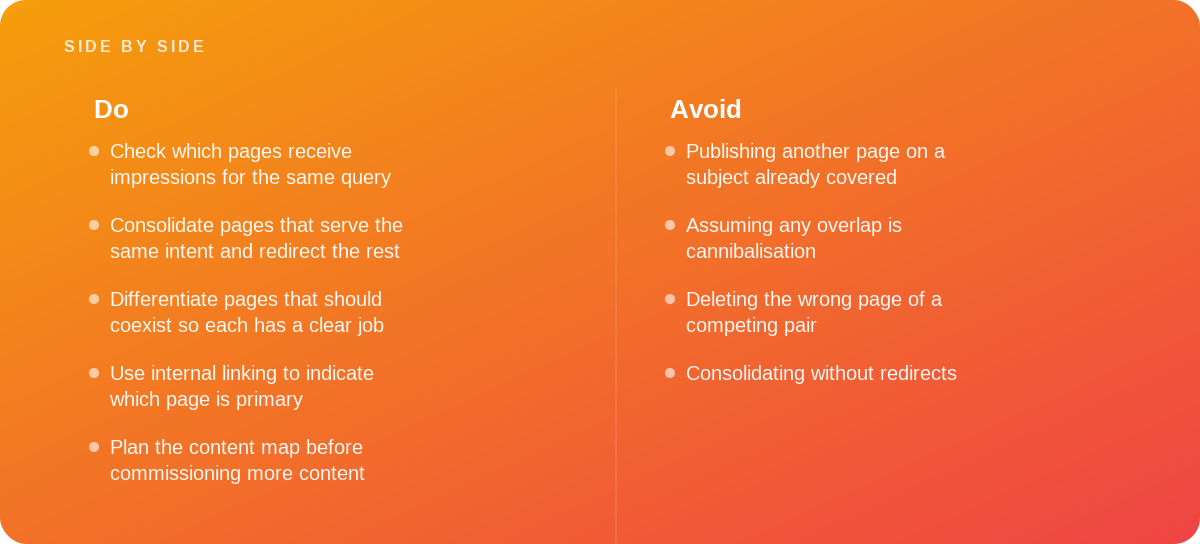
Consolidate pages that serve the same intent and redirect the rest. This is the remedy the reference guidance points to first, and it is usually right when two or more pages are trying to do exactly the same job.
How to consolidate properly
- Choose the survivor. Pick the page with the strongest combination of rankings, backlinks, clicks and a URL that fits the long-term structure. It is not always the newest or the longest page. Deleting the wrong page of a competing pair, such as the one with the external links, is a common and avoidable mistake.
- Inventory what the other pages do. Using the reversed Search Console view, list the queries each retired page ranks for and the sections that serve them. Anything useful must appear in the survivor.
- Merge the content. Rewrite the survivor to cover the full intent, bringing in unique sections, examples and data from the others. This is an edit, not a paste: the result should read as one coherent page.
- Redirect every retired URL. Use permanent (301) redirects from each retired URL to the survivor, or to the most relevant section of it. Consolidating without redirects is the mistake that turns a sensible cleanup into a traffic loss.
- Update internal links. Change internal links that pointed at the retired pages so they point straight at the survivor, rather than relying on the redirect indefinitely.
- Update sitemaps and remove retired URLs. Sitemaps should list only canonical, indexable URLs. Our guide to getting sitemap index files right covers keeping them clean on larger sites.
- Monitor. Watch the survivor's queries and impressions in Search Console for the following weeks. Expect some movement while search engines process the change.
Pros
- Removes same-intent competition completely, giving search engines one clear answer.
- Combines link signals from several URLs into one.
- Produces a single stronger page that is easier to maintain.
- Reduces the size of the content library to maintain in the future.
Cons
- The most editorial and technical effort of the four options.
- Short-term ranking movement while redirects are processed.
- Hard to reverse cleanly once redirects are in place.
- Can lose value if the merge drops content that served unique queries.
Option 2: Differentiate Pages That Should Coexist
Differentiate pages that should coexist so each has a clear job. This is the right answer when the pages are related but a searcher would use them differently, and the current problem is that they have drifted toward each other.
Typical cases include a beginner's guide and an advanced guide that both became general overviews, a service page and a blog post that both try to sell the service, or two location pages that describe the same service in near-identical terms. The fix is to sharpen each page toward its own intent.
How to differentiate
- Write one sentence for each page's job. For example: "This page helps a first-time buyer decide which type to choose" and "This page helps an existing owner maintain what they bought." If you cannot write distinct sentences, the pages probably should be consolidated instead.
- Rewrite titles, headings and introductions to match. The title tag and first heading are strong signals of what a page is for. They should not use the same phrasing.
- Remove sections that belong on the other page. Replace them with a short summary and a link. Each page should go deep on its own job, not repeat the other's.
- Give each page distinct internal links. Link to each from contexts that match its intent.
- For location pages, make the local content genuinely local. Staff, service area details, local examples and practical information differ by place. The considerations for getting franchise SEO right apply to any multi-location business.
Differentiation also benefits readers, which matters for search in its own right. Google's guidance on creating helpful content emphasizes content made primarily for people, and two pages that each clearly serve a different reader are more useful than two that blur together.
Pros
- Keeps content that serves genuinely different readers.
- Each page can rank for its own cluster of queries.
- No redirects needed, so it is easy to adjust later.
- Often improves the usefulness of both pages.
Cons
- Requires substantial rewriting of at least one page.
- Fails if the intents are not truly distinct; the pages drift back together.
- Results appear gradually as search engines reassess both pages.
- Needs editorial discipline to keep the pages apart over time.
Option 3: Deliberately Subordinate One Page
Subordination keeps both pages but makes the hierarchy explicit. It suits cases where both pages must exist for reasons outside search, or where the secondary page has real value for narrower queries, but only one should compete for the head term.
The main tool is internal linking: use internal linking to indicate which page is primary. Search engines use internal links, and their anchor text, as a strong signal of which page a site considers most important for a topic.
How to subordinate
- Point descriptive internal links at the primary page. Where the site links using the contested phrase, the link should go to the primary page. Links to the secondary page should use anchor text that describes its narrower job.
- Link from the secondary page to the primary. A clear, contextual link near the top of the secondary page, such as "for the full guide to this subject, see..." signals the relationship.
- Refocus the secondary page's title and headings. Move them toward its narrower queries and away from the head term.
- Use navigation and breadcrumbs consistently. The primary page should sit where the site structure says it is the main resource. Our practical guide to breadcrumb structured data shows how to make that hierarchy explicit.
- Consider a canonical only when the pages are near duplicates. A canonical tag tells search engines that one page is a copy of another. It is appropriate for near-identical pages, such as print versions or parameter variants, not for two different pages you want both indexed.
Subordination is also where orphaned content becomes visible. Pages with few or no internal links often turn out to be old versions of a subject covered elsewhere. Our guide to handling orphan pages explains how to find them and decide whether they should be linked, merged or retired.
Pros
- Low effort; mostly link and title changes.
- Fully reversible at any time.
- Keeps pages that have roles outside search.
- Low risk of short-term traffic loss.
Cons
- Slower and less decisive than consolidation.
- Does not fully stop competition if the pages remain similar in content.
- Depends on sitewide link discipline that can erode as new content is added.
- Link signals remain split between two URLs.
A Worked Example: One Cluster, Four Decisions
The following example is illustrative, built to show the method with realistic numbers rather than drawn from a specific site. A home improvement retailer's content library has grown over five years without a content map. Search Console data for the query "how to choose a cordless drill," segmented by page over six months, shows four URLs receiving impressions.
| Page | Share of impressions | Notes | Decision |
|---|---|---|---|
| /blog/choosing-a-cordless-drill (2021) | 41% | Most external links; outdated product references | Survivor: rewrite and expand |
| /blog/cordless-drill-buying-guide-2024 | 37% | Newer content, fewer links, same intent | Consolidate into survivor; 301 redirect |
| /category/cordless-drills | 15% | Product listing; transactional intent | Leave as is; add link to guide |
| /blog/drill-vs-impact-driver | 7% | Comparison; related but distinct intent | Differentiate: sharpen title and scope |
The two blog guides share an intent; searchers want help choosing a drill, and both pages try to give it. The ranking URL has alternated between them, and neither holds a strong position. Consolidation is right, and the question is which page survives. The newer page has fresher content, but the older one has most of the external links and a URL without a year in it, which will not date. The team keeps the older URL, moves the newer page's updated content into it, rewrites the whole piece as one guide, and redirects the 2024 URL to it.
The category page serves a different intent: people ready to buy. It appears for the query because it contains the words, but it is not really competing for the same searcher. It stays, gains a short introduction linking to the buying guide, and the guide links back to it. The comparison page is related but distinct; it is differentiated by rewriting its title and introduction around the comparison and removing a generic "how to choose" section that duplicated the guide.
After the changes, the expected pattern (again illustrative) is that the survivor gradually takes the large majority of impressions for the head query, the comparison page holds its own set of comparison queries, and the category page continues to pick up purchase-oriented searches. The team checks the same Search Console views monthly to confirm it.
Recommendations by Situation
The criteria and scorecard reduce to a small number of common situations. Each has a default answer, which the specifics of a case can override.
Two articles on the same subject, same intent
This is the classic case: two how-to guides, two buying guides or annual update posts. Consolidate, keeping the URL with the strongest links and the most durable structure, merging unique content, and redirecting the rest.
A guide and a commercial page on the same topic
Informational and transactional pages usually serve different intents. Leave both, differentiate their titles, and link between them so each does its own job. Consolidate only if the guide has turned into a sales page or the commercial page has turned into a guide.
Verdict Same intent and one clear winner: consolidate and redirect. Related but distinct intents: differentiate so each page has a job a reader could describe in one sentence. When in doubt about intent, look at what the search results reward before touching either page.
Multi-location or multi-service pages built from a template
These pages compete because they are too similar, not because they should not exist. Differentiate them with genuinely local or service-specific content. Where there is no meaningful local difference, consider consolidating into fewer, stronger pages, such as a regional page, rather than maintaining near-duplicates.
A campaign page competing with an evergreen page
Once the campaign is over, redirect the campaign page to the evergreen page. While the campaign runs, subordinate it: point internal links at the evergreen page and keep the campaign page's title focused on the offer.
A large library with widespread overlap
Do not try to fix everything at once. Prioritize queries by business value and impressions, fix the top clusters, and put a content map in place so the problem stops growing. Plan the content map before commissioning more content.
Verdict Both pages needed for reasons outside search: subordinate one through internal links and focused titles. Overlap on low-value queries or across genuinely different intents: leave it alone. Across a large library: fix the most valuable clusters first and stop new overlap with a content map, because more content will not solve a problem that too much uncoordinated content created.
Mistakes to Avoid and How to Prevent Recurrence
The mistakes in this area are consistent enough to list, and each has a straightforward prevention.
- Publishing another page on a subject already covered. The usual cause. Before any new piece is commissioned, search the site and the content map for existing coverage. If a page exists, the default should be to improve it.
- Assuming any overlap is cannibalization. Apply the intent, ranking-change and value tests before acting. Healthy overlap is normal.
- Deleting the wrong page of a competing pair. Check backlinks, queries and conversions for every page before choosing a survivor. The page that looks weaker in one metric may be stronger in another.
- Consolidating without redirects. Every retired URL needs a permanent redirect to its most relevant replacement.
- Redirect chains. When pages have been consolidated more than once, redirects can chain through several hops. Point each old URL directly at the final destination.
- Treating it as a one-off cleanup. Without a content map, the same overlap reappears within a year.
The content map as prevention
A content map is a list of every topic the site covers, the intent each page serves and the primary query it targets, with one page assigned to each intent. It does not need special software; a maintained spreadsheet works. The map should record the URL, the intent in one sentence, the primary query cluster, the owner and the date last reviewed. New content requests are checked against it, and a request that duplicates an existing entry becomes an update to that page instead.
The map also makes internal linking easier, because it tells writers which page is primary for each topic and therefore where contextual links should point.
When to Bring In Help
Many sites can handle occasional overlap themselves with the Search Console procedure above and a disciplined content map. Bring in help when the ranking URL for important terms keeps changing, when a large library has grown without a content map, or when consolidation has already cost traffic.
Each of those situations has a reason. Unstable ranking URLs on commercially important queries represent direct revenue at stake, and the diagnosis needs care. A large library without a map needs systematic analysis at scale, which is more efficient with tooling and experience. And a consolidation that has already lost traffic usually needs forensic work: checking redirects, finding content that was dropped in the merge, and deciding whether to restore anything.
Our SEO services cover cannibalization audits, consolidation planning and content mapping as part of broader technical and content work. Whoever does the work, the principles are the same: confirm the problem through intent, choose the remedy through explicit criteria, redirect everything you retire, and plan before you publish again.
Where this comes from
- Google Search Central — Consolidate duplicate URLs
- Google Search Central — Search Console performance report
- Google Search Central — Creating helpful content
The figures and practices above come from the sources listed.
Working on something like this?
We take on SEO Services work for teams who want it done once, properly. Tell us what you are building and we will tell you honestly whether we are the right studio for it. Start a project.
Where to go next
Spotted something wrong? Report an error on this page. We correct on the page and say what changed.