A Practical Guide to Search Intent
A seven-phase playbook for search intent: read the live results, classify intent, pick the right page type, fix competing pages and re-check over time.
 MediaScaleUp Editorial Team

Search intent is what a person is actually trying to do when they type a query, and therefore what kind of page can satisfy them. Someone typing "how long does a roof last" wants a figure and a little context. Someone typing "roof replacement cost Denver" is weighing a purchase. Someone typing a brand name plus "login" wants one specific page and nothing else. The words overlap far less than the goals, and the goal decides which page wins.
This matters to anyone who publishes pages hoping to be found: business owners who wonder why a carefully written service page never appears, marketers planning a content calendar, and in-house teams trying to decide whether a topic needs a guide, a comparison, a calculator or a product page. A page that misreads intent will not rank however well it is written, because it is answering a question nobody asked. Good copy, clean technical SEO and strong links cannot rescue the wrong kind of page.
What follows is a step-by-step playbook. It moves through seven phases in order, from assembling the queries that matter to re-checking them months later, and each phase has a goal, a set of actions, the outputs you should have at the end and the checks that tell you it was done properly. It includes a worked example with illustrative numbers, a realistic schedule, and guidance on when the job is better handed to specialists.
How Search Intent Works: The Four Categories and the Evidence Behind Them
Most practitioners sort intent into four categories. They are not perfect, and many queries straddle two of them, but they give a shared vocabulary and a first sorting pass that saves time in every later phase.
| Intent category | What the searcher wants | Typical query patterns | Page types that usually satisfy it |
|---|---|---|---|
| Informational | To learn, understand or get an answer | how, what, why, guide, examples, a question phrased in full | Guides, explainers, definitions, how-to articles, videos |
| Navigational | To reach a specific site, brand or page | brand names, product names, "login", "contact", "support" | Home pages, login pages, official profiles, specific brand pages |
| Commercial investigation | To compare options before a decision | best, vs, review, alternatives, top, pricing, "for small business" | Comparisons, reviews, roundups, pricing pages, category pages |
| Transactional | To act now: buy, book, sign up, download | buy, order, hire, quote, near me, a specific product plus a modifier | Product pages, service pages, booking forms, checkout flows |
The query patterns in the third column are hints, not rules. The most common error in this whole discipline is assuming intent from the words alone. "Pricing" can signal commercial investigation for software but informational intent for a general market question ("how is freelance design pricing set"). "Best" usually signals comparison, but for some queries the results are dominated by single-product reviews or even forum threads. The only reliable evidence of intent is the set of pages currently ranking, because those pages reflect what the search engine has concluded, from enormous amounts of behavioral data, that people using that query want.
Three properties that complicate the picture
Mixed intent. Some queries show several page types on the first page: a couple of guides, a product category page, a comparison, a video. That spread indicates genuine ambiguity. The engine is hedging because different people mean different things by the same words. Mixed results are not a mistake to exploit; they are information about the audience.
Intent shifts. What a query means can change over time. A product name may start as informational ("what is it") while the product is new, then turn transactional once it is widely sold, then turn navigational once people just want the official site. Seasonal events, news coverage and new technologies all move intent, sometimes quickly.
Format signals. Result features indicate the format expected. A block of videos says people want to watch. An image pack says they want to see. A "People also ask" box shows the adjacent questions searchers expect to be answered. A local map pack says they want a nearby business. A shopping carousel says they want to compare products with prices. These features are as much a part of the intent evidence as the blue links.
Google's own guidance on creating helpful, people-first content frames this well: the question is whether a visitor leaves feeling they got what they came for. Search intent analysis is simply the disciplined way of finding out what they came for before you write anything.
The Search Intent Playbook at a Glance
The playbook has seven phases. They run in order because each depends on the output of the one before: you cannot classify intent until you have read the results, and you cannot choose a page type until you have classified intent. On a small site the whole cycle might fit in a week; on a large one it becomes a standing process with a quarterly rhythm.
- Build and prioritize the query list Gather the terms that matter commercially and group them into topics, so effort goes to the queries that can move the business.
- Read the live results For each priority query, record what actually ranks: page types, formats, result features and the angle each page takes.
- Classify intent and resolve ambiguity Assign a dominant intent and, where results are mixed, a secondary one, with a note on how confident you are.
- Choose the page type and format Decide what kind of page the query deserves, matching the format the results show rather than the format you prefer.
- Map queries to pages Assign every priority query to exactly one target page and find places where your own pages compete with each other.
- Build or rewrite the page Create or restructure pages so the first screen answers the dominant intent and the rest serves secondary needs.
- Measure and re-check Watch performance by query, and re-read the results for important terms on a schedule, because intent is not fixed.
The rest of this guide takes each phase in turn. For each one you will find the goal, the actions, the outputs and the checks.
Phase 1: Build a Query List Worth Analyzing
Goal: a prioritized, grouped list of queries where getting intent right will make a measurable difference. Analyzing intent is manual work, and doing it for thousands of long-tail terms is wasteful. The first phase is about choosing where to spend attention.
Actions
- Pull the queries you already appear for. Your search console data is the most honest starting point because it reflects real impressions for your real site. Export queries with impressions, clicks, average position and the page that ranks. If the export is noisy, filter it; our guide to getting regex filters in Search Console right shows how to isolate question queries, brand terms or product modifiers so you can look at one pattern at a time.
- Add the queries you want to appear for. Services you sell, problems you solve, products you stock. Include the terms customers use in sales calls and support emails, which are often more plain-spoken than the terms marketers pick.
- Group by topic, not by exact string. "Logo design cost", "how much does a logo cost" and "logo pricing" probably belong together, but only Phase 2 will confirm whether they share intent. For now, group them tentatively.
- Prioritize. Score each group on business value (does ranking lead to revenue or leads), current visibility (are you close enough to move), and doubt (is there a reason to suspect you have the intent wrong). A query with high impressions, a position between roughly 8 and 30, and a low click-through rate is a strong candidate: the engine sees some relevance but the page is probably not what people want.
Outputs
A spreadsheet with one row per query group, the member queries, the current ranking page (if any), impressions, clicks, average position and a priority score. For a small business site, 30 to 80 groups is a manageable first pass. For a large publisher or store, start with the top few hundred by value and expand later.
- Queries exported with impressions, clicks, position and ranking page
- Target queries added from services, products and customer language
- Queries grouped into tentative topics
- Each group scored for value, visibility and doubt
- A cut-off agreed so the analysis covers the groups that matter first
- Brand and navigational terms separated so they do not distort the priority list
Checks: Could you explain to a colleague why each top-20 group is on the list? If a group is there only because it has a large volume number, and you have no page that could credibly serve it, drop it down. If the list is dominated by your own brand name, separate those queries; they are navigational and are usually already served by your home page.
Phase 2: Read the Live Results Before You Decide Anything
Goal: an accurate record of what currently ranks for each priority query, because the results page is the evidence. This is the phase most teams skip, and skipping it is how a sales page ends up targeting a query where every ranking result is a tutorial.
How to read a results page properly
Search from a clean browser profile or a private window, with the location set to the market you serve. Personalization and location both change results, and a local business in Chicago gains nothing from studying results served to someone in London. Then record, for the top ten organic results and the features above and between them:
- Page type. Guide, listicle, comparison, product page, category page, service page, tool, forum thread, video, news article, official documentation.
- Format and depth. Short answer, long guide, table-heavy, step-by-step, visual gallery, calculator. Note roughly how long the ranking pages are, but treat length as an effect of the format, not a target.
- Angle. Beginner or expert; cheap or premium; for a particular audience (small business, enterprise, homeowners); current year framing; local framing.
- Result features. Featured snippet, People also ask, video carousel, image pack, local pack, shopping results, knowledge panel, AI-generated overviews. Each tells you something about the format expected.
- Who ranks. Retailers, publishers, brands, directories, forums. If every result is a major retailer's category page, a single-product page from a small shop faces a format mismatch before it faces a competition problem.
Shortcut: Read the People also ask questions and the related searches at the bottom of the page before anything else. In under a minute they tell you what adjacent questions the audience has, which becomes the outline for the secondary sections of your page. Expand two or three of the questions; new ones load and reveal the next layer of concern.
AI-generated summaries now sit above the organic results for many informational queries. Their presence is itself an intent signal: it usually means the engine thinks a short synthesized answer satisfies much of the demand, which changes what a click-worthy page must offer. Our practical guide to AI features in search covers how to plan content when those summaries appear.
Outputs
A results log per query: one row per ranking result with its type, format, angle and domain category, plus a list of result features. Screenshots are worth saving, dated, because Phase 7 compares against them. Twenty to forty minutes per query group is realistic for a careful first read; it gets faster as patterns repeat.
Checks: Did you record what ranks, rather than what you think should rank? Did you check at least two of the member queries in each group to confirm they return similar results? If two queries you grouped together return clearly different page types, they do not share intent, and they need to be split into separate groups.
Phase 3: Classify Search Intent and Handle Mixed Results
Goal: a dominant intent, an optional secondary intent and a confidence level for every query group, written down so later decisions can be traced back to evidence.
A simple counting method
For each query, count how many of the top ten organic results fall into each page type, then map page types to intent. If seven of ten are how-to guides, the dominant intent is informational and your confidence is high. If four are comparison articles, three are product category pages and three are brand home pages, the query is mixed, and your confidence in any single reading is moderate at best.
A practical rule of thumb for recording confidence:
- High: seven or more of the top ten share a page type, and the result features agree with it.
- Moderate: one page type holds a plurality of four to six, with a clear second type.
- Low: no type holds more than three, or the results changed noticeably between two checks a few days apart.
These thresholds are working conventions, not published standards. Adjust them to your market, but apply them consistently so that "moderate" means the same thing across the whole spreadsheet.
Serving mixed intent without splitting the difference
The good-practice answer for mixed-intent queries is to build a page that addresses the dominant reading while acknowledging the secondary one. The mistake is to build a page that tries to be all readings equally: half guide, half sales page, half comparison. That page satisfies nobody, because each type of visitor must wade through material meant for someone else.
In practice this means the first screen of the page is written for the dominant intent, and secondary needs are handled lower down or through clear links. A mixed query that leans commercial might open with a comparison of options and a clear summary of who each suits, then include a short "how it works" section for the minority who arrived to learn. A query that leans informational might teach first and offer a concise, clearly separated section for readers who are ready to act.
- Dominant intent
- The reading of a query that the largest share of ranking pages serve; your page's first screen should answer it.
- Secondary intent
- A meaningful minority reading visible in the results; serve it lower on the page or via a link.
- Format signal
- A result feature (video carousel, image pack, local pack, snippet) that shows the format searchers expect.
- Intent shift
- A change over time in what ranks for a query, indicating that what people want from it has changed.
- Keyword cannibalization
- Two or more of your own pages competing for the same query, often because they serve different intents under similar wording.
Outputs and checks
Each group gains three columns: dominant intent, secondary intent (if any) and confidence. Check: for every group marked high confidence, could a colleague reach the same classification from your results log without talking to you? If not, the log is too thin or the classification is based on assumption rather than evidence.
Phase 4: Choose the Page Type and Format the Query Deserves
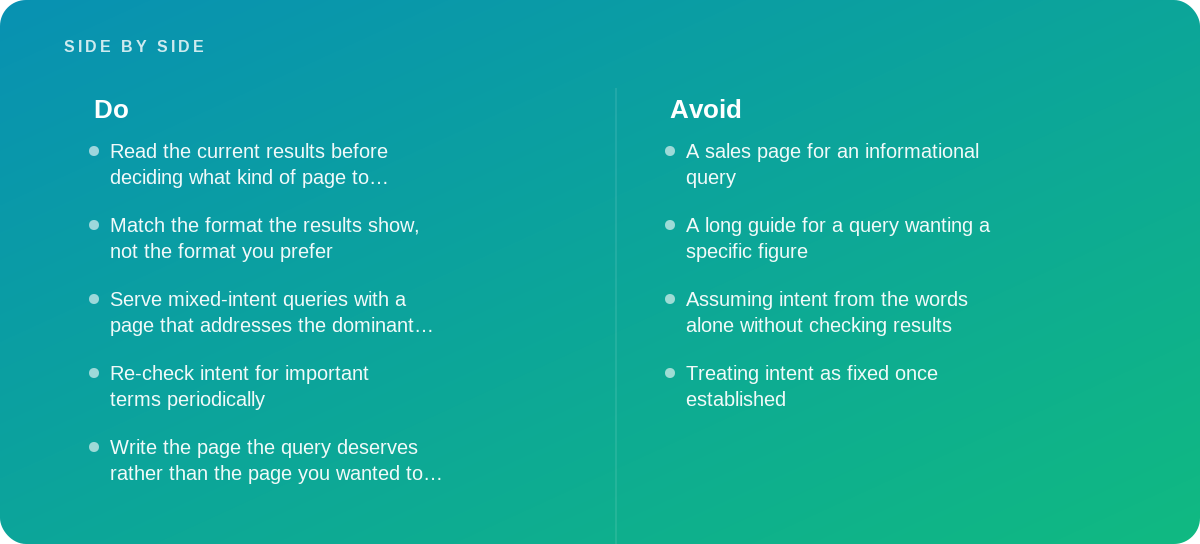
Goal: a specific page brief for each query group: the page type, the format, the depth, and the angle. The principle is to match the format the results show, not the format you prefer, and to write the page the query deserves rather than the page you wanted to publish.
Translate intent into a page decision
| What the results show | What to build | What to avoid |
|---|---|---|
| Mostly guides and tutorials; People also ask present | A thorough guide organized around the questions searchers ask, with direct answers early in each section | A service page with a short blog-style intro bolted on |
| Featured snippet showing a single figure or definition | A page that states the answer in the first sentence or two, then gives context and caveats | A 4,000-word essay that buries the number in paragraph nine |
| Comparisons, "best of" lists and reviews | An honest comparison with explicit criteria, a table and clear "who it suits" guidance | A page that only describes your own offer |
| Service or product pages from direct providers | A focused service or product page with pricing approach, process, proof and a clear way to act | An educational article hoping to convert on the way out |
| Video carousel at the top | A video, ideally with a supporting page that embeds and summarizes it | A text-only page on a topic people clearly want to watch |
| Local pack and "near me" style results | A location-specific page and an accurate business profile | A national page that never mentions where you operate |
Two mistakes appear again and again. The first is a sales page for an informational query: a business wants to rank its service page for "how to fix a leaking faucet" and cannot understand why tutorials outrank it. The searcher wanted to fix the faucet; a plumber's service page is the fallback for people who fail, and they search differently when they get there. The second is a long guide for a query that wants a specific figure: if people want the standard dimensions of a business card, they want the dimensions, and a 3,000-word history of printing will lose to a page that states them in the first line.
A useful discipline before drafting, write a single sentence that begins "The person searching this wants to…" and finish it using only what the results show. If you cannot finish it without the words "learn about our", you are describing the page you want to publish, not the one the query deserves.
Format decisions extend beyond web pages. Some queries are best served on another platform entirely, or with an asset type the site does not usually produce. Visual and how-to queries often favor video, which is covered in our guide to YouTube search optimization done properly. Queries that surface downloadable documents such as spec sheets or forms may be best served by a well-built PDF, and getting PDF files in search right explains how to make those documents rank and convert.
Outputs and checks
A page brief per group listing page type, format, target depth range, angle, the questions to answer (from People also ask and related searches), and the result features to aim for. Check: put the brief next to the results log and ask whether a page built to this brief would look at home among the current top five. If it would look out of place, the brief is wrong, however good the idea behind it.
Phase 5: Map Queries to Pages and Stop Your Pages Competing
Goal: one clear target page per query group, with commercial and informational pages each doing their own job instead of competing with each other.
Actions
- Assign each group a single target URL. Either an existing page or a page to be created. Two pages targeting the same dominant intent split signals and confuse the engine about which to show.
- Find overlaps in performance data. Look for queries where two or more of your URLs receive impressions and swap positions over time. That pattern is the clearest sign of cannibalization. The guide to search performance report analysis walks through filtering by query and comparing pages side by side.
- Decide what each competing page is for. Very often a blog post and a service page compete because the blog post drifted into selling, or the service page drifted into teaching. The fix is to sharpen each: the guide teaches and links to the service page for readers ready to act; the service page sells and links to the guide for readers who need background.
- Merge, redirect or re-target where needed. If two pages serve the same intent and neither is clearly stronger, combine them into one better page and redirect the other. If they serve different intents, re-target the wording, headings and internal links so each clearly owns its query.
Internal links carry intent as well as authority. Anchor text such as "compare our packages" tells both readers and search engines that the destination is commercial; "how the process works" signals an explanatory page. Consistent anchors reinforce the mapping. The Search Console links report guide shows how to audit which internal anchors point where, so the signals you send match the map you drew.
- Every priority query group has exactly one target URL
- Pages sharing impressions for the same query identified and reviewed
- Each competing pair given a clear job, or merged with a redirect
- Internal links between informational and commercial pages added in both directions
- Anchor text reflects the intent of the destination page
- New pages needed are listed with their briefs from Phase 4
Checks: sort the map by target URL. Any URL that appears against two different dominant intents is doing two jobs and will probably do both badly. Any group without a URL is a content gap to schedule.
Phase 6: Build or Rewrite Pages Around the Dominant Intent
Goal: pages whose structure, opening and depth match the intent the query shows. This is where analysis turns into visible change, and where the temptation to drift back toward "the page we wanted" is strongest.
Structure the first screen for the dominant intent
Usability research has long found that people scan pages rather than reading them word by word, deciding within moments whether a page is worth their time; the Nielsen Norman Group publishes a large body of work on how people search and scan. The practical consequence is that the opening of the page must confirm, fast, that the visitor is in the right place.
- Informational: state the direct answer or the core idea in the first paragraph, then expand. Use descriptive headings that mirror the questions people ask, so scanners can jump to theirs.
- Commercial investigation: show the options and the criteria early. A comparison table near the top, a short summary of who each option suits, and honest trade-offs.
- Transactional: make the action obvious. What it is, what it costs or how pricing is set, what happens next, and a clear way to start. Supporting detail follows.
- Navigational: make sure the page people are looking for exists, is indexable, and is titled in the words they use. For brand terms this is mainly hygiene.
Rewriting an existing page for a different intent
When Phase 4 shows that an existing page is the wrong type, resist cosmetic fixes. Adding a few FAQ blocks to a sales page does not turn it into a guide. Decide whether the page should change type (and keep its URL and links) or whether a new page of the right type should be created and the old one kept for the intent it actually serves. Keeping the URL is usually better when the page already ranks for the target query, even poorly, and the new type is a closer match; creating a new page is better when the existing one ranks well for other, legitimately commercial queries you do not want to lose.
Titles and meta descriptions deserve particular attention, because they are the first thing searchers see and they should signal the format. "Business Card Size: Standard Dimensions in Inches and mm" promises an answer; "Custom Business Cards, Printed Fast" promises a product. Both are fine titles, for different queries.
Outputs and checks
Published or revised pages, each with a note of the intent it targets and the date of change, so Phase 7 can measure before and after. Check: show the new page's first screen to someone who has not seen the brief, tell them the query, and ask whether they would stay. If they have to scroll to find out whether the page answers the question, the structure still favors what you wanted to say over what the searcher wanted to know.
Phase 7: Measure Results and Re-check Intent Over Time
Goal: evidence that the changes worked, and an early warning when intent moves. Treating intent as fixed once established is one of the mistakes this playbook exists to prevent.
What to measure
- Query-level position and click-through rate for each group, compared across equal periods before and after the change. Allow several weeks; rankings for revised pages often fluctuate before settling.
- Which URL ranks. If the target page has taken over from a competing page, the mapping worked, even before positions improve.
- Engagement on the page, such as whether visitors reach the key section or take the intended action. Engagement that improves while rankings hold steady still suggests a better intent match.
- Conversions by landing page for commercial and transactional pages, because a better intent match should bring visitors who are further along.
Re-checking intent on a schedule
Re-read the results for important terms periodically. A practical cadence is quarterly for your top commercial queries, twice a year for the rest of the priority list, and immediately whenever a page that used to perform well drops sharply without a technical explanation. Compare the new results against the dated screenshots and logs from Phase 2. Signs that intent has shifted include a different dominant page type, a new result feature (a video carousel, a shopping block, an AI-generated summary), or a new group of sites ranking, such as forums replacing publishers.
When results change character, go back to Phase 3 for that group and work forward again. Competitor movement can look like intent change, and the difference matters: if competitors simply published better pages of the same type, your job is to improve the page; if the type itself changed, your job is to change the page type. Our guide to monitoring competitors in search covers how to tell those situations apart.
A short set of habits keeps this phase honest:
- Before-and-after comparison set up for every changed page, using equal date ranges
- Ranking URL tracked for each priority group
- Conversions attributed by landing page for commercial pages
- Re-check dates scheduled for top queries
- Dated results screenshots stored for comparison
- A trigger agreed for unscheduled re-checks after sudden drops
Worked Example: Reworking a Design Studio's Pricing Page (Illustrative)
The following example is illustrative. It is a composite built to show how the phases fit together, not a report of a specific client, and the numbers are realistic but invented for demonstration.
A small branding studio has a page titled "Logo Design Packages" that sells three fixed-price packages. In search console, the page receives about 6,000 impressions a month for queries including "how much does a logo cost", "logo design cost" and "logo design pricing", at an average position of 14 and a click-through rate of 0.6 percent, which is roughly 36 clicks. The team assumes the page needs more words and more links.
Phase 1 and 2. The team groups the three queries and reads the results for each in a private window, set to their home market. For "how much does a logo cost", eight of the top ten results are explanatory articles that break down price ranges by type of provider, with a People also ask box asking why logos are expensive and whether a cheap logo is worth it. For "logo design packages", the results are mostly studio and platform pricing pages.
Phase 3. The groups split. "How much does a logo cost" and "logo design cost" are informational with high confidence: people want to understand the range before choosing. "Logo design packages" and "logo design pricing" lean transactional and commercial, with moderate confidence.
Phase 4 and 5. The team decides the packages page should keep targeting "logo design packages" and "pricing", and a new guide should target the cost questions. The guide explains what drives the price (scope, research, number of concepts, revision rounds, deliverable formats, usage rights), gives ranges by provider type without presenting any figure as a fixed market fact, and links to the packages page for readers ready to buy. The packages page is trimmed of its long explanatory intro and links to the guide for readers who want background.
Phase 6 and 7. Both pages go live. Twelve weeks later, the comparison over equal periods might look like this:
| Metric (monthly) | Before | After (illustrative) |
|---|---|---|
| Impressions, cost queries | 6,000 (packages page) | 7,500 (new guide) |
| Average position, cost queries | 14 | 6 |
| Click-through rate, cost queries | 0.6% | 3.5% |
| Clicks, cost queries | 36 | about 260 |
| Clicks to packages page from the guide | 0 | about 30 |
| Packages page position for "logo design packages" | 11 | 7 |
The arithmetic is straightforward: 7,500 impressions at 3.5 percent is about 262 clicks. The point is not the specific numbers, which will vary widely by market and competition, but the mechanism. The same effort spent adding words to the packages page would most likely have left it at position 14, because it was a sales page answering an informational question. Splitting the intents let each page do one job, and the packages page improved as well because it no longer carried mismatched signals.
A Realistic Schedule for a Search Intent Review
How long this takes depends on the number of query groups, how many pages need to change, and who writes the content. The schedule below suits a small or mid-sized business site with around 40 priority groups and a team that can dedicate part of each week to the work.
- Week 1 Export performance data, add target queries, group into topics and score priorities (Phase 1).
- Weeks 2 to 3 Read live results for the top groups, build the results log and save dated screenshots (Phase 2).
- Week 3 Classify intent and confidence for each group; split groups whose results disagree (Phase 3).
- Week 4 Write page briefs and draw the query-to-page map; list merges, redirects and new pages (Phases 4 and 5).
- Weeks 5 to 8 Rewrite or create pages in priority order, typically a few per week depending on writing capacity (Phase 6).
- Weeks 9 to 16 Monitor positions, ranking URLs and conversions; hold changes steady long enough to judge them (Phase 7).
- Every quarter after Re-read results for top commercial terms and re-enter the playbook at Phase 3 wherever the results have changed character.
Two practical notes. First, do not change every page at once; if twenty pages change in the same week, you cannot tell which changes helped. Stagger them in batches, highest priority first. Second, build the review into the calendar before the first cycle ends. The value of intent work compounds when it becomes routine, and decays quickly when it is a one-off project that nobody revisits.
Shortcut: Keep the Phase 2 results log in the same spreadsheet as the query map, with one tab per review date. When you re-check a query in a later quarter, the side-by-side comparison of page types makes an intent shift obvious in seconds instead of relying on memory.
Special cases: brand queries, new sites and other search surfaces
Brand and reputation queries. Queries containing your brand name are mostly navigational, but not entirely. "Brand name reviews", "brand name complaints" and "is brand name legit" are commercial investigation queries about you, and the results will show review sites, forums and news. You cannot satisfy that intent with your home page alone. A clear, honest page addressing common questions, plus attention to what third-party sources say, is the usual approach; managing reputation in search results goes into the options in detail.
New domains. A new site has no performance data, so Phase 1 relies entirely on target queries. The other phases apply unchanged, and they matter more, because a new domain lacks the authority to rank a mismatched page on strength alone. Starting with pages whose type matches the results is one of the few advantages a new site can control from day one.
Intent on other search surfaces. The same thinking applies wherever people search. A query on a video platform, a visual discovery platform or a podcast directory carries intent too, and the formats that satisfy it differ from web search. The underlying method, read what ranks and build what the query deserves, carries over directly.
When to Bring in Specialist Help
Most teams can run this playbook themselves for a modest query list. There are three situations where outside help usually pays for itself.
- Well-written pages will not rank. If content quality, technical health and links all look sound but pages stay stuck, a misread intent is one of the first things to rule out, and an experienced outside reader often spots the mismatch faster than the team that wrote the page.
- A term's results have changed character. When the page types ranking for an important query change, deciding whether to rebuild, re-target or wait is a judgment call with real cost either way.
- Commercial and informational pages are competing. Untangling cannibalization across dozens of pages involves redirects, merges and internal link changes that are easy to get wrong and slow to recover from.
Our search intent analysis service runs the phases above on your priority terms and delivers the results log, the intent classification, the page map and the briefs, so your team can act on them. For broader work across technical, on-page and content SEO, see the full range of SEO services.
Verdict Search intent is not a theory to agree with; it is a check to run before every important page is written or rewritten. Read the results, match the format they show, give each query one page that serves its dominant reading, and look again on a schedule. Most ranking problems that survive good writing and sound technical work turn out to be intent problems.
Where this comes from
- Google Search Central — How Search works
- Google Search Central — Creating helpful content
- Nielsen Norman Group — Search behavior research
The figures and practices above come from the sources listed.
Working on something like this?
We take on SEO Services work for teams who want it done once, properly. Tell us what you are building and we will tell you honestly whether we are the right studio for it. Start a project.
Where to go next
Spotted something wrong? Report an error on this page. We correct on the page and say what changed.