Animated SVG: The Decisions That Matter
A phase-by-phase playbook for animated SVG: choosing the format, cleaning files, picking CSS, WAAPI or SMIL, reduced motion and testing on real phones.
 MediaScaleUp Editorial Team

An animated SVG is a vector graphic, such as an icon, an illustration, a chart or a logo, whose parts move through CSS animations, the Web Animations API or SVG's own animation elements. Because the image is described as shapes and paths rather than a grid of pixels, it stays sharp at every size, from a 16-pixel status icon to a hero illustration on a 4K monitor, and it is often far smaller than the video or GIF that would otherwise do the same job. That combination makes animated SVG the natural choice for interface motion: loading indicators, success checkmarks, toggles, animated icons, lightweight illustrations and brand marks that need to move on a web page without dragging it down.
It matters to several groups at once. Marketers and product owners want the polish that motion brings without paying for it in page speed. Designers want their work to survive the trip from Figma or Illustrator into a browser without turning muddy or bloated. Front-end developers want animation that is maintainable, respects user settings and does not drop frames on the phones most customers actually carry. The decisions that make or break an animated SVG sit at the seams between those groups, which is why so many projects go wrong: the designer exports a file full of editor metadata, the developer animates the wrong properties, and nobody tests on anything slower than a new laptop.
This playbook walks through the work as a sequence of phases, in the order you should do them. Each phase has a goal, the actions that achieve it, the outputs you should have at the end and the checks that tell you it is safe to move on. Follow it in order the first time; once your team has the habits, you can run several phases in parallel.
The Animated SVG Playbook at a Glance
Before getting into detail, here is the whole procedure. Most failed animated SVG projects skip one of these phases entirely, usually the cleanup in phase two or the device testing in phase six, and pay for it later in rework.
- Confirm the format. Decide whether animated SVG is actually the right delivery format for this piece of motion, as opposed to video, an animated GIF, animated WebP, a Lottie file or plain CSS on HTML elements.
- Prepare the artwork. Design with animation in mind, then clean, simplify and structure the SVG so that every moving part is a named, addressable group.
- Choose the animation method. Pick CSS animations, the Web Animations API or SMIL elements based on how the graphic will be embedded, whether it needs to respond to users and who will maintain it.
- Build the motion. Animate transform and opacity wherever possible, set transform origins correctly, and keep timing and easing consistent with your motion system.
- Make it accessible. Give meaningful graphics an accessible name, hide decorative ones from assistive technology, and pause or simplify motion when a user has requested reduced motion.
- Test performance. Profile on a mid-range phone, not just a developer laptop, and fix anything that repaints complex paths or filters on every frame.
- Ship and maintain. Embed the file the right way for its job, document the conventions, and keep a source-of-truth library so the next animation starts from a clean base.
The rest of this article takes each phase in turn. The phases are deliberately small; a single animated icon might move through all seven in a day, while a set of forty brand icons might take a few weeks. The schedule later in the article shows what that looks like in practice.
Phase 1: Decide Whether Animated SVG Is the Right Format
Goal: commit to animated SVG only when it genuinely beats the alternatives for this particular piece of motion.
Animated SVG is excellent at a specific kind of motion: flat or lightly shaded vector artwork with a limited number of moving parts, where crispness at any size and small file weight matter. It is poor at photographic content, complex textures, heavy particle effects and anything that relies on per-pixel effects like film grain or realistic motion blur. If the motion you have in mind looks like a short film, it probably belongs in a video file. If it looks like an interface element or a diagram, it probably belongs in SVG.
How animated SVG compares with the alternatives
The table below summarizes the trade-offs teams weigh most often. None of these formats is universally better; each wins in a different situation.
| Format | Best for | Scaling | Interactivity | Main weakness |
|---|---|---|---|---|
| Animated SVG | Icons, logos, UI feedback, diagrams, flat illustration | Sharp at any size | Full, when inlined and scripted | Complex paths and filters are expensive to render every frame |
| Animated GIF | Email, chat, platforms that strip code | Pixelated when enlarged | None | 256-color limit, large files, no alpha blending |
| Animated WebP or APNG | Raster animation that needs real transparency | Pixelated when enlarged | None | Raster weight grows with dimensions and duration |
| Video (MP4, WebM) | Footage, rich textures, long or complex scenes | Resolution-bound | Playback controls only | Heavier, and transparency support is uneven |
| Lottie (JSON played by a runtime) | After Effects work with many layers | Sharp at any size | Through the player's API | Requires a JavaScript player library on the page |
Two of those rows deserve a closer look. If the destination cannot run code, such as an email client or a messaging app, you are choosing between raster formats; our guides on getting animated GIFs right and animated WebP and APNG cover those decisions. And if the motion was designed in After Effects with dozens of layers, the question becomes whether it can be simplified into hand-authored SVG or whether exporting to a player-based format is more honest about its complexity.
Questions that settle the decision
- Where will it live? A web page or web app can run SVG animation. An email, an ad platform with strict file rules or a social feed usually cannot.
- How many moving parts does it have? A handful of groups moving and fading is cheap. Hundreds of independently animated paths, or paths whose shapes change every frame, is not.
- Does it need to respond to the user? Hover states, progress that tracks real data and animations that start when something scrolls into view all push you toward inline SVG controlled by CSS or script.
- Will it be shown at many sizes? The more sizes and pixel densities, the stronger the case for vectors.
- Does it carry essential information? If a user would miss something important with the animation turned off, the design needs a static equivalent regardless of format.
- The destination can render SVG and, if needed, run CSS or JavaScript.
- The artwork is vector-based, with no photographic or heavily textured elements.
- The number of moving parts is known and modest.
- The team has agreed whether the animation is decorative or informative.
- Any alternative format has been considered and rejected for a stated reason.
Output: a one-paragraph decision note stating the chosen format, where it will be used and why the alternatives lost. Check: a developer and a designer have both read the note and agree with it.
Phase 2: Prepare and Clean the SVG Before Anything Moves
Goal: produce a lean, well-structured SVG in which every part that will move is a separate, clearly named element.
This is the phase most teams skip, and it is the one that determines how painful everything afterward will be. SVG exported straight from a design tool tends to carry editor metadata, redundant groups, auto-generated IDs, transforms baked in at odd places, hidden layers, unused definitions and coordinates written to six or more decimal places. None of that is visible, but all of it adds weight, and the messy structure makes it hard to target the right element with an animation.
Design with animation in mind
Cleanup starts in the design file, not after export. Ask the illustrator or designer to organize layers the way they will move. If a character's arm will swing, the arm should be its own group, with the shoulder at a sensible point so it can rotate around it. If a logo's letters will appear one by one, each letter needs to be a separate shape rather than a single merged outline. If a line will draw itself on, it should be a stroked path rather than an outlined filled shape, because stroke-based drawing effects only work on strokes.
Keep the number of distinct paths as low as the design allows. A flat icon built from four or five shapes is trivial for a browser to redraw; the same icon traced from a raster sketch might contain hundreds of tiny path segments that each have to be recalculated when anything around them changes.
Clean the exported file
Once exported, run the file through an optimizer. SVGO, the widely used open-source optimizer, and SVGOMG, its browser-based front end, remove editor namespaces, comments, empty groups and unused definitions, shorten numbers and collapse redundant structure. The important caveat is that aggressive defaults can break animation: an optimizer that merges paths, strips IDs or collapses groups will happily destroy the very hooks you need to animate. Configure it to preserve IDs and groups you have named deliberately, or run the optimization before you add animation hooks and then add the hooks by hand.
After optimizing, open the file in a text editor and read it. A well-prepared animated SVG should be legible: a viewBox on the root element, a title for meaningful graphics, a small number of groups with descriptive IDs or classes such as wheel-front or check-mark, and path data that is compact rather than sprawling. If you cannot tell which group is which by reading the markup, neither can the next developer.
Shortcut: keep two files for every animated graphic.
- A source file in your design tool with named layers, which is where visual changes happen.
- A hand-tidied production SVG with animation hooks, which is where motion changes happen.
- When the artwork changes, re-export and diff the path data into the production file rather than starting the animation over.
Structure checks worth automating
Several structural problems cause most animation bugs, and all of them can be caught by reading the file or by a simple lint step:
- Missing or wrong viewBox. Without a viewBox, the graphic will not scale predictably, which defeats the main reason for choosing SVG.
- Transforms baked into parent groups. Some tools wrap shapes in groups with translate or matrix transforms. If you then animate a transform on that group, your animation replaces the existing one and the shape jumps. Either flatten those transforms into the path data or animate a new inner or outer wrapper group.
- Duplicate IDs. If the same SVG is inlined twice on a page, or two different SVGs both contain an ID such as path-1, references to gradients, masks and clip paths can resolve to the wrong element. Use unique, prefixed IDs.
- Unneeded filters. Drop shadows and blurs exported as SVG filters are expensive to render, and more expensive still when anything under them moves. Remove them unless they are essential.
Output: an optimized production SVG with named animation targets, a viewBox, and no editor metadata. Check: the file renders identically to the design file at three sizes, and every element the animation plan mentions can be found by ID or class.
Phase 3: Choose the Animation Method That Fits the Job
Goal: pick the technique that matches how the graphic will be embedded, how interactive it must be and who will maintain it.
There are three native ways to animate SVG: CSS animations and transitions, the Web Animations API driven from JavaScript, and SVG's own declarative animation elements, often called SMIL, such as animate, animateTransform and animateMotion. All three work in current major browsers. They are not interchangeable, and the choice has real consequences for maintainability and control.
CSS animations and transitions
CSS is the default for most interface motion. Keyframes and transitions are familiar to most front-end developers, they sit alongside the rest of the site's styles, and they can respond to states such as hover, focus and a class toggled by the application. CSS can also respect user preferences directly through the prefers-reduced-motion media query. The main limitation is choreography: sequencing many elements with precise offsets relies on animation delays, which become brittle once there are more than a few steps, and CSS alone cannot easily pause, reverse or scrub an animation in response to arbitrary events.
The Web Animations API
The Web Animations API exposes the same animation engine to JavaScript. You call animate on an element with a set of keyframes and timing options, and you get back an Animation object that you can play, pause, reverse, seek, speed up or await until it finishes. The MDN Web Docs reference for the Web Animations API documents these controls in detail. This is the right tool when the animation needs to be driven by application logic: a progress ring that reflects a real upload, a sequence that must wait for data to load, or an illustration that scrubs with scroll position. It is also a cleaner way to orchestrate multi-step sequences than stacking CSS delays, because each step can start when the previous one's finished promise resolves.
SMIL animation elements
SMIL elements live inside the SVG markup itself. Their great advantage is self-containment: an SVG file with SMIL animation will animate even when it is loaded as an ordinary image, where scripts are not allowed to run. SMIL can also animate things CSS handles awkwardly, such as moving an element along a path or interpolating between two path shapes that share the same structure. The disadvantages are ergonomics and tooling: the syntax is verbose, fewer developers know it, and reacting to page state or user settings from inside the file is limited.
| Decision factor | CSS | Web Animations API | SMIL elements |
|---|---|---|---|
| Works when loaded as an image file | Yes, if the styles are inside the SVG | No, scripts do not run in image context | Yes |
| Responds to hover, focus and app state | Yes, when inlined | Yes, fully | Limited |
| Pause, reverse, seek from code | Awkward | Built in | Possible but clumsy |
| Move along a path, morph shapes | Partial and uneven across browsers | Partial | Strong |
| Respects reduced motion | Directly, with a media query | Via a matchMedia check in script | Needs extra work |
| Familiar to most web developers | Very | Moderately | Less so |
A practical rule: use CSS for state-driven interface motion, the Web Animations API for anything that must be controlled by logic or sequenced precisely, and SMIL when the file must animate on its own as an image and the motion needs path-based movement. Mixing methods in one graphic is possible, but choose one as the primary system so the next person can find where motion is defined.
Output: a short technical note naming the method, the embedding approach and where the animation code will live. Check: the chosen method actually works in the chosen embedding context; test a minimal version before building the full animation.
Phase 4: Build the Motion With Transform and Opacity
Goal: create motion that looks right and is cheap for the browser to render.
Every frame a browser draws goes through some combination of calculating styles, laying out elements, painting pixels and compositing layers. At 60 frames per second, the browser has roughly 16.7 milliseconds for each frame, and on a phone much of that budget is already spoken for. Properties that force layout or repaint on every frame eat into that budget quickly. The guidance in web.dev's article on high-performance CSS animations is to stick to transform and opacity wherever possible, because browsers can often handle changes to those properties without repainting the content itself.
What to animate, and what to avoid
In SVG terms, that means moving, rotating and scaling groups with transforms, and fading them with opacity. Motion that looks complex can usually be decomposed into those operations. A bouncing ball is a translate plus a squash-and-stretch scale. A spinning gear is a rotate. A card flipping in is a scale and a fade. An icon that pops on success is a scale overshoot followed by a settle.
The expensive cases are the ones the reference material warns against: animating complex path shapes every frame, animating filters such as blur or drop shadow, animating large gradients or masks, and animating attributes that change geometry, such as a radius or the d attribute of a detailed path. These are not forbidden, but each one should be a deliberate choice with a performance test attached, not a default.
Get transform origins right
The most common visual bug in animated SVG is a shape that rotates or scales around the wrong point. By default, transforms on SVG elements are calculated relative to the SVG's own coordinate system, which usually means the top-left corner of the viewBox, rather than the center of the shape you are animating. Setting transform-box to fill-box makes transform-origin relative to the element's own bounding box, so a transform-origin of center then does what designers expect. Alternatively, position the group so that its pivot sits at a known coordinate and set the origin explicitly in viewBox units. Decide on one convention for your project and document it.
Line drawing without redrawing paths
The popular draw-on effect, where a line appears to trace itself, uses stroke-dasharray and stroke-dashoffset. You set the dash length to the length of the path, offset it by the same amount so the stroke is hidden, then animate the offset to zero. Setting the pathLength attribute to 1 on the path normalizes its length so that the dash values can be written as simple fractions rather than measured in script. This technique repaints the stroke, so it is more expensive than a pure transform, but on a single clean path it is usually well within budget.
Timing, easing and restraint
Interface animations are short. Feedback motion such as a checkmark or a toggle typically lands somewhere around 150 to 400 milliseconds; larger illustrative entrances can run longer, but anything that makes a user wait to act should be as short as it can be while still reading clearly. Use easing curves consistently: ease-out for things entering, ease-in for things leaving, and a gentle ease-in-out for things moving from one place to another. If your organization has motion tokens for durations and easing, use them here rather than inventing new values per graphic.
Loops need special scrutiny. A loading spinner should loop while loading and stop when loading ends. A decorative illustration that loops forever becomes a distraction, costs battery, and may fail accessibility requirements for moving content. Where a loop is justified, keep it subtle, and give it an end condition or a way to pause.
For character and logo work where secondary motion matters, the same principles apply as in any other medium; our guide to animated logos and stings goes deeper on timing a brand reveal, and the piece on motion blur in animation explains why simulated blur is usually better faked with shape stretching than with a live SVG blur filter.
Output: a working animation in the production SVG, with durations and easing drawn from your motion system. Check: every animated property is either transform or opacity, or appears on a short list of justified exceptions.
Phase 5: Build Accessibility and Reduced Motion Into the Graphic
Goal: ensure the animated SVG works for people using screen readers, people sensitive to motion and people who never see the animation at all.
Name meaningful graphics, hide decorative ones
Decide whether each graphic conveys information or is purely decorative. For a meaningful inline SVG, include a title element as the first child, give the root a role of img, and connect the two with aria-labelledby so assistive technologies announce a sensible name, such as Upload complete. When an SVG is loaded through an image element, the alt attribute does this job. For a decorative graphic, set aria-hidden to true on inline SVG, or use an empty alt on an image, so screen readers skip it rather than announcing a meaningless group of shapes.
Respect prefers-reduced-motion
Operating systems let people ask for reduced motion, and browsers expose that choice through the prefers-reduced-motion media query. SVG animation should respect it. In CSS, wrap motion in a media query that either removes it or replaces it with a gentler alternative such as a simple fade. In JavaScript, check the query with matchMedia before starting a Web Animations API sequence, and listen for changes, since a user can switch the setting while the page is open. For SMIL-based files, the most reliable approach is often to provide a static alternative and choose between them in the page.
Reduced motion does not always mean no motion. A success checkmark that simply appears still communicates success. A progress indicator can update in steps rather than spinning. The aim is to remove large movements, parallax, zooms and continuous loops, while keeping the information intact.
Never let motion carry the only copy of the message
If an animation is the only thing telling users that an action succeeded, that a form has an error or that a process is still running, some users will miss it: those with reduced motion enabled, those using screen readers, and those who simply looked away. Pair the animation with text, a status message announced to assistive technology, or a persistent visual state. This is the same discipline that applies to public information animation, where the message has to survive any viewing conditions.
Two widely cited Web Content Accessibility Guidelines requirements are worth knowing here. Moving content that starts automatically, lasts more than five seconds and appears alongside other content needs a way for users to pause, stop or hide it. And content should not flash more than three times in any one-second period. Both rule out some tempting decorative ideas, which is a good thing.
- Every meaningful SVG has an accessible name through a title and aria-labelledby, or an alt attribute.
- Every decorative SVG is hidden from assistive technology.
- A reduced-motion version exists and has been tested with the operating system setting turned on.
- No essential information exists only in the animation.
- Any loop longer than five seconds can be paused, or stops on its own.
- Nothing flashes more than three times per second.
Output: an accessible, reduced-motion-aware animation. Check: test with a screen reader and with reduced motion enabled on at least one desktop and one mobile operating system.
Phase 6: Test Animated SVG Performance on Real Mid-Range Phones
Goal: confirm that the animation runs smoothly and does not slow the page on the devices your audience actually uses.
Developer laptops hide performance problems. A fast machine with a dedicated graphics chip will render almost anything smoothly, including path morphs and blurred filters that bring a mid-range Android phone to a stutter. The reference guidance is explicit: test on mid-range phones. If you do not have one, a browser's CPU throttling mode is a useful approximation, but it is not a substitute for a real device, which also has thermal limits, a different graphics stack and a smaller screen with higher pixel density.
What to measure
- Frame rate during the animation. Record a performance trace in browser developer tools while the animation runs, and look for long frames and dropped frames.
- Paint activity. Turn on paint flashing to see which areas repaint every frame. A transform-only animation should show little or no repainting; a large green flashing area around a small icon is a warning sign.
- Main-thread work. Script-driven animation competes with everything else the page does. Check that the animation still runs when the page is busy loading, and that it does not delay the page becoming interactive.
- File weight. Measure the SVG size before and after compression. Text-based SVG compresses well with gzip or Brotli on the server, so the transferred size is often a fraction of the file on disk.
- Behavior off screen. Confirm that animations that are not visible are paused or not started, so they do not consume battery.
Common fixes, in order of effect
When an animated SVG struggles, the fixes usually come from the same short list. Replace animated filters with pre-rendered shapes: a soft shadow drawn as a semi-transparent ellipse costs almost nothing compared with a live blur. Replace path morphs with transforms of simpler parts where the design allows. Reduce the number of simultaneously animating elements, staggering them so fewer move at once. Simplify path data, since a path with thousands of points costs more to rasterize every time it changes. Promote the whole SVG, rather than dozens of children, to its own compositing layer if it moves as a unit. And use an intersection observer or similar trigger to start animations only when they enter the viewport.
Shortcut: test the worst case first. Load the heaviest page where the animation will appear, on the slowest phone you support, with the animation playing during page load. If it is smooth there, it will be smooth everywhere else, and you have saved yourself a round of testing on easier pages.
Output: a short test record listing devices, browsers, observed frame behavior and file sizes. Check: no dropped-frame clusters during the animation on the reference mid-range device, and no measurable delay to the page becoming usable.
Phase 7: Embed, Ship and Maintain the Animation
Goal: deliver the SVG in the way that suits its role, and leave behind a system that makes the next animation easier.
Choosing how to embed
How you put an animated SVG on a page changes what it can do. Inline SVG, written directly into the HTML, can be styled by page CSS, controlled by scripts and made interactive, but it is not cached separately and it adds to the size of every page that includes it. An SVG loaded through an image element or as a CSS background is cached like any other image and keeps the HTML lean, but it cannot run scripts, cannot be styled from outside and is not interactive; only CSS and SMIL animation defined inside the file will play. Loading through an object element sits between the two, allowing scripts inside the file while keeping it a separate resource, at the cost of some extra complexity.
A sensible default: inline small, interactive interface graphics such as icons and toggles; load larger, self-running illustrations as images so they are cached and do not bloat the HTML. For graphics repeated many times on a page, a sprite with symbol and use elements avoids duplicating path data, though animating individual parts inside a referenced symbol has limits you should test before committing.
Document the conventions
Maintenance is where animated SVG either becomes an asset or a liability. Write down the conventions your team settled on during the project: naming for animation targets, the transform-origin approach, the standard durations and easing curves, how reduced motion is handled and which optimizer settings preserve animation hooks. Keep production files in version control with their source design files alongside. When a brand refresh arrives, a documented library of animated icons can be updated methodically; an undocumented one usually has to be rebuilt.
The same logic applies to related formats. Teams that produce HTML5 animated banner ads face strict size and platform rules, and many of the SVG preparation habits in this playbook transfer directly to that work.
Output: the shipped animation, a documented set of conventions and a versioned source library. Check: a developer who did not work on the project can find, edit and re-export one animation using only the documentation.
Worked Example: An Animated Icon Set for a Product Dashboard
The following example is illustrative, not a real client project. The numbers are realistic for this kind of work but will vary with the artwork and the team.
A software company wants twelve animated status icons for its dashboard: upload, download, sync, success, warning, error, saving, sending, searching, locked, unlocked and refresh. Each icon appears at 20, 24 and 48 pixels, and will animate when its state changes.
Phase 1, format. The icons appear inside a web application, must respond to real application state and appear at several sizes. Animated SVG, inlined and driven by CSS classes with the Web Animations API for the two icons that track progress, is the obvious choice. A GIF would pixelate at 48 pixels and could not respond to state.
Phase 2, preparation. The designer's raw exports average around 9 KB per icon, largely editor metadata, nested groups and long decimal coordinates. After redrawing on a 24-unit grid, separating moving parts into named groups and running a configured optimizer that preserves IDs, each icon is roughly 1 to 2 KB before compression. With server compression, the transferred size of the whole set is a few kilobytes, less than a single small raster thumbnail.
Phase 3, method. Ten icons use CSS keyframes triggered by a state class. The upload and download icons use the Web Animations API so that a ring can reflect actual progress and pause if the transfer stalls.
Phase 4, motion. Success uses a 300-millisecond stroke draw on the check followed by a 150-millisecond scale overshoot to 1.1 and back. Sync rotates two arrows at one turn per second while syncing and stops when complete. Error shakes horizontally by two units three times over 400 milliseconds. Every animation uses transform, opacity or, for the check, stroke-dashoffset on a single short path.
Phase 5, accessibility. Icons that sit next to a text label are hidden from assistive technology, since the label carries the meaning. The two standalone icons receive titles. Under reduced motion, the success check appears without drawing, the error icon changes color without shaking, and sync shows a static icon with a Syncing text label.
Phase 6, testing. On a mid-range Android phone, a dashboard with all twelve icons animating at once is profiled. The initial version used a drop-shadow filter on the warning icon, which caused visible repainting across its bounding area; replacing it with a flat offset shape removes the repaint entirely.
Phase 7, delivery. The icons ship as inline SVG components, with a conventions page covering naming, origins, durations and reduced-motion rules.
- Days 1 to 2 Format decision, motion inventory for all twelve icons, agreement on durations and easing tokens.
- Days 3 to 6 Redraw icons on a shared grid with animation-ready layers; export, optimize and structure the production SVGs.
- Days 7 to 10 Build CSS and Web Animations API motion for all icons; internal review of timing and feel.
- Days 11 to 12 Accessibility pass, reduced-motion variants and screen reader testing.
- Days 13 to 14 Device testing on the reference mid-range phone, performance fixes and a second review.
- Day 15 Handover of components, documentation and the versioned source library.
Three weeks of working days for twelve icons may sound generous, but the first set carries the cost of establishing conventions. The next twelve, built on the same grid, tokens and documentation, would typically go much faster. For a framework on estimating this kind of work before it starts, see our guide to scoping animation projects.
Mistakes That Undo the Playbook, and How to Catch Them
Even teams that follow the phases fall into a small set of recurring traps. Each one below maps to a phase where it should have been caught.
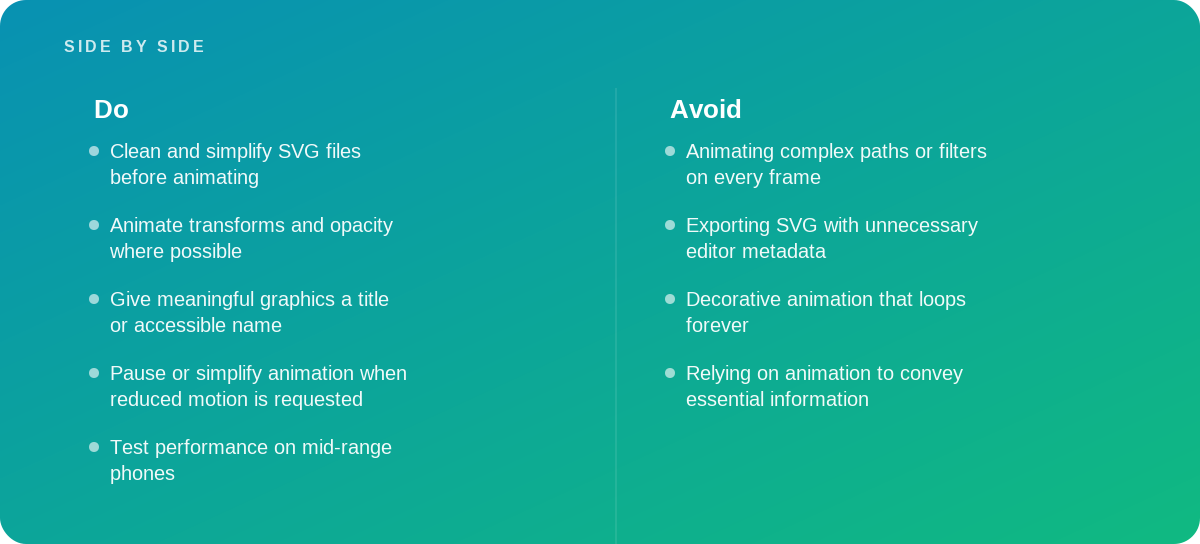
- Animating complex paths or filters on every frame
- Caught in phases 4 and 6. Look for any animation of path data, blur, drop shadow or large masks, and demand a device test before it ships. Usually the same look can be built from transforms of simpler shapes.
- Shipping editor metadata
- Caught in phase 2. If the production file contains design-tool namespaces, hidden layers or unused definitions, the optimization step was skipped or misconfigured.
- Decorative loops that never end
- Caught in phases 4 and 5. Every loop needs a reason and an end condition. If nobody can say why it loops, it should play once.
- Animation as the only carrier of meaning
- Caught in phase 5. Turn animation off entirely and use the interface; anything you can no longer understand needs a text or static equivalent.
- Wrong pivot points
- Caught in phase 4. Shapes swinging around the corner of the viewBox are a transform-origin problem, fixed with transform-box set to fill-box or explicit origins.
- Duplicate IDs across inlined graphics
- Caught in phase 2. Gradients or clip paths that appear on the wrong icon, or vanish when a second copy loads, are almost always ID collisions.
None of these requires specialist tools to detect. A code review that reads the SVG markup, a pass with reduced motion enabled and a session on a mid-range phone will catch nearly all of them.
When to Bring In Specialist Help With Animated SVG
Many teams can build simple animated SVG in-house: a spinner, a checkmark, a hover effect on a few icons. The playbook above is enough for that. The case for outside help grows in two situations named in the reference guidance, and in a few closely related ones.
The first is when animated illustrations are slowing pages down. If your performance tests show dropped frames, heavy repainting or slow page loads traced back to SVG animation, the fix often involves redrawing the artwork for animation, rethinking which parts move and choosing a different technique, which is a mix of illustration and engineering skill that is hard to find in one in-house person. The second is when a brand needs a consistent set of animated icons or illustrations. Consistency across dozens of assets depends on shared grids, motion tokens and documented conventions, and it is more efficient to establish those once, properly, than to let each product team invent its own.
Other signs include motion that must match a broader brand animation language already used in video, interactive explainers and data-driven graphics, and projects where SVG is one of several deliverables alongside 2D animated videos or social content. In those cases, a studio that handles animation and motion graphics across formats can keep timing, easing and style consistent, rather than having each format drift in its own direction.
- Performance tests show SVG animation causing dropped frames or slow pages.
- More than a handful of animated icons or illustrations must share one style.
- The artwork needs redrawing to be animation-ready, not just exporting.
- Motion must match an existing brand animation language used in video or other formats.
- No one in-house owns motion conventions, reduced-motion handling and documentation.
Whether you build in-house or bring in help, insist on the outputs this playbook describes at each phase: the format decision, the clean production file, the method note, the motion built on transform and opacity, the accessibility pass, the device test record and the documentation. Those artifacts are what separate an animated SVG that quietly improves a product from one that someone has to rebuild next year.
Where this comes from
- MDN Web Docs — SVG animation with SMIL
- MDN Web Docs — Web Animations API
- web.dev — How to create high-performance CSS animations
The figures and practices above come from the sources listed.
Working on something like this?
We take on Motion Graphics & Animation work for teams who want it done once, properly. Tell us what you are building and we will tell you honestly whether we are the right studio for it. Start a project.
Where to go next
Spotted something wrong? Report an error on this page. We correct on the page and say what changed.