A Practical Guide to Internal Linking
How to commission internal linking work: what to ask for, what drives cost, how to compare supplier quotes, red flags to avoid and how to judge the result.
 MediaScaleUp Editorial Team

Internal linking is the set of links between pages on your own website: the menus, breadcrumbs, category listings and, most importantly, the links written into the body of your content. Those links do three jobs at once. They let search engines discover pages, they pass signals from stronger pages to weaker ones, and they describe how pages relate to each other, both to crawlers and to the people reading. Because it costs nothing in media spend and sits entirely within your control, internal linking is one of the most underused levers in SEO.
This handbook is written for the person commissioning the work: a marketing lead, a business owner or an in-house SEO who has decided that the site's internal linking needs attention and is weighing whether to hire an agency, a freelancer or a technical consultant to do it. It covers what the work actually includes, what you should ask for in a proposal, what drives the cost, how to compare quotes that look nothing alike, the red flags that suggest a supplier will waste your budget, and how to tell afterward whether the job was done well.
You do not need to be an SEO specialist to follow it, but you will get more from it if you have access to your site's crawl data or Google Search Console, because the best way to hold a supplier to account is to check their claims against your own numbers.
What an internal linking project actually covers
Suppliers use the phrase "internal linking" to describe anything from a one-afternoon pass adding a few links to blog posts, to a multi-month restructure of navigation, taxonomy and templates. Before you request quotes, it helps to know the component parts so you can tell which ones you are being offered and which ones are missing.
Discovery and crawl mapping
Every serious engagement starts with a full crawl of the site using a desktop or cloud crawler, combined with the URLs you know should exist: your XML sitemaps, your CMS export and the pages that receive traffic in analytics or Search Console. Comparing those lists is how a supplier finds orphan pages, which are pages with no internal links pointing at them. Orphans are hard for search engines to discover and hard to rank, because nothing on the site vouches for them. The crawl also measures click depth, meaning how many clicks a page sits from the homepage or another entry point. Pages far from any entry point tend to be crawled less often, which matters most on large sites where new or updated content needs to be picked up quickly.
Structural analysis
The second layer looks at how link equity and relevance flow through the site. Which pages receive the most internal links, and are they the pages that matter commercially? Are service pages linked only from the main menu, or also from the articles that discuss the problems those services solve? Are there clusters of related content that never link to one another? This is where the difference between navigation links and contextual links becomes important. Site-wide links in headers and footers appear on every page, so they carry little differentiating signal. A contextual link placed inside a relevant paragraph says something specific about the relationship between two pages.
Anchor text review
Anchor text is the clickable wording of a link, and it describes the target to both readers and crawlers. A review catalogs the anchors pointing at each important page and flags vague ones such as "read more" or "click here," along with cases where the same anchor points at several different pages, which blurs which page is the authority on the topic. Our guide to anchor text that actually works goes deeper on the wording itself; for the purposes of commissioning, you simply want to know that the supplier will look at it systematically rather than by eye.
Hygiene fixes
Internal links that point to redirected or dead URLs waste crawl activity and send users through unnecessary hops or onto error pages. After a migration or a URL change, these can number in the thousands. Fixing them is unglamorous but usually the fastest measurable win in the whole project.
Implementation and governance
Finally, somebody has to make the changes: editing content, adjusting templates, adding related-content modules or breadcrumbs, and writing the rules that keep the site healthy after the project ends. Many proposals stop at recommendations. That can be the right choice if you have an in-house content team, but it needs to be an explicit decision, not something you discover when the report arrives.
- Discovery Internal links are how crawlers find pages beyond your sitemap
- Signal distribution Links from strong pages lend support to the pages they point at
- Relationships Anchor text and placement describe what the target page is about
- Orphan pages Pages with no internal links are hard to discover and rank
- Click depth Pages far from any entry point are crawled less often
- Navigation vs. context Site-wide links carry less differentiating signal than in-content ones
When internal linking is worth paying someone to fix
On a twenty-page brochure site, internal linking is something a competent marketer can handle in an afternoon with a spreadsheet: list the pages, decide which ones matter most, and make sure each is linked from two or three relevant places with clear anchor text. You do not need a supplier for that. The case for outside help grows with size, complexity and the cost of getting it wrong.
Situations where help pays for itself
- Orphan pages at scale. If a crawl compared with your sitemap shows hundreds of URLs that nothing links to, the fix is rarely just adding links. It usually means deciding which pages deserve to exist, which should be consolidated, and where the survivors belong in the structure. Our piece on handling orphan pages properly walks through that triage.
- New content is not being discovered. If articles or product pages published weeks ago still show as "Discovered, currently not indexed" or do not appear in Search Console at all, weak internal linking is one of the first things to check.
- A restructure or migration has broken linking. Replatforming, merging sites, changing URL patterns or moving a blog from a subdomain into a subfolder all tend to leave broken paths, redirect chains and pages that lost the links they used to receive.
- Multi-location or multi-brand sites. Franchise and location networks often end up with hundreds of near-identical pages that link only to the homepage. Structuring these is a specialist problem, covered in our guide to getting franchise SEO right.
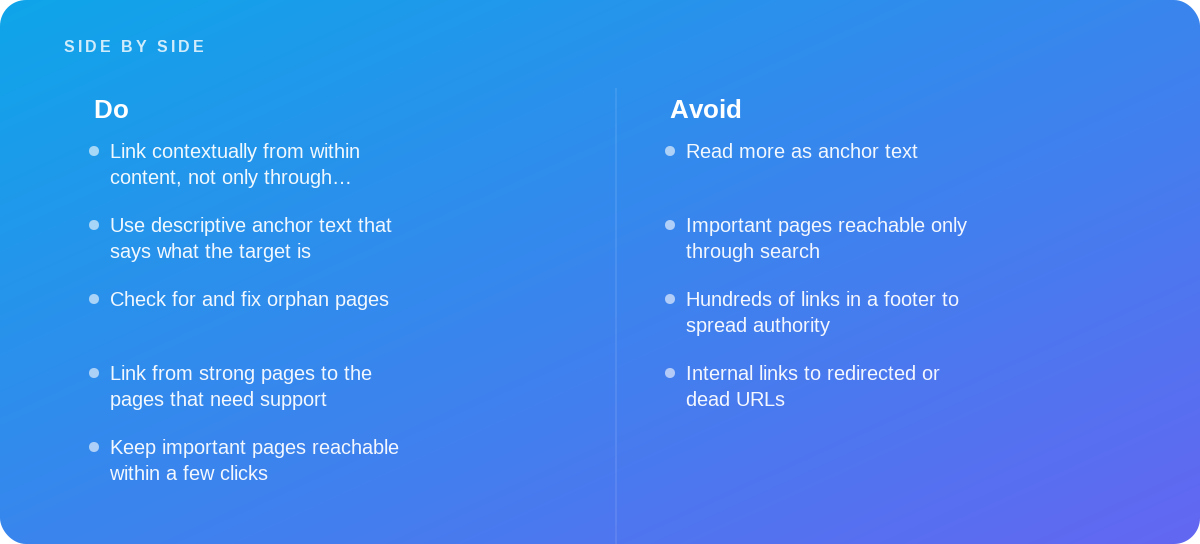
- Important pages reachable only through search. If the only way a visitor can find a key page is by typing into your site search box, crawlers probably cannot find it either, because they do not use internal search forms.
Situations where help is probably premature
If your content itself is thin or duplicated, internal linking will not rescue it. Linking amplifies what is already there. It makes sense to settle the content question first, using principles like those in our article on helpful, people-first content, and then commission linking work on a set of pages you are confident deserve to rank. Likewise, if your site is about to be redesigned or migrated, it is usually better to fold internal linking into that project than to pay for it twice.
What to ask for in the brief and proposal
A good brief makes quotes comparable. A vague brief invites each supplier to define the job in whatever way suits their workflow, and you end up comparing a two-day audit with a three-month implementation program. Spell out the following.
Scope you should specify
- Site size and sections. Give the approximate number of indexable URLs and name the sections in scope: blog, services, products, locations, help center. If some sections run on a different platform or subdomain, say so, because they often need separate crawling and separate implementation.
- Priority pages. List the ten to fifty pages that matter most commercially. A supplier who knows what you need to rank can design the structure around those pages rather than treating every URL equally.
- Who implements. State whether you want recommendations only, recommendations plus a content-edit spreadsheet your team will work through, or full implementation in your CMS.
- Template access. Say whether the supplier can change templates (navigation, breadcrumbs, related-content blocks) or only page content. Template changes usually need a developer, so they affect both cost and timeline.
- Reporting window. Ask for a baseline before work starts and a follow-up measurement a set period afterward, typically two to three months, so that search engines have time to recrawl.
Deliverables you should expect
Whatever the scope, the following deliverables are what separate a professional engagement from a list of generic tips. Ask for each by name in your brief.
- Crawl export and summary. The raw data, not just a slide deck, so you can re-check it later or hand it to another supplier.
- Orphan page list with a decision for each URL: link it, merge it, redirect it or remove it.
- Click-depth report showing how many clicks each priority page sits from the homepage, before and after.
- Broken and redirected internal link inventory with the source page, the current target and the correct final URL.
- Link opportunity map: a spreadsheet pairing source pages with target pages, the proposed anchor text and the sentence or paragraph where the link belongs.
- Structural recommendations for navigation, category pages, breadcrumbs and related-content modules, with the reasoning behind each.
- Governance notes: the rules your writers and developers should follow so the problems do not return.
If a supplier cannot tell you which of these they will deliver, or offers "a comprehensive internal linking strategy" without naming outputs, treat that as a warning sign, not a style choice.
What drives the cost of internal linking work
Prices for internal linking vary widely, and without seeing a specific scope nobody can tell you what yours should cost. What you can do is understand the factors that push effort up or down, so that when two quotes differ by a factor of three you can see why.
Site size and URL sprawl
The number of URLs a crawler has to process is the obvious driver, but the more important number is the count of distinct page types. A 50,000-page ecommerce site with five templates can be simpler to analyze than a 3,000-page publisher with twenty content types, years of legacy tags and a separate resources hub. Parameter URLs, faceted navigation and archive pages inflate crawls and need careful filtering before the analysis means anything.
How much manual editorial work is involved
The single biggest cost variable is usually whether someone has to read content and write contextual links by hand. Template changes scale: a breadcrumb or related-posts block written once applies to every page that uses the template. Contextual links in body copy do not scale in the same way. Each one needs someone to find the right sentence, choose accurate anchor text and check that the link makes sense to a reader. A proposal that promises hundreds of contextual links for a small fee is either using automation you should inspect or cutting corners on relevance.
Technical complexity
JavaScript-rendered navigation, headless CMS setups, multiple subdomains and internationalized sites all add analysis time. If part of your site lives on a subdomain, the supplier will also need to account for how links cross that boundary, a topic that overlaps with the decision covered in our guide on choosing between subdomains and subfolders.
Implementation route
Recommendations-only work is the cheapest option on paper, but its real cost includes your team's time to implement it. Full implementation costs more upfront and removes the risk that the spreadsheet sits unused. A middle route, where the supplier implements template changes and hands over a prioritized content-edit list, is often the best value for teams that have writers but no SEO specialist.
Ongoing versus one-off
A one-off project fixes the current state. A retainer keeps it fixed as you publish. Sites that publish several pieces a week tend to drift back into orphan pages and stale links within months, so for them a light ongoing arrangement, even a quarterly check, can be more valuable than a larger one-time project.
Questions to ask an internal linking supplier before you sign
A short call with each shortlisted supplier, working through the questions below, will tell you more than any case study page. Listen for specifics: named tools, named deliverables, and an honest description of what they will not do.
- How will you find orphan pages, and which URL sources will you compare the crawl against (sitemaps, analytics, Search Console, CMS export)?
- Will I receive the raw crawl data and link opportunity spreadsheet, or only a summary report?
- How do you decide which pages should receive more internal links, and how will you use my list of priority pages?
- Who writes the contextual links: a person reading the content, a tool suggesting matches, or both? How do you check relevance?
- How do you choose anchor text, and how will you avoid both vague anchors and repetitive exact-match anchors?
- Will you fix internal links that point to redirected or broken URLs, and will you update them to the final destination rather than adding another redirect?
- What template changes do you recommend, and do you need a developer on our side to make them?
- What baseline will you record before starting, and what will you measure afterward, over what period?
- What will you not do? Which parts of the site or problem are out of scope?
- What rules will you leave behind so that our writers keep linking well after you finish?
The strongest answers are concrete and a little cautious. A supplier who says "we will compare your crawl with your XML sitemaps and the pages receiving impressions in Search Console, then give you a spreadsheet with a decision for every orphan URL" is describing real work. A supplier who says "our proprietary system will optimize your link equity" is describing a sales pitch.
Pay attention to how they talk about measurement. Internal linking changes take effect only after search engines recrawl the affected pages, and the results are mixed in with everything else happening on your site and in search. An honest supplier will set expectations around leading indicators first, such as crawl coverage, indexation of previously ignored pages and reduced click depth, and treat ranking and traffic changes as outcomes to watch rather than promises.
Comparing internal linking quotes side by side
Quotes for this kind of work rarely line up neatly. One supplier prices by the page, another by the day, a third offers a fixed package. The way to compare them is to strip each proposal back to what it will actually deliver, then score those deliverables against what your site needs. The scorecard below is a template; adjust the weighting to your situation. A site with an in-house content team might care less about implementation and more about the quality of the opportunity map, while a lean team might rank implementation highest.
| Criterion | What a strong proposal includes | What a weak proposal looks like | Suggested weight |
|---|---|---|---|
| Discovery method | Full crawl compared with sitemaps, analytics and Search Console; orphan list with a decision per URL | Crawl only, or no stated method | High |
| Prioritization | Structure designed around your named priority pages and their supporting content | Every page treated equally, or links added wherever keywords match | High |
| Contextual links | Source page, target, anchor text and placement specified for each link, with human review | A link count with no detail on where or why | High |
| Link hygiene | Inventory of broken and redirected internal links, updated to final URLs | Not mentioned, or "we will add redirects" | Medium |
| Template and navigation | Specific recommendations for breadcrumbs, category pages and related-content modules | Generic advice to "improve navigation," or footer link blocks | Medium |
| Measurement | Baseline and follow-up on orphans, click depth, indexation and crawl activity | Promises of ranking positions or traffic percentages | Medium |
| Handover | Raw data, governance rules and a short training session for writers | A PDF report only | Low to medium |
Score each proposal from one to five on each row, multiply by the weight you choose, and total the results. Then look at price. The cheapest proposal is often the one that leaves out the most expensive element, which is usually human-written contextual links or implementation. That can still be the right choice if your team will do that part, but you should choose it knowingly.
Normalizing different pricing models
To compare a per-page price with a day rate or a fixed package, convert everything into the same unit: cost per priority page improved, or cost per delivered contextual link with specified placement. Ask each supplier how many hours they expect to spend on analysis versus implementation. If one proposal allocates most of its time to reporting and very little to the actual link map, you have learned something important about where your money goes.
Red flags in internal linking proposals
Most internal linking proposals are sincere, but the field attracts some practices that do little good and occasionally cause harm. The warnings below are the ones worth screening for before you sign.
Red flags to watch for:
- Plans to add dozens or hundreds of links to the footer or sidebar "to spread authority." Site-wide links carry little differentiating signal, clutter every page and make navigation harder for people.
- Automated linking that inserts a link every time a keyword appears, regardless of context. It produces repetitive exact-match anchors and links that make no sense to readers.
- Guaranteed ranking positions or traffic uplifts. Nobody controls how search engines weigh internal links against everything else on your site.
- "Read more" or "click here" anchors in the supplier's own sample work.
- No mention of broken or redirected internal links, which suggests the supplier has not crawled your site before quoting.
- Recommendations to hide links from users or to use internal links purely as keyword placement rather than navigation.
The footer tactic deserves particular attention because it keeps resurfacing. The logic sounds plausible: if every page links to every important page, authority reaches everywhere. In practice a link that appears identically on thousands of pages tells a crawler very little about which page is most relevant to which topic, and a footer with a hundred links is a usability problem for visitors. The Nielsen Norman Group's research on link and navigation usability has long argued that links should be clearly labeled and predictable, and that is equally good advice for search engines.
Automation deserves a more nuanced view. Tools that suggest link opportunities by matching topics across your content are useful, and a good supplier will use them to speed up discovery. The problem is automation that publishes links without a human reading the sentence. The test is simple: ask to see a sample of twenty proposed links from your own site, with the surrounding sentence, before you commit. If more than a handful read awkwardly or point to the wrong page, the process lacks review.
Finally, be wary of any proposal that blurs internal linking with off-site link building. The two are different disciplines. If a supplier starts talking about buying links, private networks or exchanging links with partners, read our guide to link spam and link schemes before going any further, because those practices carry real risk and are unrelated to fixing your internal structure.
Worked example: scoping internal linking for a 3,000-page services site
The following example is illustrative. It is not a client story; it shows how the numbers in a real scoping exercise tend to fit together, and how you might read a proposal against them.
Imagine a professional services company with roughly 3,000 indexable URLs: 40 service pages, 60 location pages, about 2,400 blog posts accumulated over ten years, and the remainder made up of team profiles, case studies and tag archives. The marketing team suspects internal linking is weak because newer articles take a long time to appear in search, and several service pages rank below blog posts on the same topic.
What the baseline crawl shows
A crawl from the homepage, compared with the XML sitemap and the pages that received impressions in Search Console over the last few months, produces a picture like the one below.
| Measure | Baseline (illustrative) | Target after project | How it is fixed |
|---|---|---|---|
| URLs in sitemap with no internal links (orphans) | 420 | Under 20, each with a documented reason | Link, merge, redirect or remove each URL |
| Priority pages deeper than three clicks from the homepage | 18 of 40 service pages | 0 | Service hub page, breadcrumbs, contextual links from articles |
| Internal links pointing at redirected URLs | 3,100 | 0 | Bulk update to final destination URLs |
| Internal links pointing at 404 pages | 260 | 0 | Update to replacement page or remove |
| "Read more" or "click here" anchors | 1,900 | Replaced by descriptive anchors on priority paths | Template change plus content edits |
| Contextual links into service pages from blog content | Average of 2 per service page | 8 to 15 per service page, all relevant | Human-written contextual links |
How the work breaks down
With those numbers in hand, the work divides naturally. The 3,100 redirected links and 260 broken links are mostly a mechanical find-and-replace job, often done in bulk through the database or a CMS plugin, and they may account for a large share of the measurable improvement with a small share of the effort. The 1,900 "read more" anchors are largely generated by a single blog listing template, so one template change fixes most of them at once.
The orphan pages take judgment. Of the 420, perhaps a third turn out to be old tag archives and thin news items that should be removed or consolidated. Another third are legitimate articles that simply dropped out of the category listings as newer posts pushed them onto deep pagination; they need contextual links from related articles. The rest are location or service variants that should sit under a proper hub.
The most expensive element is the contextual linking into service pages. Moving from an average of two to, say, ten relevant in-content links for each of 40 service pages means placing around 320 new links, each requiring someone to read the source article, find the right sentence and write accurate anchor text. At a realistic pace for careful editorial work, that is a multi-day task, not an afternoon.
Reading proposals against this scope
Now suppose three proposals arrive. Proposal A is the cheapest and covers the audit and a recommendations report, with no link opportunity map. Proposal B covers the audit, the bulk hygiene fixes, the template change and a spreadsheet of 320 contextual links with placement and anchor text for your writers to implement. Proposal C does everything in B and implements the contextual links itself, with a follow-up measurement after three months.
For a team with writers who have spare capacity, B is likely the best value, because it delivers every element that requires SEO judgment and leaves the time-consuming but straightforward editing in-house. For a stretched team, C may be cheaper in total once your own hours are counted. A is only good value if you already have someone who can turn a recommendations report into a link map, in which case you are really buying a second opinion.
How to judge the result of internal linking work
Internal linking is unusually measurable, because most of its direct effects show up in crawl data before they show up in rankings. Judge the work in two stages: whether the deliverables were done properly, and whether they had the expected effect.
Checking the deliverables
Run your own crawl after the supplier reports completion, or ask a colleague to. Compare it with the baseline on the measures agreed in the brief: orphan count, click depth for priority pages, broken and redirected internal links, and the number of contextual links into each priority page. These are binary questions; either the links exist and point to the right final URLs, or they do not.
Then spot-check quality. Open twenty pages at random from the link opportunity map and read the sentences containing the new links. Each should make sense to a human reader, use anchor text that accurately describes the destination, and point at the page a reader would expect. The same standards apply to any page-level work bundled with the project, which we discuss in our guide to on-page optimization decisions.
Checking the effect
Search Console is the primary tool. The Links report shows which pages receive the most internal links, so you can confirm that priority pages have moved up that list; our guide on reading the Search Console Links report explains its quirks, including why its counts lag behind a live crawl. The page indexing report shows whether previously ignored pages are now being indexed, and the URL Inspection tool shows when individual pages were last crawled. Google's own Search Central documentation on crawling and indexing explains that links are one of the main ways Google finds pages, which is why these crawl and indexing signals are the first place to look.
Give changes time. Search engines need to recrawl both the pages where links were added and the pages they point at. For a site of a few thousand pages, meaningful changes in crawl and indexing data typically take several weeks to appear, and ranking movements, if they come, often take longer. Compare like-for-like periods and note any other changes made during the window, such as new content, a redesign or seasonal demand, so that you do not credit or blame the linking work for effects it did not cause.
Judge internal linking first by what you can verify in a crawl, then by what search engines do with it. Rankings are the last signal to arrive and the easiest to misattribute.
Keeping internal linking healthy after the supplier leaves
A one-off project fixes the site as it stands on the day the work finishes. Every article published afterward is either linked well or becomes the next orphan. The governance notes you asked for in the brief are what protect your investment, and they should be short and specific enough that writers actually follow them.
Rules for writers and editors
- Every new piece links to at least two or three relevant existing pages, including the service or product page it supports.
- Every new piece receives at least two links from relevant existing articles within a week of publishing. This is the step most teams forget, and it is the one that prevents orphans.
- Anchor text describes the destination. "Our guide to breadcrumb markup" is useful; "this article" is not.
- When a page is deleted or its URL changes, internal links pointing at it are updated at the same time, not left to a redirect.
Rules for developers and site owners
Structural elements do much of the ongoing work automatically. Breadcrumbs reinforce hierarchy on every page and, when marked up correctly, can appear in search results; see our practical guide to breadcrumb structured data. Related-content modules should draw on topic or category relationships rather than simply showing the most recent posts, which only ever point at new content. Category and hub pages should be real, useful pages with introductory text and curated links, not just paginated lists sorted by date. Any new section of the site should be reachable within a few clicks of the homepage from the day it launches.
A lightweight maintenance rhythm
For most sites, a quarterly crawl compared with the sitemap is enough to catch new orphans, new broken links and priority pages drifting deeper. Sites that publish daily or run large catalogs benefit from monthly checks. This is also the natural moment to review whether the priority list itself has changed: new services, discontinued products and shifting business goals all change which pages deserve the strongest internal support. If your team would rather not run these checks, a small ongoing retainer through our site architecture and internal linking service can cover the crawl, the report and the fixes.
Making the commissioning decision
Internal linking is one of the few SEO investments where you can check almost every claim yourself. That gives you leverage as a buyer. Write a brief that names your priority pages, the sections in scope and who will implement. Ask each supplier the questions in the checklist and insist on named deliverables, especially the orphan list with decisions, the broken and redirected link inventory, and a link opportunity map with placement and anchor text. Score proposals on what they deliver rather than on their length, and treat footer link blocks, automated keyword linking and ranking guarantees as reasons to walk away.
Then hold the result to the same standard: a before-and-after crawl, a sample of links read by a human, and Search Console data over a realistic period. If you would like an outside view on where your own site stands before you write the brief, our SEO services team can run a baseline crawl and tell you which of the problems above apply.
Verdict Pay for internal linking help when your site is large enough that orphans, click depth and broken links cannot be fixed by hand in a day, or when a migration has disrupted the structure. Buy named deliverables rather than a "strategy," make sure someone reads every contextual link before it goes live, and judge the work first on crawl data you can verify, then on indexing and rankings over the following months.
Where this comes from
- Google Search Central — SEO starter guide
- Google Search Central — Crawling and indexing
- Nielsen Norman Group — Link and navigation usability
The figures and practices above come from the sources listed.
Working on something like this?
We take on SEO Services work for teams who want it done once, properly. Tell us what you are building and we will tell you honestly whether we are the right studio for it. Start a project.
Where to go next
Spotted something wrong? Report an error on this page. We correct on the page and say what changed.