Micro Frontends, Done Properly
Splitting a web front end into independently developed and deployed pieces owned by different teams.
 MediaScaleUp Editorial Team

Where most projects go wrong
The usual mistakes:
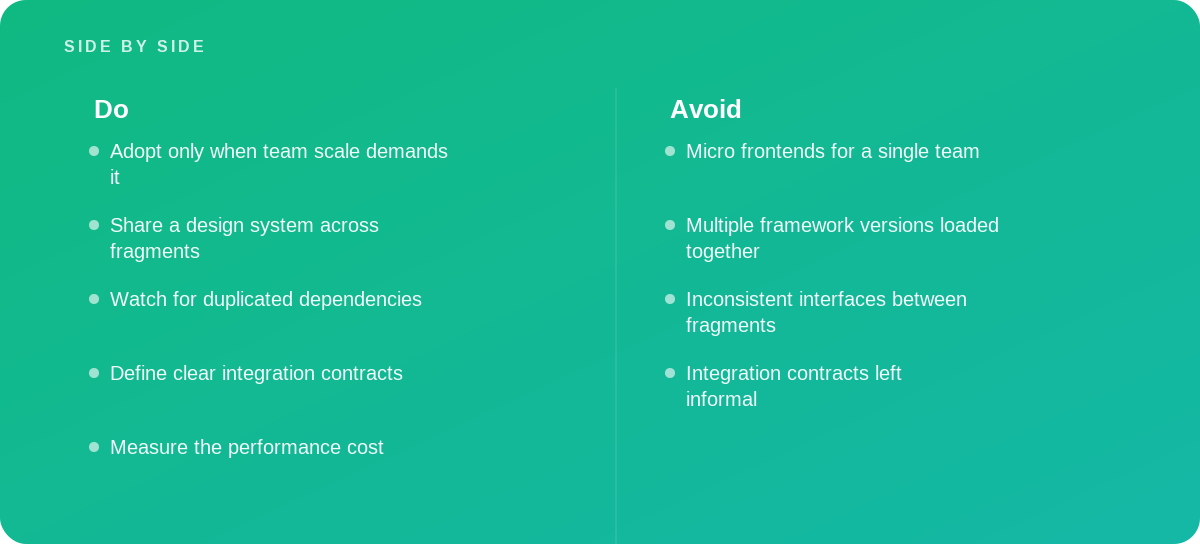
- Micro frontends for a single team
- Multiple framework versions loaded together
- Inconsistent interfaces between fragments
- Integration contracts left informal
What good looks like instead
- Adopt only when team scale demands it
- Share a design system across fragments
- Watch for duplicated dependencies
- Define clear integration contracts
- Measure the performance cost
Why it matters
The approach helps large organizations ship independently, and it adds complexity that small teams do not need.
The specs that matter
| Measure | Figure |
|---|---|
| Independence | teams deploy their parts separately |
| Consistency | shared design systems prevent visual fragmentation |
| Performance | duplicate framework code can bloat pages |
| Integration | composition happens at build time or runtime |
Knowing when to hand it over
Tip: Bring in help when front-end ownership spans many teams.
Where this comes from
- Microsoft Learn — Architecture styles
- web.dev — Performance
The figures and practices above come from the sources listed.
Working on something like this?
We take on Web Design & Development work for teams who want it done once, properly. Tell us what you are building and we will tell you honestly whether we are the right studio for it. Start a project.
Where to go next
Spotted something wrong? Report an error on this page. We correct on the page and say what changed.






