How to Get Content Localization Right
Adapting content for another market — not only translating the words, but changing examples, references and sometimes the argument.
 MediaScaleUp Editorial Team

Where most projects go wrong
The usual mistakes:
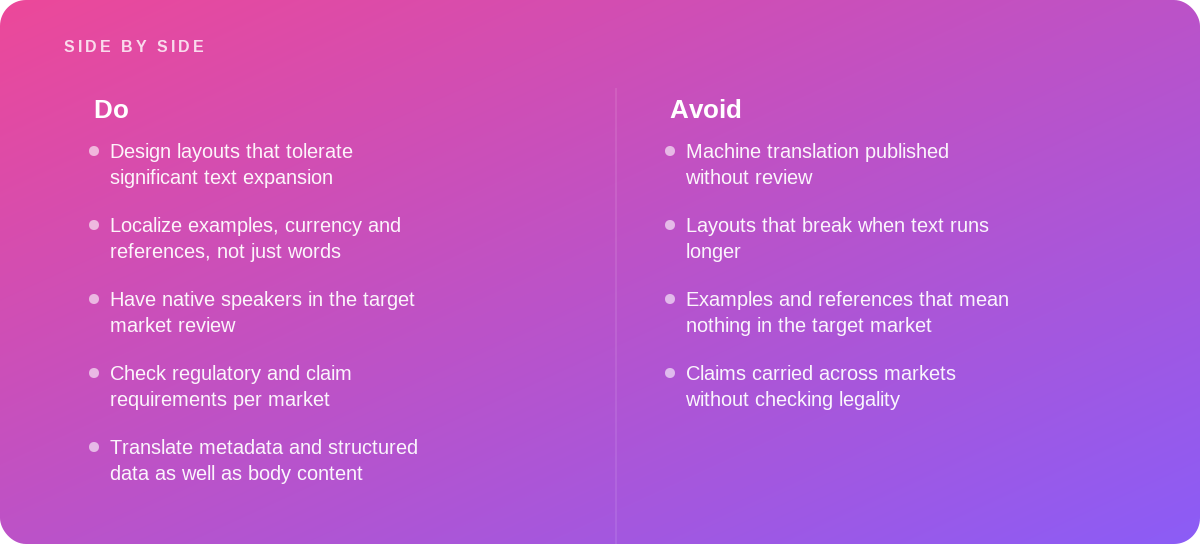
- Machine translation published without review
- Layouts that break when text runs longer
- Examples and references that mean nothing in the target market
- Claims carried across markets without checking legality
What good looks like instead
- Design layouts that tolerate significant text expansion
- Localize examples, currency and references, not just words
- Have native speakers in the target market review
- Check regulatory and claim requirements per market
- Translate metadata and structured data as well as body content
Why it matters
Translation moves the words; localization moves the meaning, and the difference is obvious to a reader in the target market.
The specs that matter
| Measure | Figure |
|---|---|
| Translation versus localization | the second adapts context, currency, examples and regulation |
| Text expansion | translated text length varies significantly by language |
| Right-to-left | requires layout as well as text changes |
| Regulatory differences | claims permissible in one market may not be in another |
| Review | native review in market is the only reliable check |
Knowing when to hand it over
Tip: Bring in help when entering a new market, when translated content is underperforming, or when layouts are breaking under localization.
Where this comes from
- W3C — Internationalization best practices
- Google Search Central — Localized versions of your pages
- European Commission — Consumer information requirements
The figures and practices above come from the sources listed.
Working on something like this?
We take on Content Strategy work for teams who want it done once, properly. Tell us what you are building and we will tell you honestly whether we are the right studio for it. Start a project.
Where to go next
Spotted something wrong? Report an error on this page. We correct on the page and say what changed.