A Practical Guide to Case Studies and Proof Content
Learn how to commission case studies and proof content: what to ask for, what drives cost, how to compare quotes, red flags, and how to judge the drafts.
 MediaScaleUp Editorial Team

Case studies and proof content are the pages on your site that show what your business has actually done, for whom, under what conditions, and with what result, in enough detail that a skeptical buyer believes it. That covers the classic long-form case study, but also shorter project summaries, before-and-after pages, client testimonials with context, results pages, and the one-paragraph proof points that sit on service pages and in proposals. They are the most requested category of content on most professional services sites and, in our experience, the least well made, because the specifics that make proof persuasive are exactly the ones clients ask you to remove.
This handbook is written for the person commissioning that work: a marketing lead, a founder, a practice head or an in-house content manager who has decided to bring in a writer, an agency or a studio to produce a set of case studies. It covers what to ask for, what actually drives the cost, how to compare suppliers who quote in completely different ways, the red flags that predict a stalled project, and how to judge the result once drafts arrive.
The central point runs through every section: the writing is rarely the hard part. The hard parts are securing permission to publish, getting access to the people who know what happened, and finding evidence for the outcome. A supplier who understands that will scope and price the work very differently from one who treats a case study as a 1,200-word blog post with a client logo on top.
What you are really buying when you commission case studies and proof content
When you pay for a case study, the visible deliverable is a page of copy. The real deliverable is a chain of work that ends in a published, approved, defensible account of a project. It helps to break that chain into its parts, because suppliers price and perform very differently on each one.
The four elements every persuasive case study needs
Strong proof content consistently contains four things: the problem the client faced, the constraint that made it hard, what was done, and the outcome. Most weak case studies have the first and third and skip the second and fourth. They describe a problem in generic terms, walk through a process, and stop, leaving the reader to assume the result was good. The constraint is what makes a story credible and distinctive: the deadline that could not move, the legacy system nobody could replace, the budget that ruled out the obvious approach, the regulator who had to approve every word. The outcome is what the reader actually came for.
Specificity is the product
What makes a case study credible is specificity: named people and roles, real dates and durations, the actual volume of work, the tools or methods chosen and why, and outcomes stated in terms that can be checked. Research on web credibility from the Nielsen Norman Group has long pointed to the same pattern: readers trust content that shows its working and is upfront about the details, and discount content that reads as vague or promotional. A case study that could have been written about any client by any competitor persuades nobody.
The work behind the words
Behind each finished case study sit several tasks you may or may not be paying for: selecting which projects to feature, securing publication rights, interviewing your delivery team, interviewing the client, gathering and checking evidence, writing, designing or formatting, running the approval process, and publishing in more than one format. When quotes differ by a factor of three, it is usually because one supplier has priced the whole chain and another has priced only the writing.
Deciding what to ask for before you brief anyone
The quality of the quotes you receive depends on the quality of the request you send. Before you contact a supplier, settle five decisions internally. Doing this first also stops you from paying a supplier to run discovery you could have done in an afternoon.
1. Which buying questions the proof needs to answer
Proof content works best when each piece answers a specific doubt a buyer has at a specific stage. An early-stage reader wants to know whether you have worked with organizations like theirs. A late-stage reader, often a procurement lead or a technical evaluator, wants to know whether you delivered on time, on budget and to specification when things got difficult. If you have already mapped your content to the stages of a purchase, as described in our guide to mapping content to the buying journey, use that map to decide which projects to feature. If you have a list of the objections your sales team hears most often, each case study should retire at least one of them; our piece on objection-handling content covers how to collect those objections.
2. How many pieces, and in what mix
A single case study rarely changes much. A set of four to eight, covering your main services, sectors and project sizes, gives a buyer a pattern to recognize. Decide whether you want every piece at full length or a tiered set: two or three flagship stories of 1,200 to 2,000 words, supported by shorter 300 to 500 word project summaries. The tiered approach is usually the better investment because the short summaries are cheaper, faster to approve and easier to keep current.
3. Which formats and outputs
List the outputs you need from each project: a web page, a PDF for sales, a one-paragraph proof point for proposals, a short quote card for social channels, a slide for pitch decks. Every additional format adds effort, but deriving them from one approved master is much cheaper than commissioning them separately later, because the approval has already been won.
4. Named or anonymized
Decide your default position. Named work persuades more; anonymized work is sometimes the only option. Know which candidate projects are likely to be named before you brief, because this changes how much evidence and interview time each piece needs.
5. Who inside your business owns access
Identify who will introduce the supplier to each client, who from your delivery team will be interviewed, and who has authority to approve the final text on your side. A supplier cannot manufacture access. If nobody internally owns the client relationship for a project, drop it from the list.
Put these decisions into a written brief. If you are unsure what a good brief looks like, our content briefs service page outlines the elements we expect, and the same structure works for proof content.
What drives the cost of case studies
We will not quote market prices here, because rates vary widely by country, seniority and sector, and any single figure would mislead. What we can do is explain the variables that move the price, so you can read a quote and understand where the money is going. In practice the price of a case study is driven far more by access, evidence and approval than by word count.
| Cost driver | Lower-effort end | Higher-effort end | Why it matters |
|---|---|---|---|
| Interviews | One internal interview, written answers from the client | Two or three internal interviews plus a recorded client interview | Client interviews produce the specifics and the voice that make a piece credible, but need scheduling, preparation and transcription |
| Evidence gathering | Outcome described qualitatively | Figures checked against reports, dashboards or signed-off documents | Substantiated numbers take real analyst or writer time and often a second conversation |
| Subject complexity | Straightforward service with a clear before and after | Technical, regulated or multi-party project | Complex projects need more research time and more careful review |
| Approval rounds | One internal round, one client round | Multiple stakeholders on the client side, including legal or communications teams | Every extra round adds editing time and calendar time; slow approval is the most common reason budgets overrun |
| Formats | Web page only | Web page, PDF, proposal paragraph, social assets, slides | Each derivative is cheaper than an original, but not free |
| Design | Existing site template | Bespoke layout, data visualization, photography | Design can match or exceed the writing cost |
| Project management | You run scheduling and chase approvals | Supplier runs the whole process end to end | This is the line item most often missing from cheap quotes |
Two practical conclusions follow. First, the cheapest way to reduce cost is not to shorten the piece but to make access easy: have the client interview agreed, the evidence located and the approver named before the supplier starts. Second, a quote that is low because it excludes interviews, evidence checking and approval management is not a cheaper version of the same product. It is a different product, and usually one that stalls at the approval stage.
Pricing models you will meet
Suppliers typically quote in one of three ways. Per piece pricing is easy to compare but can hide limits on interview time and revision rounds. Day rate or hourly pricing is transparent about effort but exposes you to the risk of slow approvals. Program or retainer pricing covers a set of case studies over several months and usually includes project management; it suits businesses that want a steady flow of proof content rather than a one-off batch. Whatever the model, ask the supplier to state what happens to the price if a client approval takes three months or a client withdraws consent entirely.
Questions to ask a supplier before you sign
You are assessing two things: whether the supplier can write, and whether they can get a case study through the process that stands between a draft and a published page. Most portfolios prove the first. These questions test the second. General guidance on assessing agencies is covered in our piece on choosing a content agency; the list below is specific to proof content.
- How do you structure a case study, and can you show two examples where the constraint is as clear as the solution?
- Who conducts the client interview, how long is it, and do you send questions in advance?
- How do you verify outcome figures, and what do you do if a number cannot be substantiated?
- At what point in the process does the client first see the content, and in what form?
- How many revision and approval rounds are included, and what does an extra round cost?
- What happens to the fee if a client declines to approve publication after the draft is written?
- How do you handle anonymized case studies so that they still contain specific, useful detail?
- Which derivative formats come from each master piece, and are they included in the quote?
- Who on your side manages scheduling and chasing, and who on our side do you need?
- Can you give us a reusable template and interview guide so we can produce future pieces ourselves?
Listen for how the supplier talks about approval. A good answer describes getting client agreement to the outline and key facts before writing, not presenting a finished draft and hoping. Listen also for how they talk about numbers. A good answer includes the word "evidence" and some process for checking it; a weak answer promises "impressive results" without mentioning where the figures will come from.
Comparing quotes on a like-for-like basis
Quotes for case studies are notoriously hard to compare because each supplier bundles the work differently. One quotes per piece and excludes interviews; another quotes a day rate with an estimate; a third offers a monthly program that includes templates, training and design. Before you compare price, normalize the scope. The scorecard below is a practical way to do that. Score each supplier from 1 (weak or missing) to 5 (strong and explicit) on each criterion, then weight the criteria that matter most for your situation.
| Criterion | What a strong answer looks like | Suggested weight | Supplier A | Supplier B | Supplier C |
|---|---|---|---|---|---|
| Scope clarity | Interviews, evidence checks, drafting, formats and approvals all itemized | High | |||
| Approval process | Client agrees outline and facts before full drafting; rounds are defined | High | |||
| Evidence handling | Written method for substantiating figures and for dropping unsupported claims | High | |||
| Sample quality | Samples show constraint and outcome, not just process | Medium | |||
| Sector understanding | Can explain your buyers' concerns without prompting | Medium | |||
| Risk terms | Clear position on fees if a client withdraws or approval stalls | Medium | |||
| Reusability | Delivers template, interview guide and style notes you keep | Low to medium | |||
| Total cost for the defined scope | Comparable once scope is normalized | Medium |
The weighting is deliberate. Price appears last and at medium weight because a case study that never gets approved has an effective cost of the full fee for nothing. Scope clarity, approval process and evidence handling are weighted highest because they predict whether the work ships at all. If two suppliers score similarly on those three, then sample quality and price should decide it.
Normalizing a quote in practice
Take each quote and rewrite it into the same list of line items: projects selected, internal interviews, client interviews, evidence checks, drafting, design, formats, approval rounds, project management. Mark each as included, excluded or unclear. Then ask every supplier to fill in the unclear items. This one exercise usually removes half the apparent price difference and exposes which low quotes are low because work is missing.
Red flags in proposals, samples and early drafts
Most failed case study projects show warning signs early. The patterns below come up repeatedly, and each is worth raising with the supplier before you commit.
Red flag: samples that describe process and never outcome.
- If every sample reads "we held a kickoff workshop, then we designed, then we delivered," the supplier either cannot get results out of clients or does not know to look for them.
- Ask for a sample where the final section states a specific, checkable result.
The second warning sign is enthusiasm for numbers without any mention of where they come from. Unverifiable percentage improvements, such as "engagement up 300%," are the most common weakness in proof content. They invite the obvious questions: 300% of what baseline, over what period, measured how, and caused by what? A reader who cannot answer those questions discounts the claim, and a regulator may too. In the United States, the Federal Trade Commission publishes guidance on endorsements and testimonials that makes clear advertisers are responsible for substantiating the claims they publish, including claims made through customer stories. Other jurisdictions have comparable rules. A supplier who does not raise substantiation unprompted is a risk to you, not just to the quality of the writing.
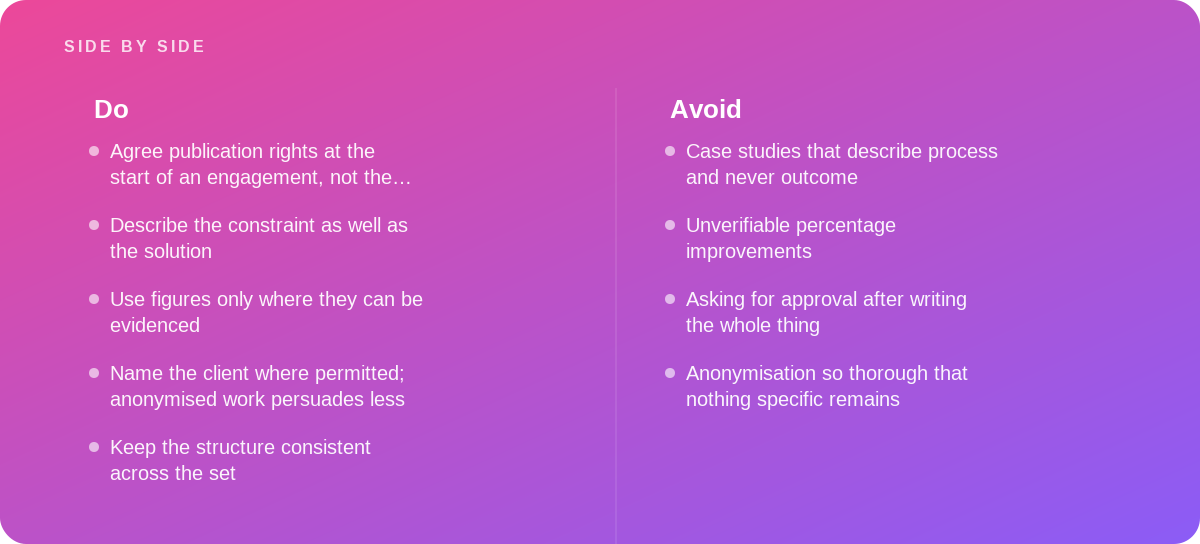
The third sign is a plan to write the whole piece and then send it for approval. Asking for approval after writing the whole thing is the single most reliable way to stall a case study. Clients faced with a finished 1,500-word draft tend to route it through more people, object to more details and sit on it longer than clients asked to confirm a one-page outline of facts.
Fourth, watch for anonymization offered as an easy default. Anonymization is possible, but it costs credibility, and done badly it removes everything that made the story worth telling. "A leading organization in a regulated industry improved its outcomes" tells a buyer nothing. If a supplier suggests anonymizing without explaining what specific detail will survive, push back.
Finally, be wary of any supplier who promises a fixed publication date for client-approved content. They cannot control the client's calendar. A credible supplier commits to their own turnaround times and to a process for chasing approvals, and is honest that client sign-off is usually required and often slow.
Publication rights and client approval: the step that decides whether anything ships
If there is one change that most improves a proof content program, it is agreeing publication rights at the start of an engagement rather than the end. By the time a project is finished, the client contact who championed it may have moved on, the legal team may have tightened its rules, or the relationship may have cooled. At the start, everyone is optimistic and the request is a small clause in a contract rather than a favor.
What to agree up front
A publication clause or side letter does not need to be elaborate. It should cover whether you may name the client, whether you may use their logo, whether you may quote named individuals, which categories of figures you may publish, and what review the client gets before anything goes live. Many clients will agree to "named, subject to review of the final text" at the outset when they would refuse a cold request two years later. If your contracts are reviewed by lawyers, work with them on a standard clause; our guide to legal content review workflows explains how to set up a review path that does not add weeks to every piece.
A staged approval process that actually works
For existing projects where rights were never agreed, the approval process needs to be designed to reduce friction at every step. The sequence below is the one we recommend to clients, and the one you should expect a competent supplier to propose.
- Ask permission in principle A short message from the person who owns the relationship, explaining what the case study is for, what it will contain and that the client will review everything before publication.
- Agree the fact sheet A one-page outline listing the problem, the constraint, what was done, the outcome and any figures, with their source. The client confirms or corrects facts at this stage, before any prose exists.
- Interview A 30 to 45 minute conversation with the client contact, focused on the constraint and the outcome in their own words, with questions sent in advance.
- Draft against the agreed facts The writer produces the piece using only facts on the approved sheet. Anything new goes back to the client as a question, not as a surprise in the draft.
- One consolidated client review The client receives the draft with a clear deadline and a request for a single set of consolidated comments.
- Final sign-off in writing Record the approval, who gave it and what version it covers, so you can show it later if asked.
This process front-loads the difficult conversation. Once the facts are agreed, the draft review is mostly about tone and wording, which clients handle quickly. Keep the signed-off version and approval record with your content records; if a client later asks for the piece to be withdrawn, you will want a clean way to do it, as covered in our guide to archiving and unpublishing content.
Evidence and numbers: what you can publish and what you should cut
Numbers are only useful in proof content where they can be substantiated. That rule protects you legally, but it also protects persuasion: a buyer who spots one unsupported number discounts the rest of the page.
Where good figures come from
Credible figures usually come from a small number of sources: the client's own reporting, shared project dashboards, signed-off project documents such as acceptance reports, invoiced volumes, and before-and-after measurements that both parties recorded at the time. The GOV.UK Service Manual is a useful model here even for private businesses, because it treats evidence as something planned from the start of a piece of work, with baselines and measures agreed before delivery, rather than reconstructed afterward. If you start measuring when you start a project, you will have case study figures when it ends.
How to state a figure so it is believed
A publishable figure has four parts: the measure, the baseline, the period, and the source. Compare "conversion improved 42%" with "checkout conversion rose from 1.9% to 2.7% over the eight weeks after launch, measured in the client's analytics against the same eight weeks of the previous year." The second version is longer and less punchy, and it is far more persuasive to the kind of reader who signs contracts. Note that the second example is purely illustrative; it shows the form of a good claim, not a result from a real project.
When you cannot substantiate a number
You have three honest options. Describe the outcome qualitatively but specifically ("the client shipped on the date originally committed to its board, despite losing two weeks to a supplier change"). Use a verifiable operational figure instead of a business-outcome figure (volumes delivered, time to turnaround, number of sites rolled out). Or quote the client describing the result in their own words, with their approval. What you should not do is round up, extrapolate, or present an estimate as a measurement.
Red flag: a draft that contains figures you have never seen before. If a supplier's draft includes percentages or totals that do not appear in the agreed fact sheet, stop and ask where they came from. Writers under pressure to make a story compelling sometimes fill gaps with plausible numbers. Every figure should trace back to a named source you could show a client or a regulator.
A worked example: commissioning a set of six
The following example is illustrative. It is not a real client or project; it shows how the planning and cost drivers above combine for a typical mid-sized professional services firm. We use hours rather than currency so the numbers hold regardless of your market's rates.
Imagine a firm that wants six pieces of proof content: two flagship case studies of around 1,600 words, and four project summaries of around 400 words, each with a proposal paragraph and a short pull quote for social use. Of the six projects, three have publication clauses in their contracts, two are candidates for naming subject to a request, and one will need to be anonymized.
| Task | Flagship (each) | Summary (each) | Total for set (hours) |
|---|---|---|---|
| Permission request and fact sheet | 3 | 1.5 | 12 |
| Internal interview and preparation | 2 | 1 | 8 |
| Client interview, preparation and transcript review | 3 | 1.5 | 12 |
| Evidence gathering and checking | 4 | 1.5 | 14 |
| Drafting | 8 | 2.5 | 26 |
| Derivative formats (proposal paragraph, quote card) | 1.5 | 1 | 7 |
| Approval management and revisions | 4 | 2 | 16 |
| Total | 25.5 | 11 | 95 |
Three things stand out. First, drafting accounts for 26 of the 95 hours, a little over a quarter. Everything else is access, evidence and approval. A quote that prices only drafting is pricing roughly a quarter of the job. Second, the two flagship pieces consume more than half of the total effort, which is why a tiered set is more economical than six flagships. Third, approval management at 16 hours is a conservative estimate that assumes one consolidated round per client. If one client routes the draft through legal and communications teams separately, that line alone can double for that piece.
On the calendar, this set would typically run over eight to twelve weeks, not because the work takes that long but because client interviews and approvals depend on other people's diaries. A realistic plan staggers the projects: start permission requests for all six in week one, interview as clients agree, and draft in the order approvals arrive rather than in a fixed sequence. Expect at least one of the six to stall, and have a reserve project in mind.
Now apply the anonymized piece. Because it cannot name the client, it needs more specific detail elsewhere to earn trust: the sector, the scale of the organization in general terms, the exact nature of the constraint, the timeline, and operational figures that do not identify the client. In this example, the writer would budget an extra hour of evidence work for that summary to compensate.
Judging the finished case study
When drafts arrive, resist judging them on polish first. A beautifully written case study that lacks a constraint and an outcome is a weak case study. Read each draft as a skeptical buyer would, and check it against the following tests.
The substance tests
- Could a competitor have published this? If you could swap in another firm's name without changing anything else, it is not specific enough.
- Is the constraint as clear as the solution? A reader should be able to state in one sentence what made this project hard.
- Is there an outcome, and can it be traced to a source? Every figure should appear on the agreed fact sheet.
- Does the client speak? An approved quote from a named person, describing the problem or the result in their own words, adds a kind of evidence your own prose cannot.
- Does it answer a buyer's doubt? You should be able to name the objection this piece retires.
The consistency tests
Keep the structure consistent across the set. Buyers skim several case studies in a row, and a consistent structure lets them compare like with like: the same headings in the same order, a summary box with client, sector, service, duration and outcome, and a consistent approach to figures and quotes. Consistency also makes future pieces cheaper, because each one starts from a proven template. If your proof content is going to be a regular output rather than a one-off, the principles in our guide to recurring content series apply directly.
Myth: An anonymized case study is nearly as good as a named one, as long as it is well written.
Reality: Anonymized work persuades less, because the reader cannot verify it and because anonymization tends to strip out exactly the details that make it credible. Anonymize when you must, and compensate with more specificity about the constraint, the scale and the method, but name the client wherever permitted.
The practical tests
Check that the piece works where it will be used. Can a salesperson lift the proposal paragraph without editing it? Does the page lead with the outcome for the reader who will only scan the top? Are the headings meaningful on their own? Is the approval record filed? Proof content also ages: a case study describing a service you no longer offer, or a client who has since left, can do more harm than good, so decide at the outset how often the set will be reviewed.
Keeping proof content current and useful after launch
Commissioning a set is the start of a program, not the end. The value of proof content decays as projects age, services evolve and clients change, and a stale case study undermines the fresh ones next to it.
Build review into the plan
Set a review date for every piece, typically annually, and assign an owner. At review, confirm that the client relationship is still in good standing, that the service described still exists in that form, and that any figures still hold. Pieces that fail review should be updated, reduced to a short summary, or retired. A periodic content audit is the natural moment to do this across the whole site, alongside checking where proof content is linked from service pages, proposals and sales materials.
Capture proof as work happens
The cheapest case study is one you planned for at kickoff. Add three habits to project delivery: record a baseline measure at the start of each engagement, note the main constraint in project documentation as it emerges, and ask at project close whether the client would be willing to be featured. These habits turn case study production from an archaeology exercise into assembly, and they cut the evidence and approval lines in the cost table substantially. They belong in your wider content strategy fundamentals, not just in the marketing calendar.
Measure what the set does
Track how proof content is used, not just how often it is viewed. Useful signals include how often sales teams attach it to proposals, which pieces appear in the journeys of prospects who become clients, and which objections sales teams report it answering. These are qualitative in part, and that is fine; the goal is to learn which projects and formats are worth repeating.
When to bring in outside help, and what kind
Plenty of firms produce good proof content in house. The time to bring in help is when a specific failure keeps recurring, and the kind of help should match the failure.
| Symptom | Likely cause | Help that fits |
|---|---|---|
| Client approval routinely blocks publication | Rights not agreed up front; drafts sent for approval too late | Process design: publication clauses, fact-sheet approval, a supplier who manages sign-off |
| Existing case studies lack substance | No interviews, no constraint, no outcome | Experienced interviewer and writer, plus a structure template |
| Results cannot be substantiated | No baselines captured during delivery | Evidence planning built into project kickoff, and honest qualitative framing for existing work |
| Pieces are inconsistent and hard to compare | Written ad hoc by different people | A template, style notes and an editor who owns the set |
| Nobody has time to chase interviews | No owner for the program | Supplier-run program with project management included |
If the problem is capacity rather than skill, a one-off batch from a supplier plus a reusable template may be enough, and your team can maintain the set afterward. If the problem is structural, such as rights never being agreed or evidence never being captured, fix the process first; commissioning more writing will only produce more drafts stuck in approval. Where you are deciding how proof content fits alongside the rest of your publishing, our content strategy service looks at the whole picture, including where case studies should sit and who should own them.
Setting the supplier up to succeed
Whoever you hire, your side of the work determines most of the outcome. Before the supplier starts, have the list of candidate projects agreed, the relationship owner for each named, publication rights checked, likely evidence sources identified and an internal approver with the authority to say yes. Agree the approval sequence in writing, including turnaround expectations for both sides. Then hold a short weekly check-in while the set is in production to unblock access problems quickly. Most delays in case study programs are small, solvable access problems that nobody noticed for three weeks.
Verdict Commission case studies and proof content as a process, not as copywriting. Choose the supplier whose proposal shows how they will win approval and substantiate outcomes, not the one with the smoothest samples or the lowest per-piece price. Agree publication rights at the start of every engagement, approve facts before prose, use only figures you can evidence, name clients wherever you can, and keep one consistent structure across the set. Do those things and even a modest budget will produce proof that buyers believe.
Where this comes from
- Federal Trade Commission — Endorsement and testimonial guidance
- Nielsen Norman Group — Credibility research
- GOV.UK Service Manual — Evidence and reporting
The figures and practices above come from the sources listed.
Working on something like this?
We take on Content Strategy work for teams who want it done once, properly. Tell us what you are building and we will tell you honestly whether we are the right studio for it. Start a project.
Where to go next
Spotted something wrong? Report an error on this page. We correct on the page and say what changed.