How to Get Content Strategy Fundamentals Right
Learn the five decisions behind any content strategy: audience, purpose, ownership, lifecycle and measurement, plus how to rescue a library that grew unplanned.
 Dana Whitfield

Content strategy fundamentals are the decisions a business makes about its content before anyone writes a word: what content it needs, who that content is for, what each piece is supposed to achieve, who keeps it accurate, how long it should live, and how anyone will know whether it worked. Those decisions sound administrative, and that is exactly why they get skipped. Teams jump straight to a calendar of topics, a target of four posts a month, or a redesign, and only discover years later that they own hundreds of pages nobody can vouch for.
This field guide is for business owners, marketing leads and in-house teams who publish regularly and want that publishing to add up to something. It is also for practitioners who have inherited a sprawling website or knowledge base and need a framework for deciding what to keep, fix or remove. The central argument is simple: most content problems are governance problems. When nobody decided what a piece of content was for, nobody can decide whether it is working, and nobody feels entitled to retire it.
The guide moves from the five core questions every strategy must answer, through ownership, lifecycle and measurement, to the advanced practice of rescuing a library that grew without a plan. Each section ends in something you can do this week: a template, a decision rule, or a check you can run on your own content.
- Core questions Audience, purpose, ownership, lifecycle and measurement, answered before commissioning
- Ownership Every content area needs a named person; unowned content decays
- Lifecycle Review and retirement are planned at creation, not discovered later
- Measurement Defined before publication, or it will not happen at all
- Volume More content raises maintenance cost roughly in proportion
- Default stance Publish less, and maintain what you publish properly
The Five Questions Behind Content Strategy Fundamentals
Every workable content strategy, whether it governs a ten-page brochure site or a fifty-thousand-page government portal, answers the same five questions. The answers differ enormously between organizations; the questions do not.
- Audience: Who, specifically, is this content for, and what are they trying to do when they arrive?
- Purpose: What should change for the business or the reader because this content exists?
- Ownership: Which named person is responsible for its accuracy, and who has authority to change or remove it?
- Lifecycle: When will it be reviewed, what triggers an early review, and under what conditions will it be retired?
- Measurement: Which signal, checked on what schedule, tells you whether the purpose is being met?
Notice what is missing from that list: topics, keywords, formats, channels and publishing frequency. Those are real decisions, but they are downstream. A topic list without the five answers is an editorial calendar, not a strategy. It tells you what to make next, but it cannot tell you whether anything you already made is worth keeping.
The questions also work at different levels. You can answer them for the whole website, for a content type (product pages, help articles, case studies, blog posts), or for a single commission. The most useful level for most teams is the content type, because it is specific enough to guide individual decisions and general enough that you only have to write the answers down once. A company with eight content types needs eight short statements, not eight hundred.
A one-page strategy record
The practical output of this section is a single table, one row per content type, with a column for each of the five questions. Keep each cell to a sentence. If a cell cannot be filled in, that gap is the most important finding of the exercise: it means content of that type is being produced without anyone having decided why. Teams often find that the blog, the resource library and the news section all have an empty purpose cell, while product documentation, which everyone complains about, is the only type with a clear owner.
Defining Audiences by Task, Not by Demographic
Audience definitions fail when they describe people instead of situations. "Marketing managers at mid-sized companies, aged 30 to 45" tells a writer almost nothing about what to put on the page. "A marketing manager who has been asked to justify an outsourcing budget and needs to compare in-house cost with agency cost before a Friday meeting" tells them nearly everything: the reader needs numbers, a comparison structure, and something they can forward.
User research from organizations such as Nielsen Norman Group has long emphasized that people come to web content to complete tasks and tend to scan rather than read word by word. That has a direct consequence for strategy: each content type should be tied to a small number of reader tasks, and the page should be judged by whether it lets the reader finish that task.
How to write a task-based audience statement
Use a three-part sentence: who the reader is in relation to your business, what they are trying to accomplish, and what they already know. For example: "An existing customer who is setting up the product for the first time, wants to finish configuration without contacting support, and has not read any of our documentation before." That sentence rules out jargon, rules out marketing copy, and implies a step-by-step format.
Limit each content type to one primary audience and at most two secondary ones. When a page tries to serve a prospect, a current customer and an investor at once, it usually serves none of them well. If a topic genuinely matters to several audiences, it is often better to write separate pieces with different depth than one compromise page.
Audiences that are easy to forget
Three audiences are routinely missed in strategy work. The first is internal staff, who use public content to answer customer questions and who have their own information needs; internal communications content is a content type with its own purpose and owners. The second is people using assistive technology or reading in a second language, whose needs should shape plain-language standards across every type. The third is future maintainers: the colleague who will have to update this page in two years needs to know where its facts came from.
Tip: Before commissioning any new content type, collect ten real questions from sales calls, support tickets or search queries that the content is meant to answer. If you cannot find ten, the audience may not need the content as much as you think.
Purpose Statements That Make Content Judgeable
A purpose statement is the single sentence that makes content measurable. Without it, any traffic looks like success and any silence looks like a promotion problem. With it, you can look at a page and say, with evidence, whether it is doing its job.
Good purpose statements describe a change in behavior or understanding, not an output. "Publish thought leadership about our industry" is an output. "Help prospects who are comparing providers understand our process well enough to request a quote without a discovery call" is a purpose. The second version tells you what the content must contain (process detail, timelines, what the client supplies), what it should link to (the quote form), and what to measure (quote requests from people who viewed the page).
The four purposes most business content serves
Almost all commercial content falls into one of four purposes, and naming which one a piece serves resolves many arguments about tone and length:
- Help someone decide: comparison pages, pricing explanations, case studies and proof content. Judged by progression to the next step.
- Help someone do something: tutorials, documentation, FAQs. Judged by task completion and by reduced support contact.
- Help someone find you: search-oriented guides and explainers. Judged by qualified visits and what those visitors do next.
- Keep someone informed: announcements, policy updates, event information. Judged by reach among the people who need to know, and by accuracy.
A piece that claims all four purposes has none. If stakeholders insist a page must do everything, the honest answer is usually two pages.
Purpose also sets the retirement rule
A clearly stated purpose also tells you when content has finished its work. An event page exists to get registrations and then to inform attendees; once the event has passed, its purpose is exhausted and it should be archived or converted into a recap. The same logic applies to launch announcements, seasonal campaigns and time-bound offers. Planning for this is covered in detail in our guide to content for events and conferences, but the principle is general: the purpose statement should make the end state obvious.
Ownership and Governance: Naming Who Is Responsible
Unowned content decays. This is not a moral failing of any particular team; it is what happens to anything that changes over time and has no one assigned to notice. Prices change, products are renamed, staff leave, regulations update, links break. A page with no owner keeps saying what it said on the day it was published, and it becomes less true every month.
Governance is simply the set of agreements about who can create, approve, change and remove content. It does not need to be elaborate. For a small business it may be three sentences in a shared document. For a regulated organization it will include formal review steps, such as those described in our guide to legal content review workflows.
The three ownership roles
Distinguish three roles, even if one person holds all of them:
- Subject owner: the person who knows whether the content is true. Usually a product manager, service lead or specialist, not a marketer.
- Content owner: the person responsible for the page as a piece of communication: its clarity, structure, links, metadata and review schedule.
- Decision owner: the person with authority to publish, significantly change or retire the content. For most types this should be the same as the content owner; escalation should be the exception.
The most common governance failure is that the content owner is a team ("marketing") rather than a person. Teams do not notice things; people do. Assign content areas to named individuals, record them in the strategy table, and reassign them explicitly when someone changes role or leaves. A quarterly check that every content area still has a current owner takes ten minutes and prevents most slow decay.
Matching ownership to team structure
How ownership is distributed depends on how the team is organized. A central content team can own everything but will struggle with subject accuracy; a distributed model, where each department owns its own section, keeps content accurate but tends to fragment tone and structure. Most mature organizations land on a hybrid: a central team sets standards and owns shared templates, while subject owners in each department hold accuracy. Our guide to structuring a content team walks through the trade-offs of each model in detail.
Warning: Do not assign ownership to someone without also giving them time and authority. An owner who cannot change a page without three approvals, or who has no hours allocated for reviews, is an owner in name only, and the content will decay just as if nobody owned it.
Planning the Content Lifecycle From Creation to Retirement
Treating publication as the end of the work is one of the most expensive habits in content. Publication is closer to the midpoint. After it come review, updating, consolidation and, eventually, retirement. A strategy that only plans the first half guarantees that the second half happens by accident or not at all.
The GOV.UK Service Manual is a useful public reference here, because it treats content as something that is created to meet a user need, maintained while that need exists, and removed when it no longer does. That framing applies well beyond government: every page should be able to answer "what user need does this still meet?"
Setting review intervals
Review intervals should follow how fast the underlying facts change, not a single sitewide rule. A reasonable starting framework:
| Content type | What changes | Suggested review interval | Early review triggers |
|---|---|---|---|
| Pricing, packages, terms | Commercial decisions | Every 3 months | Any price or policy change |
| Product and service pages | Features, process, scope | Every 6 months | Launches, renamed services, new tooling |
| How-to and help content | Interfaces and procedures | Every 6 months | Software releases, rising support tickets |
| Evergreen guides | Standards and best practice | Every 12 months | Regulatory change, major platform updates |
| News and announcements | Nothing; they are time-stamped | Once, at 12 months | Decide archive, redirect or keep |
These intervals are starting points, not standards. A software company shipping monthly releases may need to review help content far more often; a firm selling a stable professional service may manage with annual reviews of most pages.
Deciding what happens at retirement
Retirement is not one action but several. Content can be updated and kept, merged into a stronger page, redirected, moved to an archive that is clearly marked as historical, or removed entirely. The right choice depends on whether the page still has inbound links or search visibility, whether anyone relies on it as a record, and whether its information is now wrong. Our practical guide to archiving and unpublishing content sets out the decision tree; the strategic point is that the retirement condition should be written down when the content is commissioned.
A good retirement condition is specific: "Retire when the 2026 service tiers are replaced," "Archive six months after the event," "Merge into the main pricing guide if it receives fewer visits than the guide for two consecutive quarters." Vague conditions such as "when it is out of date" are not conditions, because nobody is looking.
Measurement Defined Before Publication
If measurement is not defined before publication, it will not happen. After launch, the team is already working on the next thing, the analytics setup was never configured for the right events, and no baseline was recorded. Six months later someone asks whether the resource hub worked, and the only available answer is a pageview count.
Measuring volume rather than effect is the natural result. Number of posts published, total pageviews and social shares are easy to count and say almost nothing about whether content served its purpose. A help article that gets fewer visits because the product became easier to use is a success; a blog post with high traffic from people who immediately leave is not.
Matching metrics to purpose
| Purpose | Primary signal | Supporting signals | Misleading on its own |
|---|---|---|---|
| Help someone decide | Progression to inquiry, quote or trial from the page | Scroll depth to pricing or process sections, return visits | Total pageviews |
| Help someone do something | Support contacts on the topic, task success in testing | Internal search refinements, feedback widget ratings | Time on page (long can mean confused) |
| Help someone find you | Qualified organic visits that continue to a second page | Search impressions for target queries, newsletter signups | Keyword rankings without visit quality |
| Keep someone informed | Reach among the intended group | Email opens by segment, fewer "did you know" questions | Social shares |
A pre-publication measurement note
For every content type, and for any single piece expected to take more than a day of work, write a three-line measurement note before commissioning: the signal that will show the purpose is met, where that signal will be read (the analytics report, the help desk tag, the CRM field), and when it will be checked. Add a baseline if one exists. The note belongs in the content brief, where the writer and the reviewer both see it.
Search visibility deserves a specific note. Google Search Central guidance on creating helpful content is consistent in asking whether content is made primarily for people and demonstrates real expertise, rather than being produced mainly to attract search visits. That aligns with everything above: content with a clear audience and purpose tends to satisfy those criteria, while content produced to fill a publishing schedule tends not to.
One practical habit makes this stick: put a date in the calendar for the first measurement check at the moment you publish, typically 60 to 90 days out for search-oriented content and 30 days for help content. A measurement plan without a calendar entry is a wish.
Volume, Maintenance Cost and the Case for Publishing Less
More content increases maintenance cost roughly in proportion. Every page you publish is a small, permanent commitment: it must be reviewed, its links must be checked, its facts must be kept current, and it must be considered every time something about your business changes. Publishing to a schedule with no strategy behind it quietly converts a marketing budget into a maintenance liability.
Worked example: what a publishing schedule really costs
The following is an illustrative model, not data from any real client. Assume a company publishes four blog posts a month and has done so for five years, giving a library of 240 posts. Assume each post needs a light review once a year, and that a light review (checking facts, links, screenshots and calls to action, and making small edits) takes about 45 minutes on average. Assume a further 10 percent of posts each year need a substantial rewrite of around 4 hours.
- Light reviews: 240 posts x 0.75 hours = 180 hours a year.
- Substantial rewrites: 24 posts x 4 hours = 96 hours a year.
- Total maintenance: about 276 hours a year, before a single new post is written.
At four new posts a month, the library grows by 48 posts a year, adding roughly 36 hours of light review and around 19 hours of rewrites to next year's load. If the team's capacity is fixed, maintenance either crowds out new work or, more commonly, simply does not happen, and the library decays.
Now compare an alternative in the same illustrative model: the company audits the 240 posts, finds that 60 still serve a stated purpose, merges 40 into those 60, redirects or archives the remaining 140, and from then on publishes two substantial pieces a month. The maintained library drops to around 60 to 80 pages, annual maintenance falls to somewhere in the range of 70 to 100 hours, and each new piece gets more research and editing time. The exact figures will differ for every organization, but the shape of the result is reliable: fewer, better-maintained pages cost less and tend to perform better per page.
What drives maintenance cost up
- Volatile facts: prices, screenshots, feature lists and legal references need frequent checks.
- Duplication: the same fact stated on twelve pages must be changed on twelve pages.
- Distributed authorship without standards: inconsistent structure makes every review slower.
- Regulated subjects: any review that requires legal or compliance sign-off multiplies time.
- Multiple languages or regions: each variant is a separate page to maintain.
AI drafting tools change the production side of this equation but not the maintenance side. If a tool lets a team produce three times as many drafts, it also lets them create three times as many pages to review. Our practical guide to AI-assisted content covers where these tools genuinely help; the strategic point is that cheaper production makes the discipline of publishing less more important, not less.
Turning the Fundamentals Into a Working Operating Model
Decisions about audience, purpose, ownership, lifecycle and measurement only matter if they show up in the daily work of commissioning, writing, approving and publishing. That translation is what people usually mean by content operations, and our guide to the decisions that matter in content operations covers it in depth. The essentials are a small set of artifacts that carry the strategy into every piece.
The strategy table
The one-page record described earlier, with one row per content type. It is the reference every other document points to, and it should be reviewed at least once a year or whenever the business changes direction.
The brief template
Every commission should start from a brief that restates, for that piece, the audience task, the purpose, the owner, the review date, the retirement condition and the measurement note. A writer who receives a brief with those six fields filled in can make good decisions without a meeting. A writer who receives only a title and a word count will guess, and the guesses will vary.
The publishing checklist
A short checklist applied at the moment of publication: owner recorded in the content management system, review date set, measurement tracking confirmed, internal links added from at least one relevant existing page, and any page this one supersedes redirected or updated. Five checks, a few minutes, and they prevent most of the problems that later require an audit.
The review queue
A list, sorted by review date, of every page due for review in the next 90 days, grouped by owner. This can be a report from the content management system, a spreadsheet, or a filtered view in a project tool. What matters is that owners see it regularly and that reviews produce one of four outcomes: keep as is, update, merge, or retire.
Special content types may need additional rules. Question-and-answer content, for example, tends to multiply as teams add one-off entries, so it benefits from a stricter consolidation rule; our guide to FAQ pages and question content discusses how to keep it manageable.
Advanced Practice: Rescuing a Library That Grew Without a Strategy
Many teams reading this do not have a blank slate. They have years of accumulated content, several past redesigns, and no record of why most of it exists. Applying the fundamentals retroactively is harder than applying them to new work, but it follows a predictable sequence.
Step one: inventory before judgment
Export every URL, with its title, content type, publication date, last-modified date, author if known, and basic performance data over the last twelve months. Do not start judging pages until the inventory is complete; partial inventories lead to partial decisions and missed duplicates. A structured content audit formalizes this step and adds qualitative scoring.
Step two: write the strategy table first
Before scoring individual pages, fill in the five-question table for each content type as it should work going forward. This gives the audit a standard to judge against. Without it, each page is judged on its own terms and nearly everything looks defensible to someone.
Step three: score each page against its type
For each page, ask: does it serve a primary audience task for its type? Does it meet the stated purpose, as far as the data shows? Is it accurate? Does it duplicate another page? Can a named owner be assigned? Pages that fail on purpose and have no plausible owner are candidates for retirement regardless of how much effort went into them.
Step four: decide in batches
Group pages into keep, update, merge, and retire, and act on each group as a batch. Merging deserves care: combine the strongest material into the best-performing URL and redirect the others to it, rather than creating a new URL and losing existing signals. Retirement also needs care where content serves as a record; our guide to content archiving for records explains when content must be preserved rather than deleted.
Step five: install governance before publishing again
The most common reason rescued libraries decay again is that the team goes straight back to publishing at the old rate. Assign owners, set review dates, and run the first quarterly review cycle before resuming new production. That first cycle shows whether the system actually works with your team's real capacity.
Myth: Deleting old content always damages search performance, so it is safer to keep everything.
Reality: Keeping inaccurate, thin or duplicate pages creates its own problems, from confused readers to diluted relevance. Pages with genuine inbound links or steady useful traffic should be merged or redirected thoughtfully, but pages that serve no purpose are usually a liability, not an asset.
Common Failure Patterns and How to Spot Them Early
The mistakes that undermine content strategy are well known, and each one leaves visible symptoms long before it becomes a crisis. Learning to spot them lets you intervene while the fix is still small.
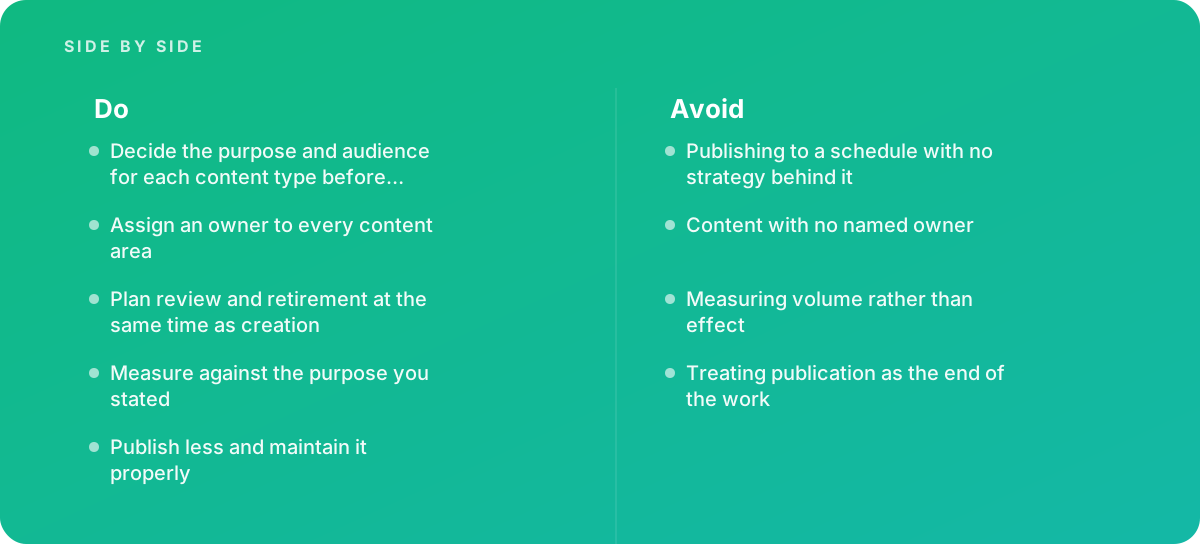
Publishing to a schedule with no strategy behind it
Symptom: the editorial calendar is organized by date, and topics are chosen in the week before they are due. Nobody can explain how this month's posts relate to last month's. Fix: tie every calendar slot to a content type in the strategy table and a specific audience task, and allow slots to stay empty when no worthwhile piece is ready.
Content with no named owner
Symptom: when a customer reports an error on a page, it takes days to find out who can fix it. Fix: add an owner field to the content management system and make it required on publication. For existing content, the audit assigns owners in bulk.
Measuring volume rather than effect
Symptom: monthly reports lead with posts published and total sessions, and nobody can say whether support contacts, inquiries or conversions changed. Fix: rebuild the report around the primary signal for each content type, and show volume metrics only as context.
Treating publication as the end of the work
Symptom: the newest pages are polished and the oldest ones contain former product names, departed staff and broken links. Fix: the review queue, owned and visible, with time allocated in each owner's workload.
Two situations make these patterns especially costly. In a crisis, outdated or contradictory pages can do real harm, which is why crisis content preparation depends on knowing exactly what you have published. And in multi-location businesses, such as franchise networks, every ungoverned local page multiplies the risk of inconsistent claims.
Content Strategy Terms That Matter
Content strategy borrows vocabulary from publishing, information architecture and operations, and teams often use the same word to mean different things. Agreeing on a handful of terms removes a surprising amount of friction from strategy discussions.
- Content type
- A category of content that shares an audience, purpose, structure and review cycle, such as product pages, help articles or case studies.
- Governance
- The agreed rules about who can create, approve, change and retire content, and how those decisions are made.
- Content owner
- The named individual responsible for a page or content area remaining clear, accurate and reviewed on schedule.
- Purpose statement
- A single sentence describing the change in reader behavior or understanding a piece of content is meant to produce.
- Retirement condition
- A specific, checkable event or threshold that triggers archiving, merging, redirecting or removing content.
- Content inventory
- A complete list of existing content with its metadata; the factual starting point for any audit.
- Content audit
- A qualitative and quantitative assessment of inventoried content against the strategy, producing keep, update, merge or retire decisions.
When to Bring In Outside Help With Content Strategy
Most of what this guide describes can be done in-house by a team that has the time and authority to do it. Outside help earns its cost in three specific situations: when a content library has grown to the point where the team cannot maintain it, when nobody in the organization can say what the content is for, and when publishing has continued for years without any measurable effect.
In each case the underlying problem is that the internal team is too close to the content, or too stretched by daily production, to step back and make the structural decisions. An outside team can run the inventory and audit, facilitate the purpose and ownership decisions with stakeholders who might not otherwise agree, and hand back a working operating model rather than a slide deck.
If you go this route, judge candidates by whether they start with questions about audience, purpose and ownership, or with a proposal to publish more. Our guide to choosing a content agency lists the questions worth asking, and our content strategy services describe how we approach audits, governance and planning work.
Content that nobody owns, nobody measures and nobody plans to retire is not an asset. It is an unscheduled maintenance bill.
Verdict Getting content strategy fundamentals right means answering five questions before you commission anything: who the content is for, what it should achieve, who owns it, when it will be reviewed and retired, and how success will be measured. Teams that write those answers down, assign named owners, plan the whole lifecycle and publish less but maintain it properly end up with smaller libraries that work harder. Teams that skip them end up with large libraries nobody can vouch for.
Where this comes from
- GOV.UK Service Manual — Content strategy
- Nielsen Norman Group — Content strategy research
- Google Search Central — Creating helpful content
The figures and practices above come from the sources listed.
Working on something like this?
We take on Content Strategy work for teams who want it done once, properly. Tell us what you are building and we will tell you honestly whether we are the right studio for it. Start a project.
Where to go next
Spotted something wrong? Report an error on this page. We correct on the page and say what changed.