MPEG-DASH Streaming, Done Properly
Dynamic Adaptive Streaming over HTTP, an international standard for adaptive streaming that, like HLS, delivers video in segments at multiple quality levels.
 MediaScaleUp Editorial Team

Where most projects go wrong
The usual mistakes:
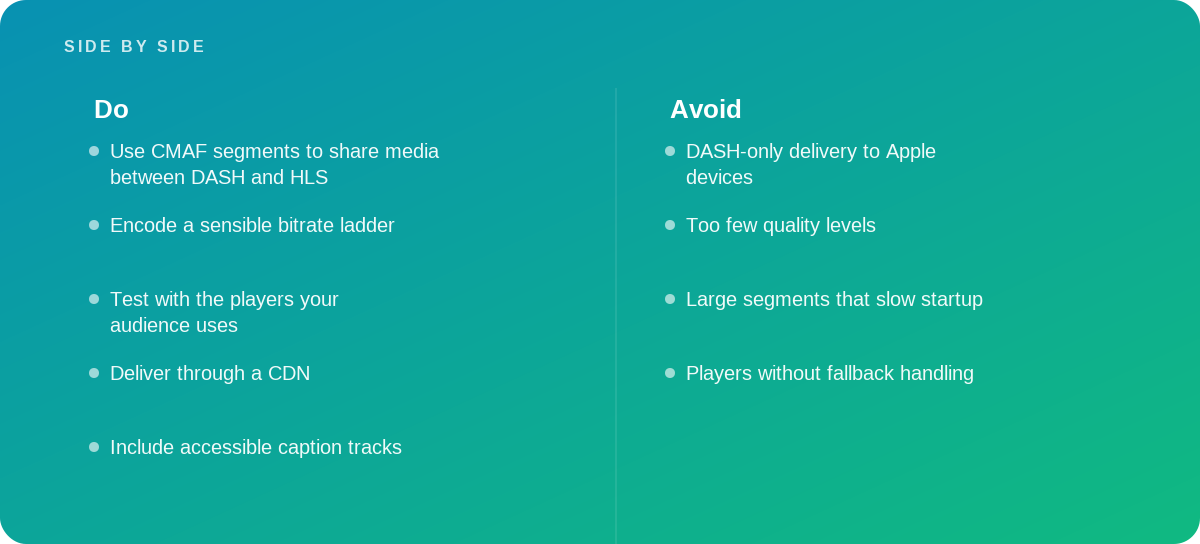
- DASH-only delivery to Apple devices
- Too few quality levels
- Large segments that slow startup
- Players without fallback handling
What good looks like instead
- Use CMAF segments to share media between DASH and HLS
- Encode a sensible bitrate ladder
- Test with the players your audience uses
- Deliver through a CDN
- Include accessible caption tracks
Why it matters
DASH is codec-agnostic and widely used by large streaming services, often alongside HLS for full device coverage.
The specs that matter
| Measure | Figure |
|---|---|
| Standard | ISO/IEC 23009-1 |
| Manifest | an MPD file describes available streams |
| Codec-agnostic | works with H.264, HEVC, AV1 and others |
| Apple devices | native playback typically uses HLS instead |
Knowing when to hand it over
Tip: Bring in help when building a streaming platform or large video library.
Where this comes from
- ISO — ISO/IEC 23009-1 Dynamic adaptive streaming over HTTP
- MDN Web Docs — Media Source Extensions API
The figures and practices above come from the sources listed.
Working on something like this?
We take on Video Editing & Production work for teams who want it done once, properly. Tell us what you are building and we will tell you honestly whether we are the right studio for it. Start a project.
Where to go next
Spotted something wrong? Report an error on this page. We correct on the page and say what changed.