How to Get Background Video Loops for Websites Right
Six common myths about background video loops for websites, debunked: autoplay rules, file weight, pause controls, text contrast, seamless joins and sizing.
 MediaScaleUp Editorial Team

Background video loops for websites are short, silent clips that play behind a page's content, usually a hero section, and are set to autoplay, stay muted and repeat on their own. Done well, they give a page atmosphere that a still photograph can't: steam rising off a coffee cup, a slow drift across a production floor, light moving over fabric. Done badly, they make the page slow and distracting, and they can shut some visitors out.
This guide is for business owners, marketers and in-house web teams deciding whether a background loop is worth it and how to brief one. It is also for editors and developers who build them. The format is simple. We take the six misconceptions we run into most often, explain why each one fails, and describe the practice that works. Each point rests on how browsers actually handle video and on what the accessibility standards require, not on taste.
Everything here comes down to one idea. A background loop is a web asset first and a piece of film second. It has to load fast, sit behind text without hurting readability, let people stop it, and loop without a visible seam. If you plan for those four things from the first brief, the creative choices get easier, not harder.
What a background loop actually has to do on a page
Before the myths, it helps to be clear about the job. A background loop is decorative. It supports the headline and the call to action above it; it is not the content. A viewer should be able to ignore it completely and still understand the page. That single test settles a lot of arguments later: if the footage carries information someone needs, such as a product demo or a step-by-step process, it belongs in a proper player with controls and captions, not in the background.
In technical terms, a background loop is an HTML video element with a handful of attributes: autoplay so it starts without a click, muted so browsers allow that autoplay, loop so it repeats, playsinline so iPhones keep it inside the page instead of opening a full-screen player, and a poster image that appears before the first frame is ready. The MDN Web Docs reference for the video element documents each of these attributes, along with preload and source selection. It's worth a read for anyone who touches the markup.
Around that element sit the decisions that decide whether the loop helps or hurts. The table below lists them, the choices you have for each, and what each one costs.
| Decision | Typical options | What it affects |
|---|---|---|
| Clip length | Roughly 6 to 20 seconds | File size, how noticeable the repeat is |
| Resolution | 720p, 1080p, occasionally larger | Sharpness on large screens versus weight |
| Codec and container | H.264 in MP4 as the baseline; VP9 or AV1 in WebM as lighter alternatives | Compatibility and compression efficiency |
| Loading strategy | Poster first, video deferred; preload none or metadata | First paint and data use |
| Motion control | Visible pause button, reduced-motion handling | Accessibility compliance and comfort |
| Text treatment | Overlay tint, gradient, blur, or a calm section of footage | Readability of the headline and buttons |
With the job defined, here are the misconceptions that most often get in the way.
Myth 1: Autoplay background video plays on every device
Myth: If you add the autoplay attribute, the video starts for every visitor on every browser and device.
Reality: Browsers allow autoplay only under certain conditions, and even then some device settings can block it. A background loop has to look finished whether or not it ever plays.
Modern browsers restrict autoplay to protect users from unexpected sound and wasted data. The rule that matters for background loops is simple: browsers allow muted autoplay. A video with an audio track that isn't muted will usually be blocked until the visitor interacts with the page. That's why the muted attribute is not optional, even when the file has no sound in it. Browsers decide based on the element's muted state, not on whether the audio is silent.
The second requirement is specific to iPhones. Without the playsinline attribute, Safari on iPhone has historically treated video as something to open in its full-screen player. For a background element, that behavior makes no sense, and playsinline keeps the video inline inside the layout where you placed it. Leave it out and the loop may never play on the device many of your visitors use.
Where autoplay still fails
Even with muted and playsinline set correctly, there are situations where the loop won't start:
- Power-saving modes on phones and laptops can suspend autoplaying media to save battery.
- Data-saver settings and some browser extensions block or delay video downloads.
- Corporate networks sometimes filter video file types or throttle media traffic.
- Script errors elsewhere on the page can stop the code that starts or controls playback.
In every one of these cases, the visitor sees the poster image. That's why the poster isn't a placeholder you can fill with a random frame. It is the version of the hero that some share of your audience will actually see. Pick a frame that works as a strong still photograph, export it at a sensible compression level, and check that the headline reads well over it. If the design only works while the video is moving, the design isn't finished.
The practical fix
Write the markup with all four attributes (autoplay, muted, loop, playsinline) plus a poster. Then test in three states: video playing, video blocked, and video still loading on a slow connection. Treat the poster state as the baseline design and the motion as an enhancement on top. Teams that work this way rarely get surprised after launch.
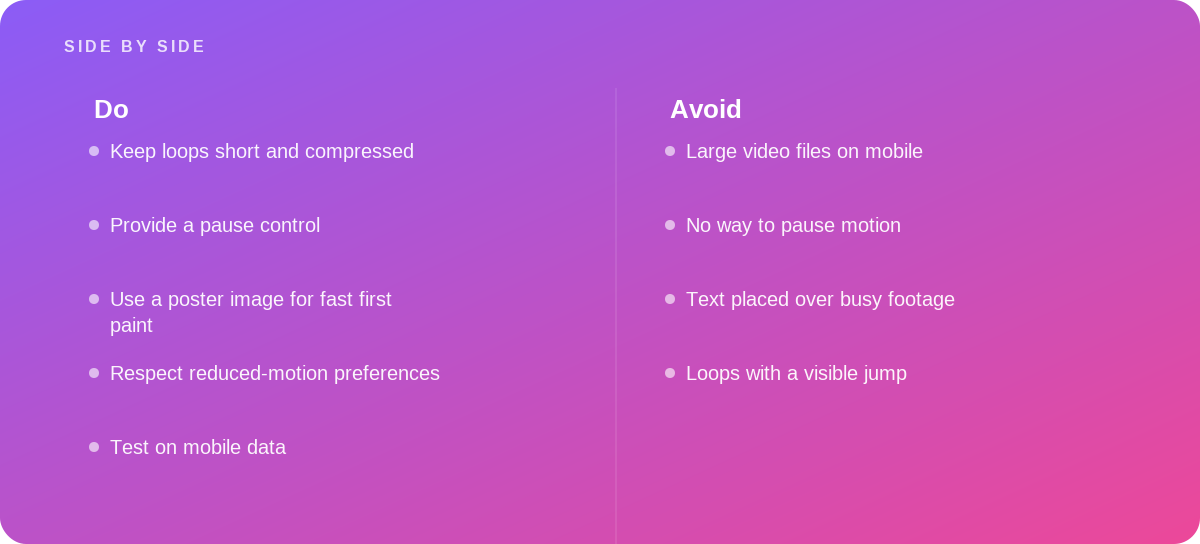
Myth 2: Once it's compressed, a background video costs almost nothing
Compression helps a great deal, but it doesn't make video free. Video is usually the heaviest thing on any page it appears on, often by a wide margin, and a background loop typically sits in the most important place on the site: the top of the home page, where first impressions and load-time measurements both happen.
Myth: Run the file through a compressor and the performance problem goes away.
Reality: Even a well-compressed loop can be several megabytes, larger than the rest of the page combined. Weight has to be budgeted from the brief, not fixed at export.
The reference point we give clients is plain arithmetic. File size is roughly bitrate multiplied by duration. A 10-second loop encoded at 2 megabits per second is about 20 megabits, or 2.5 megabytes. At 4 megabits per second it's 5 megabytes. Those numbers are why the length of the clip and the target bitrate are the two levers that matter most, and why they belong in the brief rather than being left to whoever exports the file.
What drives file size
- Motion and detail in the footage. Codecs compress by reusing information between frames. Slow, smooth movement over soft surfaces compresses well. Water, foliage, crowds, smoke, film grain and fast camera moves compress badly, because almost every pixel changes on every frame.
- Resolution. Going from 720p to 1080p more than doubles the pixel count. The encoder needs a higher bitrate to hold the same quality.
- Frame rate. 60 frames per second has twice as many frames to encode as 30. For ambient background movement, 24 to 30 frames per second is almost always enough. Our guide to choosing frame rates for web animation explains the trade-offs in more depth.
- Codec. H.264 in an MP4 container plays nearly everywhere and is the safe baseline. Newer codecs such as VP9 and AV1, usually delivered in WebM, can reach similar quality at lower bitrates, but support and encoding time vary. Offering a WebM source first and an MP4 fallback second lets each browser pick the first format it can play.
- Audio. A background loop should have no audio track at all. Strip it at export. It saves bytes and removes any doubt about whether the file is silent.
Loading strategy matters as much as file size
How and when the file loads matters as much as how big it is. The poster image should be what paints first. It should be a compressed still, ideally in a modern image format, sized to the hero container. The video itself can be deferred: set preload to none or metadata and start the download once the page's critical content has rendered. For MP4 files, make sure the file's index (the "moov atom") sits at the start of the file, often called "fast start," so the browser can begin playback before the whole file arrives.
Measure the effect on the page, not just the file
A file size tells you what the loop costs to download. It doesn't tell you what it does to the page. Run a lab performance test, such as the one built into your browser's developer tools, before and after adding the video, with the same throttling settings. Compare when the hero first becomes visible, how much data moves before the page is usable, and whether the main thread stalls while the video decodes. In many hero layouts the poster image, not the video, is the largest element painted early. That's one more reason to size and compress it carefully. If the numbers get noticeably worse, the fix is usually one of three things: a smaller poster, a later start for the video download, or a shorter or lower-bitrate loop.
On small screens, many teams serve a lighter file, a still image, or nothing at all. A phone on a mobile connection is exactly where a multi-megabyte decorative asset does the most harm, and the small viewport means the visitor gets less out of the motion anyway. Media queries in the markup or a small script can pick the source by viewport width. Always test on a real device with a throttled or genuinely mobile connection before you sign off, not just on the office network.
Some teams reach for an animated GIF because it seems simpler. For anything photographic, that's almost always the wrong trade. GIF is a very inefficient format for video-like content, and a GIF loop is usually many times larger than an equivalent MP4. Our guide to getting animated GIFs right covers where that format still makes sense and where it doesn't.
Myth 3: Decorative motion doesn't need a pause button
This is the misconception with the most serious consequences, because it's the one that creates an accessibility failure rather than just a slower page. The reasoning goes: it's only decoration, there's no information in it, so there's nothing to control. The standard says otherwise.
Myth: A background loop is decoration, so accessibility rules about media don't apply to it.
Reality: Moving content that starts automatically, lasts more than five seconds and plays alongside other content needs a way to pause, stop or hide it. A looping background video meets all three conditions.
Web Content Accessibility Guidelines success criterion 2.2.2, Pause, Stop, Hide, covers exactly this case. The W3C Web Accessibility Initiative's explanation of SC 2.2.2 explains the reasons. Movement next to text pulls attention, and for people with attention-related disabilities it can make reading the rest of the page very hard. For people with some vestibular or cognitive conditions, continuous motion can cause real discomfort. The criterion is at Level A, the baseline level of conformance. It isn't an optional extra for sites aiming at the highest bar.
What a good pause control looks like
- Visible without hunting. Place it on or next to the video, usually in a corner of the hero, not in a footer or settings panel.
- A real button. Use a native button element so it can be reached with the keyboard and announced correctly by screen readers, with an accessible name such as "Pause background video" that switches to "Play background video."
- Enough contrast and size. The icon has to stay visible over every frame of the footage, including the lightest and darkest moments. A small solid backing shape behind the icon solves this reliably.
- Remembered. If a visitor pauses the loop, keep it paused as they move between pages that share the same hero, for example by storing the choice for the session.
Respect reduced-motion preferences as well
Operating systems let people ask for less motion, and browsers expose that choice through the prefers-reduced-motion media query. When it's set, the sensible default is to not autoplay the loop at all. Show the poster and let the visitor start the video if they want to. This is separate from the pause control, not a replacement for it. Many people who find motion distracting never change that system setting, so the button still has to be there.
The same thinking applies to other kinds of automatic motion on a page. If your site also uses scroll-linked effects, our practical guide to scroll-triggered animation covers how to scale those back for reduced-motion users without breaking the layout.
Myth 4: Any footage works if the headline is big enough
Designers often pick footage because it looks great full-screen in the edit suite, then drop a headline and two buttons on top. In the browser, the headline flickers between readable and unreadable as the footage behind it changes. Size alone doesn't fix that.
Myth: If the type is large and bold, it'll read over whatever footage sits behind it.
Reality: Readability depends on contrast at every frame, not on average. Busy, high-contrast footage behind text is one of the most common reasons background video fails.
The accessibility guidelines set minimum contrast ratios for text against its background: 4.5:1 for normal body text and 3:1 for large text under success criterion 1.4.3. With a still image you can measure that once. With video, the background changes constantly, so the ratio has to hold at the brightest and busiest moment in the loop, not just on the frame you checked in the design file.
Choosing and treating footage for text
- Pick calm footage. Good background loops tend to have a limited tonal range, slow movement and large areas of soft texture. A locked-off or slowly drifting camera works far better than handheld or fast cuts.
- Plan negative space. If you're shooting or commissioning new footage, frame it so the subject and the action sit away from where the headline will go. On a left-aligned layout, keep the main action on the right third.
- Use a tint or gradient overlay. A semi-opaque dark or brand-colored layer over the video, or a gradient that darkens only the text side, is the most reliable fix. Apply it in CSS rather than baking it into the video, so you can adjust it without re-encoding.
- Consider softening the footage. A slight blur or reduced saturation in the grade pushes the video back so the type can come forward. It also tends to reduce file size, because softer frames compress better.
- Check the extremes. Scrub through the entire loop with the final type layered on top, and stop on the lightest and busiest frames. If any frame fails, adjust the overlay or trim that section out.
Buttons deserve the same care as headlines. A ghost button (outline only) often disappears against moving footage, so a solid fill is usually safer for the primary call to action.
Myth 5: A loop is just a clip set to repeat
The loop attribute tells the browser to jump back to the start when the video ends. It does nothing to hide that jump. If the last frame doesn't match the first, every visitor sees a hard cut every few seconds: a cloud that teleports, a light that snaps back, a person who vanishes mid-stride.
Myth: Trim any clip to length, set it to loop, and the browser will make it seamless.
Reality: Seamlessness is built in the edit, before export. The browser simply restarts the file, so a visible jump in the source becomes a visible jump on every repeat.
Techniques that produce a clean loop
- Find a natural loop point. Some footage already repeats: waves, a rotating object, a steady pan across a repeating texture. Scrub for two frames that match closely and cut there.
- Crossfade the end into the start. Duplicate the clip, overlap the tail of the first copy with the head of the second, and dissolve between them over roughly half a second to two seconds, depending on how much movement there is. Then render only the section between the two matching points, so the dissolve becomes the join.
- Build the loop in motion graphics. For animated or generated backgrounds, set the animation's end keyframes to match its start exactly, and use cyclical expressions or looping noise so the motion ends where it began.
- Avoid ping-pong for real footage. Playing a clip forward and then backward hides the cut but makes people, smoke and water move unnaturally in reverse. It can work for abstract motion, but it rarely convinces for live action.
There's also a playback detail. Some browsers show a very brief pause or stutter at the loop point, especially with long files or files whose keyframe structure isn't friendly to seeking back to the start. Keeping the clip short, placing a keyframe on the first frame (which encoders do by default), and testing across the main browsers will catch this before launch. Our practical guide to seamless loops goes through the editing techniques in detail, including how to handle camera movement and lighting changes.
If the loop needs to sit over a colored or patterned page rather than filling a rectangle, the job becomes a transparency problem. Browser support for video with an alpha channel is uneven, and file sizes jump. Read our guide to transparent video and alpha channels before promising that effect in a brief.
Myth 6: Longer, sharper footage always looks more premium
There's a natural instinct to use the best master you have: the 4K file, the full 45-second take, the high-frame-rate version. On a web page, those choices usually make the experience worse, not better.
Myth: Higher resolution and a longer clip make the background loop look more premium.
Reality: Behind an overlay and a headline, the difference between 1080p and 4K is rarely visible, while the extra weight is felt by every visitor. A short, well-chosen loop almost always reads as more polished than a long, heavy one.
Length
Most effective background loops fall somewhere between about 6 and 20 seconds. Shorter than that, the repetition becomes obvious, and the viewer starts noticing the pattern instead of the mood. Longer than that, file size climbs with little gain, because most visitors will scroll past the hero within a few seconds anyway. The right length depends on the footage: slow, even motion can repeat every 8 seconds without anyone noticing, while footage with a distinctive event, such as a person walking through frame or a bird crossing the sky, needs to be longer or needs that event removed.
Resolution
For full-width heroes, 1280 by 720 is often enough once an overlay, softening and a headline are in place. 1920 by 1080 is a reasonable ceiling for large desktop screens when the footage is shown with little treatment. Resolutions above that are rarely justified for a decorative loop. If you serve different files by screen size, a mobile version can drop to 720 pixels wide or narrower, and often a portrait crop suits a phone layout better than scaling down a landscape frame.
Frame rate and grade
Match the frame rate of the source where you can, and don't raise it. Conforming 24 frames per second footage to 60 only adds weight. A slightly softer grade, with lifted blacks, gentler highlights and reduced saturation, helps the footage sit behind the type and compresses more cleanly than a punchy, high-contrast one.
This is also where background loops differ from other motion work. A brand sting or an explainer is watched on purpose, so detail and pacing earn their place. Our guides to explainer video animation and animated logos and stings deal with footage people choose to watch. A background loop is seen in passing, so restraint is the craft.
Worked example: specifying a hero loop for a studio home page
To show how these decisions fit together, here is an illustrative example. It isn't a client project; the numbers are realistic starting points you would adjust after testing.
The page is the home page of a small manufacturing company. The brief calls for a hero with footage of a machine shop floor, a left-aligned headline, a one-line subhead, and a single primary button.
Step 1: Select and cut the footage
From 90 seconds of raw footage, the editor picks a slow, locked-off shot of a lathe with gentle movement of light across metal. There are no people walking through frame, so there's nothing that draws attention on repeat. A 10-second section is chosen, and the last 1.5 seconds are crossfaded into the first 1.5 seconds to create a seamless join. The main action sits on the right two-thirds of the frame, leaving the left side calmer for type.
Step 2: Grade and treat
The grade lowers contrast and saturation slightly. In the page CSS, a gradient overlay darkens the left 60 percent of the hero, fading to nearly transparent on the right. The designer scrubs the whole loop with the headline and button layered on top and confirms that white text stays above the 4.5:1 contrast ratio on the brightest frame.
Step 3: Encode
The 10-second clip is exported at 1280 by 720, 25 frames per second, with no audio track. Two files are produced:
- A WebM file using a modern codec, targeted at roughly 1.2 megabits per second, which works out to about 12 megabits, or 1.5 megabytes.
- An MP4 fallback using H.264, targeted at roughly 1.8 megabits per second, about 18 megabits or 2.25 megabytes, with fast start enabled so playback can begin before the download finishes.
A 720-pixel-wide portrait crop at around 1 megabit per second (about 1.25 megabytes) is also produced for phones. The team reviews each file full screen and at hero size. If banding or blockiness appears in the gradients of the metal, the bitrate is raised in small steps until it disappears, and the new sizes are rechecked against the budget.
Step 4: Build and test
The poster image is a strong still from the loop, exported as a compressed image at around 100 to 200 kilobytes. The video element uses autoplay, muted, loop and playsinline, with preload set to none, and a script starts loading the video after the page's main content has rendered. A native pause button sits in the lower right corner with a solid backing shape. When the visitor's system asks for reduced motion, the video doesn't autoplay and the button reads "Play background video."
The team tests on a desktop browser, an iPhone, an Android phone on a throttled mobile connection, and with the power-saving mode switched on. In that last case the poster shows, and the page still looks finished. Total cost of the motion on desktop is about 1.5 megabytes in modern browsers. On phones it is about 1.25 megabytes, and that happens only after the page is readable.
Notice what the example doesn't include: a 4K master, a 40-second take, or a soundtrack that someone forgot to strip. Each of those would have multiplied the weight without making the hero look better at the size it is actually seen.
Checklist for background video loops that load fast and stay accessible
The six myths share a pattern. Each one treats the loop as if it were only a video. The practice that replaces them treats it as a component of the page, with a budget, a fallback and controls. Use this list when you brief, build or review a background loop.
- Confirm the footage is decorative; anything carrying information goes in a proper player with controls and captions.
- Set autoplay, muted, loop and playsinline on the video element, and include a poster image.
- Design the poster state first and make sure the page looks finished without motion.
- Budget file size from length and bitrate in the brief, and strip the audio track.
- Keep loops roughly 6 to 20 seconds, at 720p to 1080p and the source frame rate.
- Offer a lighter source or a still image on phones, and test on a real mobile connection.
- Defer the video download until the page's critical content has rendered; enable fast start on MP4 files.
- Add a visible, keyboard-accessible pause button with a clear accessible name.
- Skip autoplay when the visitor's system requests reduced motion.
- Check text contrast on the brightest and busiest frame, and use an overlay or gradient where needed.
- Build the seamless join in the edit and watch several full cycles in each major browser.
If a draft loop fails more than two of these checks, it's usually faster to go back to footage selection than to keep patching the encode. Calm footage with room for type fixes several problems at once: smaller files, better contrast and an easier loop point.
When to bring in a motion specialist
Plenty of teams can ship a solid background loop in-house, especially with stock footage that already loops and a developer who knows the video element. Bring in help when the background video is slowing the page or creating accessibility problems you can't resolve, when you need custom footage shot or animated to leave room for type, or when the loop has to work across a large site with many templates and screen sizes.
What to keep an eye on after launch
Background loops tend to decay quietly. A marketing team swaps in new footage without re-encoding it, a redesign moves the headline onto the busiest part of the frame, or a template change drops the pause button on one page type. Put the loop on your regular site review list. Check the file sizes actually being served, confirm the pause control and reduced-motion behavior on each template that uses video, and re-test contrast whenever the footage or the copy changes. These checks take minutes and catch the problems most likely to creep back in.
A good specialist will ask about your page, not just your footage. Expect questions about the headline length, the size budget, what the page should look like with motion off, and how the pause control will fit your design system. If a proposal only mentions resolution and frame rate, it's missing half the job. Our animation and motion graphics service covers background loops alongside the rest of a site's motion work, including cutting, grading, encoding and handoff notes for developers. You can also browse more practical guides in our motion graphics and animation articles.
Where this comes from
- MDN Web Docs — The video element
- W3C Web Accessibility Initiative — Understanding SC 2.2.2 Pause, Stop, Hide
The figures and practices above come from the sources listed.
Working on something like this?
We take on Motion Graphics & Animation work for teams who want it done once, properly. Tell us what you are building and we will tell you honestly whether we are the right studio for it. Start a project.
Where to go next
Spotted something wrong? Report an error on this page. We correct on the page and say what changed.