A Practical Guide to A/B Testing for Design
Running two or more versions of a design against real traffic and measuring which performs better on a defined metric.
 MediaScaleUp Editorial Team

Where most projects go wrong
The usual mistakes:
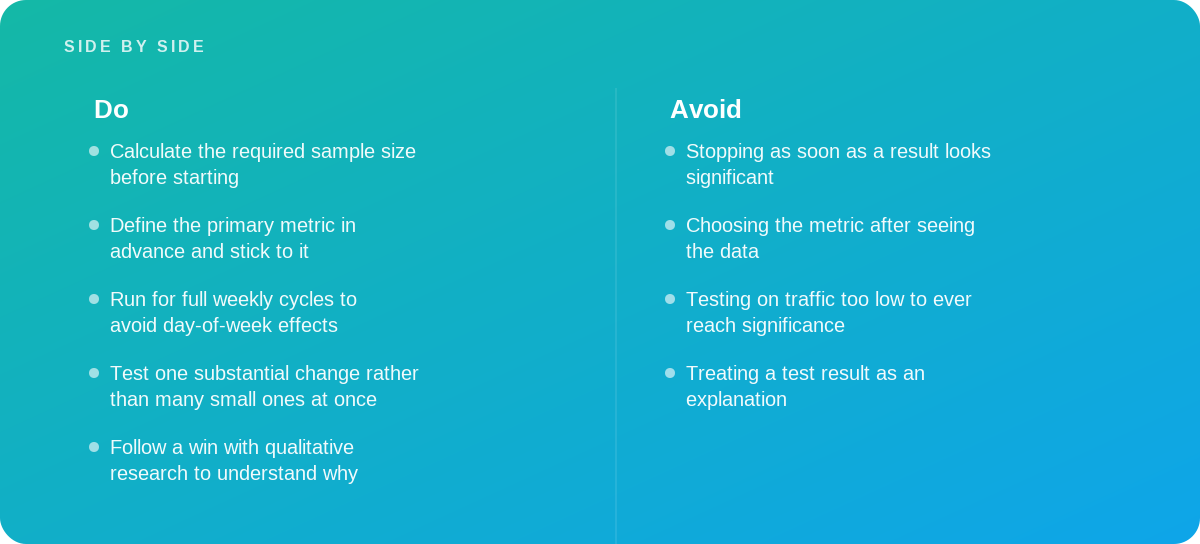
- Stopping as soon as a result looks significant
- Choosing the metric after seeing the data
- Testing on traffic too low to ever reach significance
- Treating a test result as an explanation
What good looks like instead
- Calculate the required sample size before starting
- Define the primary metric in advance and stick to it
- Run for full weekly cycles to avoid day-of-week effects
- Test one substantial change rather than many small ones at once
- Follow a win with qualitative research to understand why
Why it matters
It settles arguments with evidence, and it is misused more often than any other research method because the statistics are easy to get wrong.
The specs that matter
| Measure | Figure |
|---|---|
| Requirement | enough traffic and conversions to detect the expected effect |
| Stopping early | inflates false positives substantially |
| Sample size | should be calculated before the test starts |
| Multiple metrics | testing many outcomes raises the chance of a spurious result |
| What it cannot tell you | why a version won |
Knowing when to hand it over
Tip: Bring in help when tests are consistently inconclusive, when traffic is too low for testing to be viable, or when a testing program needs designing.
Where this comes from
- Nielsen Norman Group — A/B testing guidance
- Google Analytics Help — Experiment reporting
- Baymard Institute — Testing methodology
The figures and practices above come from the sources listed.
Working on something like this?
We take on UI & UX Design work for teams who want it done once, properly. Tell us what you are building and we will tell you honestly whether we are the right studio for it. Start a project.
Where to go next
Spotted something wrong? Report an error on this page. We correct on the page and say what changed.