Transit and Public Announcements: What Actually Works
Recorded and live announcements in stations, vehicles and public buildings.
 MediaScaleUp Editorial Team

What is at stake
Announcements are safety and access information, and accessibility rules cover how they are delivered.
The playbook
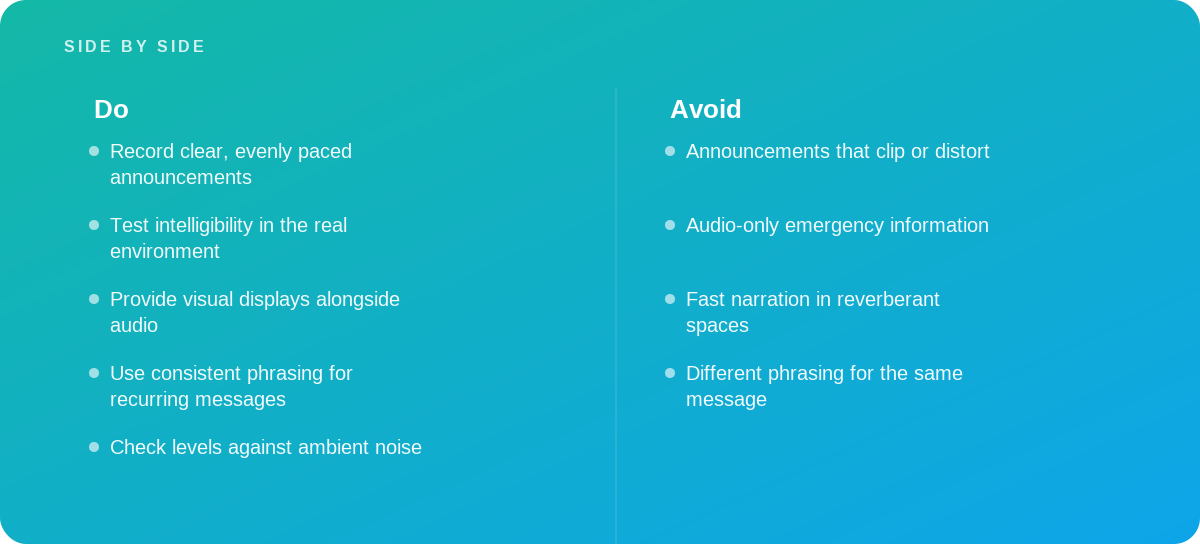
- Record clear, evenly paced announcements
- Test intelligibility in the real environment
- Provide visual displays alongside audio
- Use consistent phrasing for recurring messages
- Check levels against ambient noise
Where it goes wrong
Avoid:
- Announcements that clip or distort
- Audio-only emergency information
- Fast narration in reverberant spaces
- Different phrasing for the same message
The numbers behind it
| Measure | Figure |
|---|---|
| Accessibility | public transport announcements have accessibility requirements |
| Intelligibility | speech clarity in noisy spaces is the core challenge |
| Visual equivalents | announcements need visual alternatives |
| Consistency | standard phrasing helps comprehension |
Getting outside help
When to hand it over: Bring in help when public spaces upgrade announcement systems.
Where this comes from
- U.S. Access Board — Communication elements and features
- U.S. Department of Transportation — Accessibility
The figures and practices above come from the sources listed.
Working on something like this?
We take on Audio Editing & Production work for teams who want it done once, properly. Tell us what you are building and we will tell you honestly whether we are the right studio for it. Start a project.
Where to go next
Spotted something wrong? Report an error on this page. We correct on the page and say what changed.