Time Series Data Storage, Done Properly
Storing measurements taken over time, such as sensor readings, metrics and usage counters.
 MediaScaleUp Editorial Team

Where most projects go wrong
The usual mistakes:
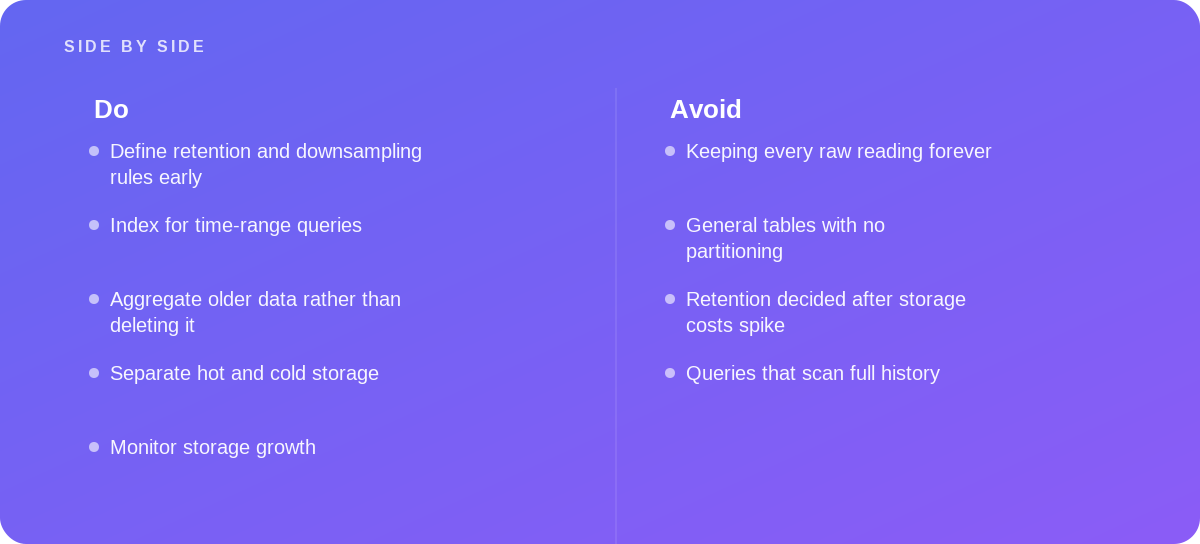
- Keeping every raw reading forever
- General tables with no partitioning
- Retention decided after storage costs spike
- Queries that scan full history
What good looks like instead
- Define retention and downsampling rules early
- Index for time-range queries
- Aggregate older data rather than deleting it
- Separate hot and cold storage
- Monitor storage growth
Why it matters
Time series data grows relentlessly, and general-purpose tables become slow and expensive without a strategy.
The specs that matter
| Measure | Figure |
|---|---|
| Volume | high-frequency data accumulates quickly |
| Downsampling | older data can be stored at lower resolution |
| Retention | raw data is rarely needed forever |
| Query patterns | time-range queries dominate |
Knowing when to hand it over
Tip: Bring in help when metrics or sensor data grows fast.
Where this comes from
- Microsoft Learn — Time series data
- Microsoft Learn — Data partitioning
The figures and practices above come from the sources listed.
Working on something like this?
We take on Web Design & Development work for teams who want it done once, properly. Tell us what you are building and we will tell you honestly whether we are the right studio for it. Start a project.
Where to go next
Spotted something wrong? Report an error on this page. We correct on the page and say what changed.




