Music Licensing and Clearance: What Actually Works
Follow an illustrative ad campaign from brief to launch and learn how music licensing works: two rights, license scope, temp tracks and keeping records.
 MediaScaleUp Editorial Team

Music licensing and clearance means getting permission to use a specific piece of music for a specific purpose, in a specific territory, for a specific period. That sounds like paperwork, and much of it is, but it decides whether a finished video can go live, whether a paid campaign keeps running once it starts, and whether a brand gets a demand letter six months after launch. Every piece of recorded music carries two separate rights, one in the composition and one in the master recording. Using a track without clearing both is the most common rights failure in commercial production.
This guide is for marketers, in-house video teams and business owners who commission video with music in it, and for editors who have to keep projects clearable. Instead of listing rules, it follows one project from brief to delivery and explains each decision as it comes up. The project is illustrative. It is a composite of the kind of work a production studio handles, not an account of a real client, and its numbers are there to show how the reasoning works, not to serve as benchmarks.
The illustrative project is a spring campaign for a mid-sized furniture retailer: one 60-second brand film, cut down to 30 and 15 seconds, running as paid pre-roll and paid social, on the brand's own channels, and on screens in its stores. Almost every common clearance trap shows up in a campaign like this, which makes it a useful case to walk through.
The Brief: What the Furniture Campaign Needed Its Music to Do
The brief arrived as a creative deck and a media plan. The deck described the mood: warm, optimistic, a little nostalgic, with a lift at the moment the family walks into the finished living room. The media plan mattered more for clearance, because it said where and how long the music would be heard. Reduced to the facts that shape a license, the illustrative brief looked like this:
- Deliverables: a 60-second hero film, a 30-second cutdown and a 15-second cutdown, plus square and vertical versions of the two shorter edits for social feeds.
- Media: paid pre-roll on YouTube, paid placements on two social platforms, organic posts on the brand's own channels, the retailer's website, and looping playback on screens in its stores.
- Territory: the United States and Canada, with the Canadian versions carrying a French-language end card.
- Term: a 12-month flight, with an option the client wanted to keep open to run the hero film again the following spring.
- Constraint: a fixed overall production budget with no separate music line, which turned out to be the first problem.
The first decision happened before anyone discussed tracks. We converted the media plan into a written license specification: a single paragraph listing each medium, each territory and the term, which any music supplier could quote against. Without it, every conversation with a library, publisher or composer starts with "what do you need it for?" and ends with a license that covers something slightly different from what you actually plan to run.
Those four figures are the illustrative project's scope, and each one feeds directly into the license. Seven deliverables across five kinds of media mean the music has to be cleared for every one of those uses, not just for "online video." That is why the specification had to exist before a single track was auditioned.
Mapping the Two Rights Before Anyone Opened the Edit
The single idea that prevents most clearance failures is that a recorded song is two copyrighted works stacked on top of each other. The composition is the melody, harmony and lyrics as written, usually controlled by the songwriters' music publishers. The master recording is the particular recorded performance, usually controlled by the record label or whoever paid for the recording. Our guide to how sound recording and composition copyrights differ goes into ownership in more depth. For this project, what mattered was the practical consequence: to put a commercially released song into an ad, you need a synchronization license from the composition owners (permission to synchronize the music with moving images) and a master use license from the recording owner. Getting one without the other leaves you just as exposed as having neither.
A few things make this harder than it sounds:
- Compositions often have several owners. A song with three co-writers may be split across three publishers. Each one has to agree, and any one of them can refuse or ask for a higher fee.
- A cover version does not avoid the composition. Re-recording a famous song gets around the master, because you own your new recording, but you still need the composition owners' sync license. Many teams find this out too late.
- Old recordings are not automatically free. A composition may have entered the public domain while a particular recording of it is still protected, and the rules differ by country. Our piece on public domain and royalty-free music decisions covers where teams get caught.
- Performance royalties are a separate stream. When music is broadcast or played in public, performing rights organizations collect royalties for the composition's owners. That is usually the broadcaster's or venue's responsibility, but it matters for in-store screens, as we come back to below.
Decision: Every candidate track would be logged with both rights holders named before it went into an edit. If we could not name who controlled the composition and who controlled the master, the track stayed out of the timeline.
That rule sounds bureaucratic, but it takes minutes per track and it is what makes the rest of the process predictable. A track whose ownership can't be traced is a track you can't clear, however well it fits the picture.
Defining License Scope: Media, Territory and Term for This Campaign
Every music license is defined by three variables: media (where it plays), territory (where in the world) and term (for how long). The fee, and whether the owner will license at all, depends on all three. The media plan we had turned into a license specification covered them as follows.
Media
Paid advertising is the variable that catches people most often. Many libraries and subscription services sell licenses that cover organic content on your own channels but exclude paid media, broadcast, or both, or put them in a higher tier. Pre-roll on YouTube and paid social placements are paid advertising, even though they are online. Organic posts on the brand's own accounts are not. The in-store screens were a third case: the video's sync rights had to allow in-venue display, and separately, the retailer needed to confirm whether its existing public performance arrangements for in-store music covered music played back inside video. We asked the retailer's operations team to check with whoever handles its background music licensing. Our guide to retail background music done properly explains why in-store audio is licensed differently from online video.
Territory
Copyright is territorial, and so are licenses. A license limited to the United States does not cover the Canadian versions of the same ad, even if the edit is identical. Within the European Union, much copyright law is harmonized, but licensing is still commonly granted territory by territory. The European Commission's copyright framework is a useful reminder that even across a single market, rights are defined country by country. For this campaign, we specified "United States and Canada" rather than "North America," because some licenses define North America to include Mexico and some do not, and a fee quoted for a wider area than you need is money wasted.
Term
A 12-month term was straightforward. The option to rerun the hero film the following spring was not. A term that ends after the first flight means the second flight needs a new license, and nothing obliges the rights owner to offer the same terms again. We asked every supplier to quote the 12-month term and, separately, a price for extending by a further 12 months, agreed now as an option. That way the client knew the cost of the rerun before they committed to the creative.
| Scope variable | What the campaign needed | Where licenses commonly fall short |
|---|---|---|
| Media: paid online | YouTube pre-roll, paid social placements | Subscription tiers limited to organic or non-advertising use |
| Media: owned | Brand channels, website | Usually covered, but check "client use" versus "creator use" |
| Media: in-venue | Looping playback on in-store screens | Public performance handled separately from sync rights |
| Territory | United States and Canada | Single-country licenses; inconsistent definitions of "North America" |
| Term | 12 months, plus an option for 12 more | Fixed terms with no pre-agreed renewal price |
| Versions | 60, 30 and 15-second edits in three aspect ratios | Licenses that cover "one production" and not its cutdowns |
The last row matters more than it looks. Some licenses count each edit as a separate production and some cover cutdowns of a single spot. The illustrative campaign had seven deliverables, so the wording decided whether we needed one license or several.
The Temp Track Problem We Headed Off in Week One
When the offline editor delivered the first assembly, it was cut to a temporary track: a well-known commercial pop song with a big chorus lift, which the director had used on the mood reel. Everyone loved it. Nobody had budgeted to clear it.
This is the most expensive habit in commercial post-production. An edit built around a temp track takes on its tempo, its phrasing and its emotional peaks. Cuts land on its downbeats, and the reveal is timed to its chorus. By the time the client approves the edit, they have approved the song too, whether or not anyone has asked what it costs to license. Then one of three things happens. The track turns out to be available at a fee far above the budget. Or it is unavailable at any price, because the artist doesn't license to advertising, one co-publisher refuses, or the label won't license the master. Or the team re-edits to a replacement that everyone agrees is worse, because they are hearing it against a song they have lived with for weeks.
Trap avoided: Editing to a temporary track nobody has budgeted to clear. We raised it the day the assembly arrived, not at client approval, and gave the team two choices:
- Price the temp track now, through the publishers and label, with a firm deadline for a quote.
- Replace it before the next review with cleared or clearable alternatives, so the edit is built on music that can actually go to air.
The client asked for a quote on the temp track. We sent a request to its publishers and label with the full license specification. The reply came back with a fee well beyond the whole production budget for the spec as written, and a condition that the label approve the final edit. That settled it. The team moved to alternatives in week two rather than week six, and the editor re-cut to candidate tracks while the structure of the edit was still flexible.
If you do use temp music, there are two sensible rules. Temp only with tracks you could realistically license, such as library tracks within the budget. Or temp with something deliberately unlike any final choice, so the edit isn't locked to one song's structure. Our article on choosing music for video covers how to brief music around the picture instead of around a favorite track.
Choosing a Clearance Route: Commercial Track, Production Music or a Commission
With the temp track ruled out, there were three realistic ways to get music into this campaign, and they trade off cost, control, speed and risk in different ways.
- License another commercial track. Direct deals with publishers and a label for a released song. It gives you the most recognition, but costs the most, carries the most uncertainty and takes the longest, because every rights holder negotiates separately.
- Production music. Pre-cleared libraries where one company controls both the composition and the master, licensed per use or by subscription. It is fast and predictable, and one agreement covers both rights, provided the tier matches your media.
- Commission original music. A composer writes and records a piece for the film. It fits the picture exactly and can be owned outright or licensed broadly, but it needs lead time and a clear agreement on who owns what.
| Criterion | Commercial track | Production music | Original commission |
|---|---|---|---|
| Rights holders to deal with | Several: publishers plus label | Usually one library | The composer, sometimes a publisher |
| Time to a signed license | Weeks, sometimes longer | Same day to a few days | Two to four weeks including writing |
| Cost predictability | Low until quotes arrive | High: published rate cards | High once the fee is agreed |
| Fit to picture | Edit adapts to the song | Edit adapts to the track, with stems | Music is written to the edit |
| Exclusivity | Rarely | None: others can use the same track | Can be exclusive |
| Risk of refusal or delay | High | Low | Low |
Commercial tracks were already ruled out by the temp track quote. The real choice was between production music and a commission. What decided it was timing and future use. The shoot was three weeks away, and the client wanted the option of a sonic signature it could reuse across future campaigns. A commission would give them that, but writing, revising and recording in the time available was tight. Production music could be licensed within days.
Decision: Use production music for this campaign, with a license tier that explicitly covers paid media, and brief a composer separately, with no deadline pressure, for a short sonic logo the brand could own for future work. That kept the launch date safe and gave the client a longer-term asset.
If the brand identity question had been more pressing, a commission would have been the better choice. Our guides to commissioning original music and audio branding and sonic identity cover what goes into that agreement: ownership, exclusivity, stems and future edits.
Reading the Production Music License Line by Line
The music supervisor shortlisted four library tracks from two libraries against the creative brief. The director chose one, a piano-and-strings piece with a percussion build that landed where the family enters the room. Before anyone celebrated, we read the license terms for the tier the client was about to buy. This is where production music projects usually go wrong. The music is pre-cleared, but only for the uses the tier names.
What we checked
- Does the tier cover paid advertising? The library's standard subscription covered online content on the subscriber's channels, but its terms excluded paid ad placements and broadcast. Assuming a library subscription covers paid advertising is one of the most common mistakes in this area. The campaign needed the library's advertising tier, which was sold per production.
- Who is the licensee? Licenses bought by a production company are sometimes limited to that company's own content. We made sure the license named the retailer as the end client and permitted use on its channels.
- What counts as one production? The advertising license covered "a single advertisement and its cutdowns and versions." That covered all seven deliverables. The written confirmation went into the file.
- Territory and term. The tier offered worldwide or single-territory options with 12-month terms and set renewal prices. United States plus Canada was priced as a two-territory option, which cost less than worldwide.
- Editing rights. The license had to allow editing, looping and remixing from stems, since the cutdowns would need restructuring.
- Content identification. The library registers its catalog with automated detection systems, so we checked how it clears claims on licensed uses. More on that below.
- Performance royalties and cue sheets. The library's composers are members of performing rights organizations. The license required a cue sheet if the ad was ever broadcast, which it was not in this flight.
Trap avoided: Assuming the studio's library subscription covered the campaign. It covered the organic social posts and nothing else. Buying the advertising tier cost more than the subscription, but running paid media under the wrong tier would have been an unlicensed use, visible to the library's detection systems from the first impression.
A final point on terms: keep the version of the license that was in force on the day you bought it. Libraries update their terms. Your rights are set by the agreement you accepted, and you want a copy of it rather than a link to a page that may change.
Editing the Cleared Track to 60, 30 and 15 Seconds
The library track ran just under three minutes. The hero film needed 60 seconds with the build landing at about 38 seconds, the 30 needed the build at about 20, and the 15 needed one clean statement of the motif with a proper ending rather than a fade. This is craft rather than clearance, but the two meet: the license has to permit the edits you make. Ours permitted cutting, looping and stem mixing but not changing the melody or adding new musical material. That ruled out having a composer add a bespoke ending.
- Map the track's structure Mark every section boundary, downbeat and phrase length in bars, plus the tempo, before cutting anything. The illustrative track was a steady tempo in four-bar phrases, which made clean edits possible.
- Plan the edit backward from the ending Find a real ending in the track, then count back from the target duration so the build and the resolution land on the picture's key moments.
- Cut on phrase boundaries with stems Edit the stems (piano, strings, percussion) separately so a cut hidden under a percussion hit doesn't leave a string note hanging.
- Build each cutdown as its own edit Do not trim the 60 into the 30. Re-plan from the ending so each version has a complete musical shape.
- Mix for each destination Mix the music under the voiceover for speech clarity, and deliver loudness to each platform's specifications, with a separate mix for in-store screens, which often play with sound low or in noisy spaces.
- Log what was changed Record the edit decisions against the license terms so anyone reviewing later can see the use stayed within what was licensed.
Our walkthrough of editing music to length covers the phrase-counting method in more depth. On this project, the result was three versions that each ended on a real cadence. That matters more than it seems, because a 15-second spot that fades out sounds unfinished.
Platform Detection, Content ID and Allowlisting Before Launch
Most major video and social platforms run automated content identification. Rights owners, including production music libraries, submit reference audio, and the platform compares new uploads against it. When it finds a match, the rights owner's chosen policy applies: the video might be tracked, have ads placed on it with revenue going to the claimant, or be blocked in some territories. YouTube Help's pages on Content ID and music policies explain the claim and dispute process from the uploader's side.
A licensed use can still receive a claim. The detection system identifies the audio, not the license behind it. Two practical consequences for the illustrative campaign:
- Allowlist the channels before launch. The library offered channel allowlisting (sometimes called whitelisting). The licensee registers the channels where the licensed content will appear, and the library tells its claiming system to leave them alone. We registered the retailer's brand channels on each platform before the first upload.
- Know the dispute route. Paid ads on some platforms are reviewed differently from organic uploads, and claims can still appear. We kept the license number and the library's claim-clearing contact in the delivery notes so the client's social team could resolve a claim in minutes, not days.
There is a related point in the other direction. A platform not detecting a piece of music does not mean it is safe to use. Relying on a platform not detecting a use is a strategy that fails as soon as the rights owner registers the track, and registration can happen at any time, including after your campaign has launched. Detection is how infringement gets found. It is not a test of whether something is licensed.
- Week 1 Brief received; media plan turned into a written license specification; temp track flagged on the first assembly.
- Week 2 Temp track quote received and ruled out; four library tracks shortlisted with both rights holders logged.
- Week 3 Track selected; advertising-tier license terms reviewed and purchased for United States and Canada, 12 months, with renewal price noted.
- Weeks 4 to 5 Shoot and edit; music cut to 60, 30 and 15 seconds from stems; mixes delivered for each platform and for in-store playback.
- Week 6 Channels allowlisted with the library; clearance file assembled; campaign launched.
- Month 11 Scheduled review of the renewal option ahead of the term ending.
The schedule has no "clearance week" at the end, because clearance ran alongside the creative work from the first day. That is the main structural lesson of the project. Budget and clear music at the brief stage, not after the edit.
Building the Clearance File That Outlives the Campaign
A license only protects you if you can produce it when asked, and the question often comes long after the campaign has ended: a claim on an archived video, an audit, a new marketing manager who wants to reuse the film. The rule is to keep the license for as long as the use continues, and in practice, for as long as any copy of the video remains published anywhere. We filed the documentation against the project, not in someone's inbox.
- The signed or accepted license agreement, saved as a PDF with the date of purchase, plus the terms as they read that day.
- The license specification that was quoted against: media, territory, term and the list of deliverables.
- Track metadata: title, composer, publisher, library, catalog number and any identifiers the library supplies.
- Both rights holders named, even though a single library controls both in this case.
- Written confirmation that cutdowns and aspect-ratio versions count as versions of one production.
- The list of allowlisted channels and the date each was registered.
- The term end date and renewal price, with a reminder set for a month before expiry.
- The composer agreement for the separately commissioned sonic logo, including ownership terms.
We also added one line to the video's master file notes in the client's asset library: the license number and term end date. Anyone who pulls the file in two years sees immediately that the music has a clock on it. Our guide to audio rights and clearance records covers how to structure this kind of file across a catalog of productions, which becomes essential once a brand has dozens of videos live at once.
Professional bodies such as the Audio Engineering Society publish material on audio practice, including metadata, and good metadata is what keeps a clearance file useful. A license that says "Track 14" is much harder to match to a video than one that carries the catalog number and composer names.
Reuse, Renewals and the Second Campaign
Ten months into the illustrative flight, the client asked the obvious question: could they take the hero film's music and use it on a new campaign for a different product line, and put the film on a connected TV service as well? The answer to both was "not under the current license," and the file made that clear in minutes.
- A new campaign is a new production. The license covered one advertisement and its versions. A new ad with the same music needs a new license, even though the track is the same.
- A new medium may be a new tier. Connected TV placements were outside the tier bought. Some libraries treat them as online and some as broadcast. We asked the library in writing, rather than guessing.
- A new territory is a new grant. The client mentioned possibly running in the UK. The current license was limited to the United States and Canada, and using a track cleared for one territory in another is a straightforward breach.
The general rule: re-clear before reusing a track on a new campaign or a new platform. The renewal option we priced in week three made the simple case, running the same film for another 12 months in the same places, a matter of paying a known fee. Everything else needed a fresh license request against a new specification.
Put simply, a license covers the use described in it and nothing else. When the media, territory, term or production changes, the clearance has to be done again.
Meanwhile, the composer had delivered the brand's sonic logo, a four-note motif with full ownership assigned to the retailer. From the next campaign onward, the brand had a piece of music it could put anywhere, which reduces how much clearance future campaigns need.
When This Project Would Have Needed Outside Help
The illustrative project stayed manageable because the music was production music from a single library, and the scope was clear from the start. Three changes to the facts would have called for specialist help. These are the points at which any team should bring it in.
- Before any broadcast or paid media use of a commercial track. Negotiating sync and master rights with several publishers and a label, clearing samples, and filing cue sheets for broadcast is music supervision work. Rights holders expect experienced counterparts, and a badly worded request can raise the price.
- When a claim or demand letter has already arrived. A Content ID claim on a licensed track is usually routine. A letter from a rights owner's lawyer about an unlicensed use is not, and the response should come from someone who knows how these settle.
- When an edit has been built around an uncleared temp track. The choice between pricing the track, re-editing, or commissioning a sound-alike brief, which carries its own legal risk if it copies too closely, should be made with clearance expertise before the client approves the cut.
Our music editing and licensing service covers the whole route shown here: turning a media plan into a license specification, finding and clearing tracks, editing to length, and building the clearance file. It sits within our wider audio editing and production services. For the business side of licensing, such as background music, podcasts and events as well as advertising, our practical guide to music licensing for businesses is the broader reference.
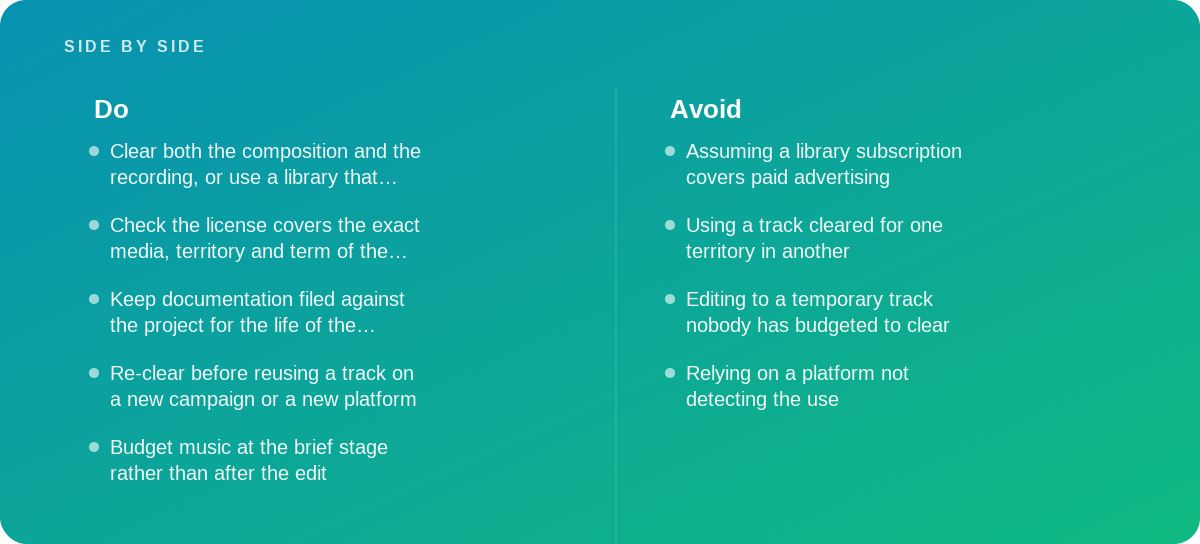
Summarized, the illustrative project comes down to five habits. Turn the media plan into a license specification before choosing music. Clear both the composition and the recording, or use a library that controls both. Check that the tier covers the exact media, territory and term. Keep temp music clearable or deliberately different from anything final. File the license against the project for as long as the video lives. None of these is complicated. What they need is to happen at the start of the project rather than the end, and that timing is what separates a clearance process that works from one that finds problems once the budget has been spent.
Where this comes from
- YouTube Help — Content ID and music policies
- European Commission — Copyright framework
- Audio Engineering Society — Rights and licensing
The figures and practices above come from the sources listed.
Working on something like this?
We take on Audio Editing & Production work for teams who want it done once, properly. Tell us what you are building and we will tell you honestly whether we are the right studio for it. Start a project.
Where to go next
Spotted something wrong? Report an error on this page. We correct on the page and say what changed.