How to Get Motion Graphics Briefs and Scoping Right
Learn how to scope motion graphics work: choose between fixed scope, a paid scoping phase or capped time and materials, and lock deliverables and revisions.
 MediaScaleUp Editorial Team

Most motion projects that go over budget do not fail in the animation software. They fail weeks earlier, in a brief that described a mood and a reference video but never said how many seconds, in how many aspect ratios, in how many languages, approved by whom, with how many rounds of changes. Motion graphics briefs and scoping are the work of defining what an animated piece must do, how long it runs and exactly what is being delivered, before anyone commits production time to it.
That definition matters more in motion than in almost any other creative discipline. Animation is priced largely by the second and by complexity, and every change made after the animation stage has started ripples through keyframes, renders and exports. A vague brief for a brochure costs you a few extra rounds of layout. A vague brief for a 60-second explainer can cost you a second production cycle. This guide is written for marketers, brand managers and in-house producers who commission animation, and for the studio-side producers and designers who have to turn those requests into schedules and quotes.
Rather than offering one template and hoping it fits, this article treats scoping as a decision. There are three workable ways to scope a motion project: a fixed-scope brief, a paid scoping phase ahead of the commitment, and capped time-and-materials for work that is still evolving. Below you will find the criteria that decide between them, a scored comparison, a worked example with a full deliverables matrix, and a recommendation for each common situation.
What a Motion Graphics Brief Has to Settle Before Production
A creative brief tells a team what to make. A scope tells everyone what will be delivered, when, and under what terms of change. Good motion briefs do both, and the scoping half is usually the half that is missing. Before a single styleframe is designed, five things need a definite answer.
1. Purpose and placement
Where will the piece run and what should the viewer do afterward? A 15-second paid social cutdown, a looping lobby display and a narrated product explainer are different products with different pacing, sound and legibility requirements. Placement drives almost every downstream choice: whether captions are burned in, whether the piece must work with the sound off, whether the first two seconds must carry the brand, and whether the file must loop seamlessly. A piece designed for a gallery wall, for example, follows different rules from one designed for a feed; the considerations for motion graphics built for museum exhibits are a good illustration of how much the viewing context changes the brief.
2. Duration
Duration is the single largest cost driver, so it has to be a number, not a feeling. "About a minute" leaves a 45-second difference in the budget between 45 and 90 seconds. State a target runtime per deliverable and a tolerance, for example 60 seconds plus or minus three seconds, and tie the script word count to it. Many producers plan narration at somewhere around 130 to 160 spoken words per minute, depending on the voice and the pace the piece needs, so a 60-second piece with a 250-word script is very likely over length before a frame is drawn. Time a read-through aloud to be sure.
3. The deliverables matrix
Every combination of aspect ratio, duration, language and file format is a separate deliverable that someone has to build, check and export. A brief that says "the hero film plus social versions" has not specified deliverables. A brief that says "one 16:9 master at 60 seconds, a 9:16 cutdown at 15 seconds and a 1:1 cutdown at 15 seconds, each in English and Spanish, delivered as ProRes 422 HQ masters and H.264 MP4s" has. The matrix section later in this article shows how to write it.
4. Revision rounds and approval
How many rounds of changes are included, at which stages, and who has the authority to approve? Revision rounds should be defined in the scope, never assumed, and the approver should be one named person with a defined stage for sign-off.
5. Assets and source material
Logos in vector format, brand fonts with the right licenses, color values, product renders or CAD files, existing footage, music, voiceover and legal copy all need to be confirmed as available and licensed before production begins. An animation schedule cannot absorb a two-week wait for a font license or a product shot that turns out not to exist.
Why Motion Punishes an Unclear Brief
In print or web design, a late change usually means editing a file. In motion, a late change can mean re-timing a sequence, re-animating transitions on either side of it, re-rendering, re-syncing sound, re-exporting every variant and re-checking every one of them. The cost of a change depends heavily on when it is made, which is why scoping in this discipline is about locking decisions in the right order.
A typical 2D motion pipeline moves through script, storyboard, styleframes, animatic, animation, and finishing (sound mix, render, variants and export). Adobe's documentation for After Effects and Premiere Pro, available through the Adobe Help Center, describes much of the technical workflow that sits behind these stages, from composition settings to render queues and output modules. What the software documentation cannot tell you is when each decision should be frozen. The table below sets out what each stage settles and how expensive it is to reopen.
| Stage | What it locks | Cost of a change made here | Typical change requests |
|---|---|---|---|
| Script | Message, word count, runtime | Low: text edits | Reordering points, trimming claims, legal wording |
| Storyboard | Shot order, key visuals, transitions | Low to moderate: redraw frames | Swapping metaphors, adding a product shot |
| Styleframes | Look: color, type, illustration style | Moderate: redesign a few frames | Palette tweaks, typography changes |
| Animatic | Timing against voiceover and music | Moderate: re-time scenes | Pacing, holding on a frame longer |
| Animation | Movement, transitions, detail | High: re-animate and re-render | New scenes, changed messages, style shifts |
| Finishing and variants | Sound, exports, all ratios and languages | Very high: every change multiplies across variants | Copy changes discovered in localized versions |
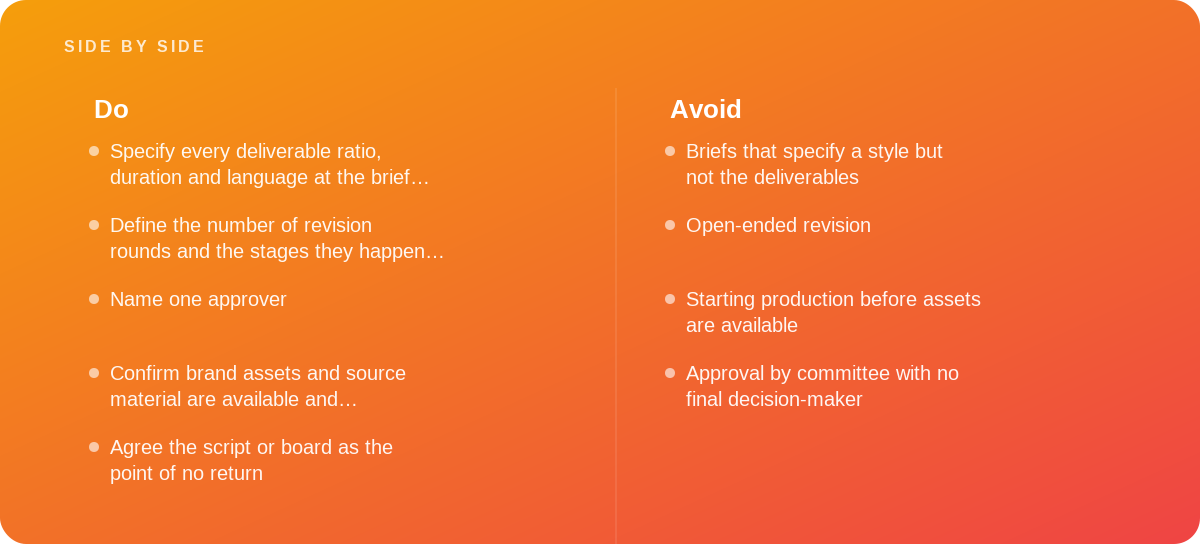
Two patterns explain most blown motion budgets. The first is a brief that specifies a style but not the deliverables: the team designs something beautiful for 16:9, and then learns at finishing that a 9:16 version with different safe areas and a Spanish version with noticeably longer on-screen text are also expected. The second is open-ended revision: without a defined number of rounds at defined stages, feedback on the script arrives during animation, and feedback on the animation arrives during localization.
Specific technical choices compound the problem. Adding 3D, live-action compositing or tracked graphics raises complexity per second, and each of those has its own points where changes get expensive. If your brief includes them, it is worth understanding the specifics, for example how 3D affects a motion graphics schedule or what blending graphics with live footage requires in plate quality and tracking before animation can start.
The Criteria That Decide How to Scope a Motion Project
Before comparing scoping approaches, it helps to be explicit about what you are optimizing for. Six criteria do most of the work. Weight them according to your situation; a regulated financial brand and a startup launching next week will not weigh them the same way.
- Cost predictability. How confident can finance be in the final number at the point of commitment? This matters most when budgets are fixed annually or tied to a purchase order that is hard to amend.
- Tolerance for unknowns. How well does the approach cope when the deliverables, the message or the product itself is not yet settled? A product that is still changing, or a campaign whose media plan is not final, scores differently here from a known annual refresh.
- Speed to start. How quickly can production begin? Some approaches front-load definition work, which delays the first frame but often shortens the overall schedule.
- Revision control. Does the approach make it structurally hard for changes to arrive at the wrong stage, or does it depend on goodwill and discipline?
- Stakeholder alignment. Does the approach force disagreements about direction into the open early, while they are cheap to resolve?
- Administrative overhead. How much tracking, reporting and contract management does it demand from both sides?
Stakeholder alignment deserves particular attention because it is so often the hidden cause of scope growth. Research and guidance from the Nielsen Norman Group on stakeholder alignment in design projects makes a point that applies directly to motion: disagreements that are not surfaced at the start do not disappear, they re-emerge later as feedback, at a stage where acting on them costs far more. A scoping approach that brings the real decision-makers into the room before the script is locked will usually save more money than any amount of negotiation on the day rate.
Option One: The Fixed-Scope Brief
The fixed-scope brief is the most familiar model. The client supplies a brief, the studio returns a quote and schedule against a written scope, and both sides sign off before production starts. The price covers a defined set of deliverables, a defined number of revision rounds at defined stages, and a defined schedule. Anything outside it becomes a change request with its own cost and timing.
What it needs to work
A fixed scope is only as reliable as the information behind it. It works when the message is settled, the deliverables matrix is complete, the assets exist, and there is one approver who can speak for the organization. It is the natural choice for a product explainer for a launched product, an annual brand sting refresh, an event opener with a known running order, or a set of social ads built to an established media plan.
How to write the scope clause
The scope document for a fixed-price motion job should include, at minimum: the deliverables matrix with ratios, durations, languages and formats; the number of revision rounds at each of script, storyboard, styleframes, animatic and animation; the named approver; the asset list with owner and delivery date for each item; the stage treated as the point of no return; and the definition of a change request, including how it is priced and how it moves the schedule. Treat the storyboard or approved script as the point of no return, so that any change to message or structure after it is by definition a change request rather than a revision.
Pros
- Highest cost predictability at the point of commitment.
- Clear, contractual revision limits that protect both schedule and budget.
- Low administrative overhead once signed: progress is measured against stages, not hours.
- Easy for procurement and finance to approve against a single purchase order.
Cons
- Only as accurate as the brief; missing deliverables become change requests later.
- Studios price in risk when a brief is thin, so uncertain scopes are quoted higher.
- Rigid when the product, message or media plan is still moving.
- Can encourage arguments about whether a request is a "revision" or a "change."
The most common failure of fixed scopes is not the model itself but a brief that pretends to more certainty than exists. If you find yourself writing "variants TBC" or "languages to be confirmed" into a fixed-price scope, that is a signal the project may be better served by a scoping phase first.
Verdict Choose a fixed-scope brief when the message is final, the full deliverables matrix can be written today, all brand assets and source material are in hand, and one person has the authority to approve. For a known, repeatable piece such as a launched-product explainer, this is the cheapest and calmest way to buy animation.
Option Two: A Paid Scoping Phase Before the Commitment
In this model, the project is split in two. A short, separately priced scoping phase produces the things that make a fixed quote reliable: an agreed script or script outline, a deliverables matrix, a rough storyboard or style direction, an asset audit and a stakeholder map with a named approver. Only once those exist does the studio quote the production phase, usually as a fixed scope.
What the scoping phase produces
A useful scoping phase ends with documents the client owns, whether or not they continue with the same studio. Typical outputs are a one-page creative brief, a script at the agreed length, a storyboard or a set of thumbnails for the key beats, one or two styleframes or reference boards, the complete deliverables matrix, an asset register listing every file needed with its owner, license status and delivery date, and a production schedule with sign-off stages marked. The phase is usually short, measured in days or a couple of weeks rather than months, and its cost is a fraction of the production budget.
Why it often saves money overall
The scoping phase converts unknowns into knowns before the expensive stages start. It is where stakeholders who disagree about direction are made to agree, where the legal team reads the script, where the regional marketing team confirms which languages they actually need, and where someone discovers that the product renders are three versions out of date. Each of those discoveries is cheap during scoping and expensive during animation. It also lets the studio quote production with less risk padding, because the unknowns it would otherwise price in are gone.
The European Broadcasting Union's technical and production resources at EBU Technology and Innovation reflect the same principle from the broadcast side: delivery specifications, formats and technical requirements are planned and agreed up front, because discovering them at the end of production is costly. Motion work destined for broadcast, or for any platform with strict delivery specs, benefits from treating the specification as part of the scope rather than a detail for the export stage.
Pros
- Surfaces stakeholder disagreement and missing assets while they are cheap to fix.
- Produces a fixed production quote with far less padding for risk.
- The client owns the scoping outputs and can take them to any studio.
- Lets both sides test the working relationship on a small commitment.
Cons
- Adds time before the first animated frame.
- Requires a separate approval and budget line, which some procurement processes resist.
- Only works if the right stakeholders actually take part in it.
- Can feel like paying for "planning" when the team is eager to see motion.
The scoping phase is also where accessibility and localization requirements should be settled. Decisions about flashing content, motion intensity and caption treatment are far easier to design in from the start; the guidance on motion accessibility and photosensitivity is worth reading before the styleframes are approved. Similarly, if text will be translated, the storyboard needs room for expansion, and the approach to localizing motion graphics should be agreed before the master is built, not after.
Verdict Choose a paid scoping phase when several stakeholders have a say, when deliverable requirements are not fully known at kickoff, when the piece is large or high-visibility, or when localization and multiple formats are likely. Paying a small amount to remove uncertainty before committing to production is usually the best value in motion.
Option Three: Capped Time and Materials for Evolving Work
Some motion work cannot be fully defined in advance: an in-house content program that produces animated assets every week, a product UI that is still being designed, a series of short social pieces responding to a changing campaign, or exploratory work on a new visual language. For these, a fixed scope either becomes a fiction or gets rewritten every few weeks. The alternative is time and materials with a cap: the studio bills for time spent against an agreed rate, within a monthly or project ceiling, and work is planned in short cycles.
How to keep it disciplined
Time and materials does not mean an unscoped project. Each cycle, often one or two weeks, should still have a small brief: what will be produced, in which formats, and who approves it. The cap should be stated in hours or currency, with a threshold, for example at 80 percent of the cap, at which the studio must flag the burn and agree priorities with the client. Revision rounds remain defined per piece, and the approver is still one person. What changes is that the list of pieces is allowed to evolve.
Where templates fit
Evolving, high-volume work is often better served by building a system than by animating each piece from scratch. A set of well-built templates lets editors or junior designers produce routine variants within guardrails while the studio's time goes to new, higher-value work. If your program looks like this, read about templating motion for scale before deciding how to scope it; a template build is a fixed-scope project in its own right, and the program that uses it can then run on a lighter, capped arrangement.
Pros
- Absorbs changing priorities without renegotiating the contract each time.
- Fast to start: work can begin as soon as the first cycle is briefed.
- Suits ongoing programs, exploratory work and products still in development.
- Billing reflects the effort actually spent rather than a risk-padded estimate.
Cons
- Lowest cost predictability for any individual piece.
- Relies on disciplined per-cycle briefs; without them it drifts into open-ended revision.
- Higher administrative overhead: timesheets, burn reports and regular prioritization.
- Easy for scope creep to hide inside a budget that is technically "within cap."
The biggest risk with this model is that it becomes a way of avoiding decisions. If the reason you want time and materials is that stakeholders cannot agree on direction, a cap will only control how much money is spent on the disagreement. It will not resolve it.
Scoring the Three Scoping Approaches Side by Side
The scorecard below rates each approach against the six criteria on a five-point scale, where 5 is strongest. These are editorial judgments about how the models typically behave when run competently, not measured data; the right weighting depends on your situation, and a strong brief can lift any model while a poor one will sink any of them.
| Criterion | Fixed-scope brief | Paid scoping phase, then fixed | Capped time and materials |
|---|---|---|---|
| Cost predictability | 5 if the brief is complete, 2 if it is not | 4 overall, 5 for the production phase | 2 per piece, 4 for the monthly total |
| Tolerance for unknowns | 1 | 4 | 5 |
| Speed to start | 4 | 2 | 5 |
| Revision control | 5 | 5 | 3 |
| Stakeholder alignment | 2: assumes it already exists | 5: the phase is built to create it | 2: disagreement can persist |
| Administrative overhead | 5 (low overhead) | 4 | 2 |
Read the scorecard as a set of trade-offs rather than a league table. The fixed-scope brief wins on predictability and simplicity but scores poorly on unknowns and alignment, because it assumes both are already solved. The scoping phase gives up speed to start in exchange for the strongest alignment and a reliable production price. Capped time and materials is the fastest to start and the most flexible, but it transfers risk to the client and demands the most management attention.
Two practical conclusions follow. First, if your organization will struggle to get a single approver or to agree on the message, the scoping phase is almost always the right choice regardless of project size, because neither of the other models addresses that problem. Second, these are not mutually exclusive: many well-run programs use a scoping phase for the first, defining piece, a fixed scope to produce it, and a capped arrangement for the stream of variants and follow-ups that come after.
Writing the Deliverables Matrix: A Worked Example
The deliverables matrix is the most useful single page in any motion scope, because it turns vague ambitions like "and the social versions" into a countable list. The following example is illustrative, not a real client project, and the effort figures are indicative ranges used to show the arithmetic rather than a price list.
The illustrative brief
A mid-sized software company is launching a new feature and wants an animated explainer. The first draft of the brief reads: "A 60 to 90 second 2D explainer in our brand style, plus social cuts, for launch in six weeks." That sentence contains at least four open decisions: the runtime, the number and shape of the social cuts, the languages, and the file formats. Working through the matrix with the marketing lead turns it into the following.
| Deliverable | Ratio | Duration | Languages | Formats | Count |
|---|---|---|---|---|---|
| Hero explainer (website, sales) | 16:9 | 75 s | English, German | ProRes 422 HQ master, H.264 MP4, SRT captions | 2 |
| Feature cutdown (paid social) | 9:16 | 15 s | English, German | H.264 MP4, captions burned in | 2 |
| Feature cutdown (feed) | 1:1 | 15 s | English, German | H.264 MP4, captions burned in | 2 |
| Product page loop | 16:9 | 8 s loop, no audio | Language-neutral | H.264 MP4 and WebM | 1 |
| Presentation version | 16:9 | 75 s, no voiceover, captioned | English | H.264 MP4 | 1 |
"A 60 to 90 second explainer plus social cuts" has become eight distinct deliverables. None of them is unreasonable, and most reuse the master animation, but each needs layout adaptation, checking and export. The German versions need text expansion room designed into the storyboard, a German voiceover recorded to the animatic timing, and a native-speaker review of every on-screen word. The presentation version needs a different pacing decision, since presenters often want to speak over it, which is covered in more depth in the guidance on motion graphics in presentations.
Turning the matrix into effort
Suppose, for illustration, that the studio's planning estimate for the 75-second English master is 15 to 20 production days across script support, boards, styleframes, animatic, animation and finishing. Adapting the master into each additional ratio might add one to three days per ratio depending on how much recomposition is needed; each additional language might add two to four days across voiceover sync, text replacement and checking; and the loop and presentation version might add a day or two each. On those illustrative assumptions, the variants add roughly 8 to 16 days to the master, which means that about a third to nearly half of the total effort is in deliverables that the first draft of the brief described in four words.
That is the whole argument for writing the matrix at the brief stage. If those eight deliverables are discovered in week five instead of week one, the German text expansion forces redesign of frames that were already animated, the vertical cutdown reveals that key visuals sit outside the 9:16 safe area, and the launch date slips.
Revision rounds in the example
The illustrative scope for this project allows two rounds on the script, one round on the storyboard, two rounds on styleframes, one round on the animatic and two rounds on the animation of the English master, followed by one consolidated round on all variants. The approved storyboard is the point of no return: after it, changes to message or structure are change requests, priced and scheduled separately. The named approver is the product marketing lead; legal reviews the script only, and the German market lead reviews only the German versions, each in their own defined window.
Revision Rounds, a Single Approver and the Point of No Return
Deliverables define what is made. Revision terms define how it gets finished. Three rules make the difference between a motion project that lands on time and one that loops.
Define rounds by stage, not in total
"Three rounds of revisions" is not a useful scope clause, because it does not say when they happen. Three rounds on the animation stage is expensive; three rounds on the script is cheap. Allocate rounds to stages, weighted toward the early, inexpensive ones. A round should be defined as a single consolidated set of feedback from the approver, delivered in one document or one annotated review, within an agreed window such as two working days. Feedback that arrives piecemeal from several people counts as multiple rounds, or is not accepted until it is consolidated.
Name one approver
Approval by committee with no final decision-maker is one of the most reliable ways to break a motion schedule. The fix is not to exclude stakeholders but to route them: everyone with an interest contributes feedback to the approver, who resolves conflicts and returns one consolidated decision. Name that person in the scope, and name their deputy for holidays. Where specialist reviewers are needed, such as legal, compliance, accessibility or regional teams, give each one a defined window at a defined stage, and make clear that their remit is limited to their specialism.
Choose the point of no return deliberately
Every motion scope should name the stage after which the message and structure are frozen. For most projects that is the approved script or the approved storyboard. For work that is heavy on timing, such as pieces cut to music, it may be the animatic. Anything after that point that changes what the piece says, or the order in which it says it, is a change request. This is not about being inflexible; it is about making the cost of late change visible so that the organization can decide whether it is worth paying.
Some changes are easy to underestimate. A new line of voiceover changes timing throughout the piece. A brand color adjustment late in the process can affect every render and every variant, a problem worth understanding through the lens of color management in motion design. A changed soundtrack can alter the edit points the whole animation was timed to. When in doubt, ask the studio for an impact estimate before approving a change, rather than after.
Recommendations for Common Motion Scoping Scenarios
The scorecard shows the trade-offs; the following situations show how they play out in practice.
A single, well-defined piece for a launched product
The message is settled, the brand guidelines are current, the approver is obvious and the media plan is fixed. Use a fixed-scope brief. Spend your effort on the deliverables matrix and the asset list, and make sure the scope names the storyboard as the point of no return.
A flagship piece with several stakeholders and a large variant set
A brand film, an investor or event opener, or a campaign that will run in multiple markets. Use a paid scoping phase, then a fixed production scope. The scoping phase should end with an agreed script, a complete matrix with languages confirmed by each market, an asset register and a named approver. If you cannot get agreement on those in the scoping phase, you have learned something important for a small fraction of the production cost.
An ongoing content program or a product still in development
Weekly social assets, feature release animations, or UI motion that follows a product roadmap. Use capped time and materials with per-cycle mini-briefs, and consider a fixed-scope template build to handle routine variants. Keep the single-approver and stage-based revision rules; they matter more here, not less.
A project that has already gone off the rails
If production is underway and the scope has already expanded beyond the original brief, stop adding work to the existing arrangement. Pause at the next stage boundary, document what has been approved, rebuild the deliverables matrix and treat the remainder as a new, properly scoped phase. Continuing to absorb changes into the original budget rarely ends well for either side.
Verdict Default to a paid scoping phase whenever you are unsure, because it is the only approach that reliably fixes the two root causes of motion overruns: unknown deliverables and unaligned stakeholders. Use a pure fixed scope only when both are already solved, and use capped time and materials only for genuinely evolving, ongoing work with disciplined per-cycle briefs.
Common Scoping Mistakes and How to Catch Them Early
Most scoping mistakes are visible in the brief before any money is spent, if you know what to look for. Read your draft brief against the following failure patterns.
- Style without deliverables. The brief includes three reference videos and a paragraph about tone, but no ratios, durations or languages. Fix it by writing the matrix before discussing style.
- Runtime as a range. "60 to 90 seconds" is a 50 percent budget range. Pick a target and a tolerance, and write the script to it.
- Open-ended revision. "Revisions until approved" or an unspecified number of rounds. Replace it with rounds per stage and a definition of what a round is.
- Production before assets. The schedule starts on Monday but the product renders, fonts or voiceover talent are "coming." Make asset delivery a dependency with dates, and start the clock only when the assets are in hand and licensed.
- Committee approval. Five people are copied on every review and no one can say "approved." Name one approver and route everyone else through them.
- Hidden technical requirements. The piece will need tracked graphics on existing footage, an in-engine version or an on-screen countdown synced to a live event, but the brief does not say so. Each of these has specific scoping implications; for example, motion tracking for graphics depends on footage that was shot with tracking in mind.
- Audio as an afterthought. Voiceover, music licensing and sound design are left out of the scope and then added late, forcing re-timing. Decide at the brief stage whether audio is included and who supplies it.
A useful discipline is to have someone who was not involved in writing the brief read it and list every question they would need answered before quoting. If the list is longer than five or six items, the brief is not ready for a fixed price, and a scoping phase will likely save money.
When to Bring in Outside Help with Scope
Many in-house teams scope routine motion work well on their own. There are three situations where bringing in an experienced motion producer or studio to help with scoping, rather than only with production, is usually worth it.
The first is when scope has already expanded beyond the original brief. By then, the internal team is often too close to the history of the project to see where the real boundaries should be, and an outside producer can reset the matrix, the revision terms and the approval route without the weight of earlier compromises.
The second is when several stakeholders disagree about direction. A neutral party running a structured scoping phase, with a clear agenda of decisions to be made, can often achieve alignment that internal meetings have not, simply because the conversation is framed around concrete choices rather than preferences.
The third is when deliverable requirements are still unknown at kickoff. If nobody can yet say which platforms, ratios or languages are needed, a studio that has scoped similar work can propose a sensible default matrix and flag which unknowns carry the most cost. Our animation and motion graphics team regularly starts engagements this way, with a short scoping phase that produces a brief the client owns.
Whatever route you take, the principle is the same. In motion, the cheapest time to make a decision is before production starts, and the most expensive time is after it finishes. A scope that names every deliverable, fixes the revision rounds by stage, identifies one approver, confirms the assets and marks a clear point of no return is the most effective cost control available in this discipline.
Where this comes from
- Adobe Help Center — Production workflow
- Nielsen Norman Group — Stakeholder alignment
- European Broadcasting Union — Production planning
The figures and practices above come from the sources listed.
Working on something like this?
We take on Motion Graphics & Animation work for teams who want it done once, properly. Tell us what you are building and we will tell you honestly whether we are the right studio for it. Start a project.
Where to go next
Spotted something wrong? Report an error on this page. We correct on the page and say what changed.