Documentation and Knowledge Bases: The Decisions That Matter
Content that helps people use a product or resolve a problem without contacting support.
 MediaScaleUp Editorial Team

Where most projects go wrong
The usual mistakes:
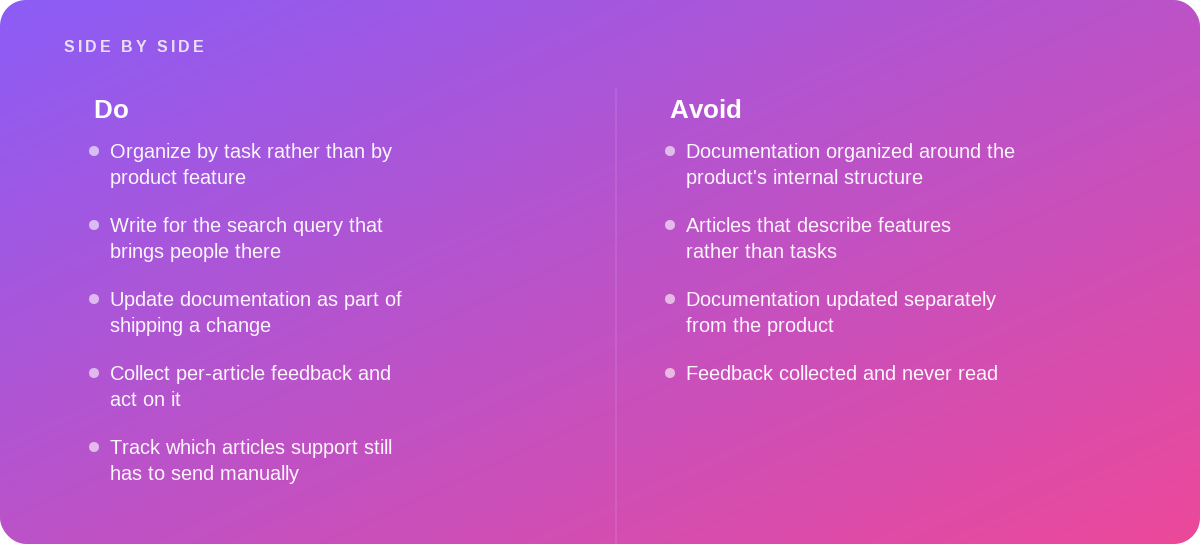
- Documentation organized around the product's internal structure
- Articles that describe features rather than tasks
- Documentation updated separately from the product
- Feedback collected and never read
What good looks like instead
- Organize by task rather than by product feature
- Write for the search query that brings people there
- Update documentation as part of shipping a change
- Collect per-article feedback and act on it
- Track which articles support still has to send manually
Why it matters
Documentation is measured directly in support cost, which makes it one of the few content types with an unambiguous business case.
The specs that matter
| Measure | Figure |
|---|---|
| Measure | deflected support contacts and task success |
| Search | most documentation is reached by search, not browsing |
| Structure | task-based organization rather than feature-based |
| Maintenance | documentation decays with every product change |
| Feedback | per-article feedback identifies failures |
Knowing when to hand it over
Tip: Bring in help when support volume is high for documented issues, when documentation has fallen behind the product, or when a knowledge base needs restructuring.
Where this comes from
- Nielsen Norman Group — Support content research
- GOV.UK Service Manual — Help and guidance content
- Google Search Central — Content structure
The figures and practices above come from the sources listed.
Working on something like this?
We take on Content Strategy work for teams who want it done once, properly. Tell us what you are building and we will tell you honestly whether we are the right studio for it. Start a project.
Where to go next
Spotted something wrong? Report an error on this page. We correct on the page and say what changed.