Monolith or Microservices: How to Choose
The architectural choice between one deployable application and many small services that communicate over networks.
 MediaScaleUp Editorial Team

What is at stake
Microservices add operational complexity that many teams do not need, while well-structured monoliths can scale further than often assumed.
The playbook
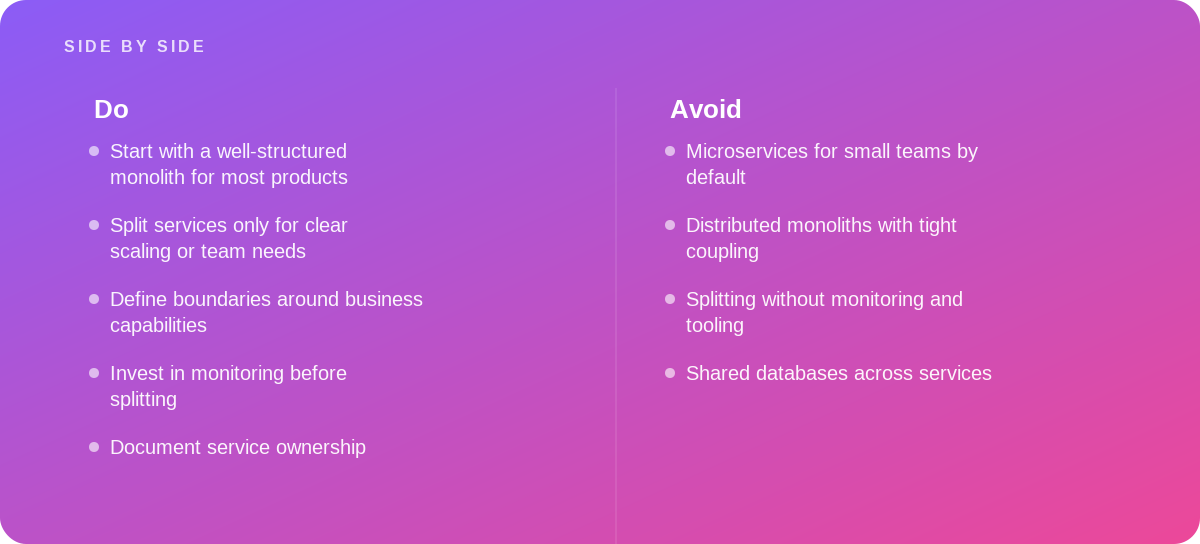
- Start with a well-structured monolith for most products
- Split services only for clear scaling or team needs
- Define boundaries around business capabilities
- Invest in monitoring before splitting
- Document service ownership
Where it goes wrong
Avoid:
- Microservices for small teams by default
- Distributed monoliths with tight coupling
- Splitting without monitoring and tooling
- Shared databases across services
The numbers behind it
| Measure | Figure |
|---|---|
| Monolith | a single deployable application |
| Microservices | independently deployable services |
| Trade-offs | microservices add network, deployment and monitoring complexity |
| Modular monolith | clear internal boundaries within one application |
Getting outside help
When to hand it over: Bring in help when architecture decisions affect scaling or team structure.
Where this comes from
- Microsoft Learn — Microservices architecture style
- Microsoft Learn — Architecture styles
The figures and practices above come from the sources listed.
Working on something like this?
We take on Web Design & Development work for teams who want it done once, properly. Tell us what you are building and we will tell you honestly whether we are the right studio for it. Start a project.
Where to go next
Spotted something wrong? Report an error on this page. We correct on the page and say what changed.




