HTTP/2 and HTTP/3, Done Properly
The newer versions of the protocol that carries web traffic, and what they change about how resources should be delivered.
 MediaScaleUp Editorial Team

Where most projects go wrong
The usual mistakes:
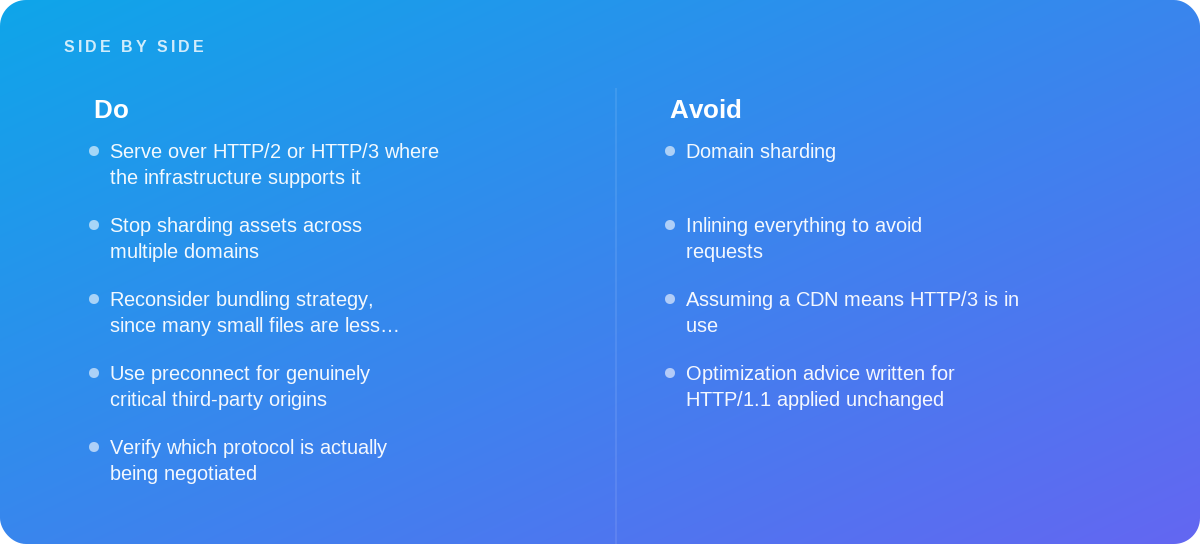
- Domain sharding
- Inlining everything to avoid requests
- Assuming a CDN means HTTP/3 is in use
- Optimization advice written for HTTP/1.1 applied unchanged
What good looks like instead
- Serve over HTTP/2 or HTTP/3 where the infrastructure supports it
- Stop sharding assets across multiple domains
- Reconsider bundling strategy, since many small files are less costly than before
- Use preconnect for genuinely critical third-party origins
- Verify which protocol is actually being negotiated
Why it matters
Several long-standing optimization practices were workarounds for HTTP/1.1 limitations, and some of them are now actively harmful.
The specs that matter
| Measure | Figure |
|---|---|
| HTTP/2 | multiplexing over a single connection, and header compression |
| HTTP/3 | built on QUIC over UDP, avoiding head-of-line blocking at transport level |
| Obsolete practices | domain sharding and aggressive file concatenation |
| Connection cost | fewer connections needed than under HTTP/1.1 |
| Support | widely available through CDNs and modern servers |
Knowing when to hand it over
Tip: Bring in help when infrastructure changes are needed, when protocol negotiation is not what you expect, or when legacy optimizations are hurting performance.
Where this comes from
- RFC Editor — HTTP/2 and HTTP/3 specifications
- MDN Web Docs — Evolution of HTTP
- Cloudflare Learning Center — HTTP/3 and QUIC
The figures and practices above come from the sources listed.
Working on something like this?
We take on Performance & Accessibility work for teams who want it done once, properly. Tell us what you are building and we will tell you honestly whether we are the right studio for it. Start a project.
Where to go next
Spotted something wrong? Report an error on this page. We correct on the page and say what changed.