Skip to content
Video Editing & Production

How to Get Synthetic Media Disclosure Right

Telling audiences when video has been generated or significantly altered by AI, including synthetic voices and faces.

MediaScaleUp Editorial Team 2 min read 16 views
How to Get Synthetic Media Disclosure Right

Where most projects go wrong

The usual mistakes:

  • Realistic synthetic people with no disclosure
  • Using a person's likeness without permission
  • Synthetic endorsements
  • Assuming disclosure is optional

What good looks like instead

  • Disclose synthetic content in the platform tools
  • Add visible labels where content could mislead
  • Keep consent records for any real person's likeness
  • Attach content credentials where supported
  • Review campaigns against platform policies
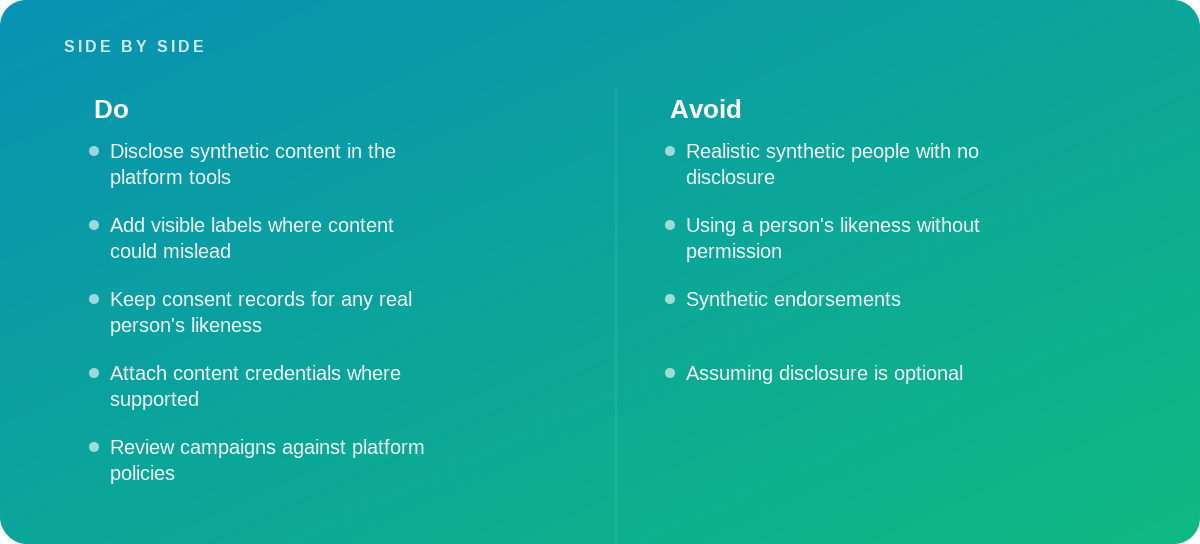
What to do and what to avoid with synthetic media disclosure, side by side
Good practice against the usual mistakes, from the sources listed below.

Why it matters

Platforms require disclosure for realistic synthetic content, and regulators are active on impersonation and deception.

The specs that matter

Published figures for Synthetic Media Disclosure
MeasureFigure
Platform rulesYouTube requires creators to disclose realistic altered or synthetic content
Impersonationthe FTC's rule addresses impersonation of businesses and government
Election contentseveral states regulate synthetic political media
Provenancecontent credentials can record how media was made

Knowing when to hand it over

Tip: Bring in help before publishing synthetic media in campaigns.

Where this comes from

The figures and practices above come from the sources listed.

Working on something like this?

We take on Video Editing & Production work for teams who want it done once, properly. Tell us what you are building and we will tell you honestly whether we are the right studio for it. Start a project.

Where to go next

Spotted something wrong? Report an error on this page. We correct on the page and say what changed.

All services

The work behind this article, and what it costs.

See it in practice

All the work
Before: Green Screen: Rotating Food Product Keyed into a Café Scene
After: Green Screen: Rotating Food Product Keyed into a Café Scene
Green-screen source Keyed + composited

Green Screen: Rotating Food Product Keyed into a Café Scene

Chroma key, despill, color matching, background defocus and vignette, compositing (ffmpeg)

Studio demo on a public-domain photo, not a client job

Watch the video

Green Screen Compositing Food & Restaurant 24-48 hours

Before: Cinematic Grade: Flat Drone Footage to a Moody Film Look
After: Cinematic Grade: Flat Drone Footage to a Moody Film Look
Original flat footage Cinematic grade

Cinematic Grade: Flat Drone Footage to a Moody Film Look

Filmic tone curve, split toning, graduated sky filter, vibrance, vignette and sharpening, with a wipe compare video

Studio demo on a public-domain photo, not a client job

Watch the video

Cinematic Color Grading Travel & Tourism 24-48 hours

Before: Logo Animation: A Coastal Tea Brand Mark Draws Itself On
After: Logo Animation: A Coastal Tea Brand Mark Draws Itself On
Static logo artwork Animated logo frame

Logo Animation: A Coastal Tea Brand Mark Draws Itself On

Logo design, self-drawing stroke reveal, staggered wave wipes, wordmark rise, particle burst and light sweep

Studio demo on a public-domain photo, not a client job

Watch the video

Logo Animation Food & Beverage 3-5 days

MediaScaleUp Editorial Team

Articles here are researched, written and checked by the MediaScaleUp studio team before they are published, and dated when they are reviewed.

Keep reading

More in Video Editing & Production