How to Get Mechanism of Action Animation Right
Follow one illustrative mechanism of action animation from brief to delivery: claims mapping, abstraction, motion choices, review rounds and archiving.
 Tomas Lindqvist

A mechanism of action animation shows how a drug, device or biological process works at the cellular or system level: a molecule binding a receptor, an enzyme being blocked, a stent expanding against a vessel wall, a signal failing to reach the cell nucleus. It is one of the few kinds of animation where a single wrong frame can matter more than the whole look of the film. These pieces are used in regulated promotion, sales detailing, congress booths, patient education and investor decks, so scientific accuracy and approved claims matter as much as visual polish.
This guide is for brand managers, medical affairs teams, marketing leads at device and life-science companies, and animators taking on their first regulated job. Instead of a list of tips, it follows one project from brief to delivery and explains each decision along the way: what the team chose, why, and which traps it avoided. The project is illustrative. It is a composite built to show a realistic process, not a real client, product or campaign, and every number in it is an example, not a benchmark.
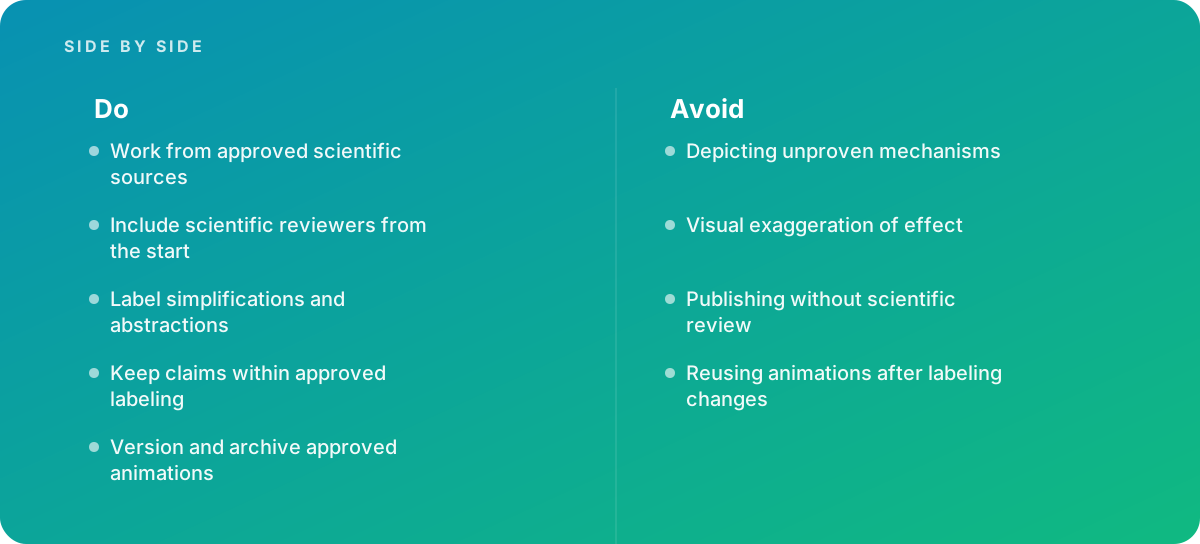
The underlying rules are simple to say and hard to keep. Show only what the evidence supports. Stay inside approved labeling. Put scientific and regulatory review in place from the first day. Label every simplification so nobody mistakes an abstraction for literal biology. Version and archive what gets approved, because the film will outlive the label it was built on.
The Illustrative Project: A 90-Second Mechanism of Action Animation for an Oral Enzyme Inhibitor
Here is the setup. A mid-size pharmaceutical company, which we will call the client, has an oral small-molecule drug, which we will call Product A. Product A is approved for a chronic inflammatory condition. Its label describes it as an inhibitor of an intracellular enzyme that sits in a signaling pathway. When the enzyme is blocked, the pathway sends fewer signals, and the cell produces less of a family of inflammatory messenger proteins. The brand team wants a mechanism of action animation for three uses: a sales rep tablet detail aid, a looping version for a medical congress booth, and a cut for the product's healthcare professional website.
The client's brief was one page long. It asked for "a premium 3D look," "about two minutes," and "a clear demonstration of how Product A stops inflammation." Each of those three phrases needed unpacking before any work started, and the rest of this walkthrough is largely about how the team did that.
Those figures belong to this illustrative project. Your own numbers will depend on the complexity of the biology, how many markets the film has to clear, how often your review committee meets, and whether you are building 3D assets from scratch or adapting existing ones. Treat them as a sense of proportion, not a quote.
Why the brief had to be rewritten first
"Stops inflammation" is a clinical outcome claim, not a mechanism. The approved label said Product A inhibits the enzyme and reduces the downstream signaling. It did not say the drug stops inflammation, and the clinical data described partial reductions in disease activity, not elimination. If the animation had shown inflammation vanishing, it would have gone beyond both the mechanism and the efficacy data in a single shot. So the first deliverable was not a storyboard. It was a rewritten objective, agreed in writing: "Show, at a level of abstraction that a specialist physician finds credible, how Product A inhibits the target enzyme and how that inhibition reduces downstream inflammatory signaling, consistent with the approved prescribing information."
Decision: The studio asked the client to name its medical reviewer, regulatory reviewer and legal reviewer before signing the scope, and to confirm which document was the single source of truth for claims. The answer was the current approved prescribing information plus a short list of peer-reviewed papers already cleared by medical affairs. Nothing else could be animated as fact.
Building the Scientific Source Pack Before Anyone Draws a Molecule
The most common failure in mechanism of action work happens before production starts: the team animates from memory, from a competitor's film, or from a textbook diagram that has been simplified past accuracy. In our illustrative project, weeks one and two went into building a source pack. That is a structured folder, owned by the client's medical affairs lead, that every later decision had to trace back to.
The source pack contained four kinds of material:
- Approved labeling. The current prescribing information, with the relevant sections on mechanism, pharmacodynamics and clinical studies highlighted. This sets the ceiling for any claim.
- Cleared scientific references. Peer-reviewed papers on the target enzyme's structure and the signaling pathway, already approved for promotional use by the client's review committee.
- Structural data. Published protein structures that the 3D artist could use as the basis for the enzyme model, so its overall shape and binding pocket were grounded in real data rather than invented.
- A claims matrix. A spreadsheet listing every statement and every visual event the film might contain, the reference that supports it, the page and paragraph, and a column for reviewer sign-off.
The claims matrix is the backbone of the job. In this project it started with 58 candidate rows and ended with 41. The 17 that were dropped either had no support in the cleared references or went further than the label allowed. One example: an early idea showed the drug molecule leaving the cell intact after unbinding. The label and references said nothing about the drug's behavior after unbinding, so the shot was cut rather than guessed at.
Who owns what in the source pack
Ownership matters because the animators are not the scientific authority, and they should not be put in that position. The studio's job was to translate the references into images and to flag anything the images implied that the references did not state. The client's medical reviewer owned the science. The regulatory reviewer owned alignment with labeling. Legal owned fair balance and anything that might read as a comparative or superiority claim. When those lines blur, animators end up making scientific calls by default, usually under deadline pressure.
Trap avoided: The client's first reference list included a preclinical paper suggesting a second, off-target anti-inflammatory effect. It was interesting and visually attractive, but it was not part of the approved mechanism. Depicting an unproven mechanism in promotional material is one of the fastest ways to fail review, or worse, to pass review by accident and create a compliance problem later. The team left it out entirely.
Scripting From Approved Claims, Not From the Visuals
Once the source pack was stable, the team wrote the narration script before a single frame was designed. That order is deliberate. In regulated animation, the words are what reviewers can check line by line against the label. If the visuals come first, the script ends up describing whatever looks good, and the review turns into a negotiation about pictures.
The script went through a simple structure that works for most mechanism of action films:
- Context: the normal role of the pathway, shown briefly and neutrally.
- Disease state: what goes wrong in the condition, at the level described in the label or cleared references.
- Intervention: the drug reaches its target and binds.
- Consequence: the specific downstream effect the label describes.
- Boundary: a closing line that anchors the viewer back to the approved indication, with fair balance handled as the regulatory team requires for the channel.
Every sentence was numbered and mapped to a row in the claims matrix. The first draft ran 310 words, which at a measured medical narration pace of about 130 to 140 words per minute came to well over two minutes. That was too long for a sales call, where the rep has limited time with a physician. The team cut to 205 words, which landed at about 90 seconds with room for pauses on the key binding moment.
Words that reviewers flag
Certain verbs reliably trigger review comments because they overstate what a mechanism does. "Stops," "blocks completely," "eliminates," "restores," "cures," and "targets only" all imply an absolute effect or a selectivity that the data may not support. The script used "inhibits," "reduces," and "is designed to," but only where the label used equivalent language. Where the label was silent on selectivity, the script was silent too. This is not timid writing. It is writing that will survive review on the first round and not the third.
Decision: The team cut the requested two minutes to 90 seconds and proposed a separate, longer "deep dive" version for medical science liaisons later. The short film has to be usable in a real sales conversation. Depth for scientific audiences belongs in a different asset with its own review path.
Choosing the Level of Abstraction and Labeling Every Simplification
No mechanism of action animation is literal. Molecules do not have colors. Proteins do not glide politely into position. The inside of a cell is crowded beyond anything a readable frame can show. Every film is an abstraction, and the question is not whether to simplify but how to simplify without misleading. The reference material is plain on this point: abstraction must not mislead.
In the illustrative project, the team wrote a one-page "abstraction register" alongside the claims matrix. It listed each deliberate simplification, why it was made, and how the viewer would be told. The register had eight entries. The important ones are shown below.
| Simplification | Why it was made | How it was disclosed or constrained |
|---|---|---|
| Cytoplasm shown mostly empty | A realistic molecular crowd would hide the target enzyme entirely | On-screen label "Simplified representation" at first appearance of the cell interior |
| Enzyme rendered as a smoothed surface based on published structure | Atomic detail reads as noise at tablet size | Overall shape and binding pocket location kept faithful to structural data; medical reviewer approved the silhouette |
| Single drug molecule shown binding | Viewers can follow one molecule; hundreds would be confusing | Narration refers to the drug in general terms, never "a single dose" |
| Time compressed | Binding and signaling happen on timescales that cannot be shown literally | No clocks, counters or implied durations anywhere in the film |
| Signaling proteins shown as glowing pulses | Actual phosphorylation events are invisible at this scale | Pulse design kept consistent and reduced, never switched off entirely, to match "reduces" |
| Color coding of molecules | Needed to separate drug, target and signal at a glance | Colors chosen to avoid implying good or bad; red avoided for the drug |
The last two rows carry the most weight. If the label says the drug reduces signaling, the animation cannot show the signaling pulses stopping. A 100 percent visual effect for a partial pharmacological effect is visual exaggeration, and reviewers are right to reject it. The team animated the pulses at a lower frequency and brightness after binding, and the medical reviewer agreed that it matched the pharmacodynamic language in the label without implying a specific percentage.
How much to disclose on screen
Some teams worry that "simplified representation" labels look weak. In practice, specialist audiences expect them and trust films that use them. The label should appear once, early, and clearly. It does not need to be repeated on every shot. What it cannot do is excuse a depiction that the evidence does not support. A disclaimer tells the viewer the picture is schematic. It does not license the picture to say something the science does not.
Storyboards and Styleframes: Designing a Visual Language Reviewers Can Check
With the script numbered and the abstraction register agreed, the team moved into storyboards in week four. The storyboard had 14 scenes, and each panel carried the script line number and the claims matrix row it depicted. That sounds bureaucratic. It is actually what makes review fast: a reviewer can see a panel, check row 23, and approve or comment without reconstructing the logic.
Three styleframes followed, each a fully rendered still showing the intended final look:
- Tissue level: a stylized view of the affected tissue, used for the disease-state section.
- Cell level: the cell interior with the signaling pathway in its active state.
- Molecular level: the drug approaching the enzyme's binding pocket.
The styleframes were reviewed by the medical reviewer before any animation, because a style decision can create a scientific problem. An early frame used a strong red glow for the inflamed tissue and a cool blue for the drug. That reads well, but it frames the drug as a heroic force against a villain, which drifts toward emotional persuasion that some review committees will question. The final palette used neutral, desaturated tissue tones, a distinct but not heroic accent color for the drug, and a warm amber for the signaling pulses.
2D, 3D or a hybrid
The client asked for a premium 3D look, and for the molecular section that was the right call. The binding pocket is a three-dimensional fact, and showing the drug fitting into it is much more convincing in 3D animation than in flat illustration. But the pathway overview, where the viewer needs to understand a sequence of steps, was clearer as a simplified 2D schematic layered over the 3D cell. Teams weighing this choice should look at what 2D animated videos do well: diagrams, labels and sequence. A hybrid often beats pure 3D for comprehension, and it is cheaper to revise when a reviewer changes a label.
For projects where the core content is data rather than biology, such as plotting pharmacokinetic curves or trial endpoints, the rules change again. Our guide to scientific data animation covers how to animate charts without distorting the axis or the effect size. That matters here because many mechanism films end with an efficacy slide, and that slide has its own accuracy rules.
The Project Timeline, Week by Week
The schedule below is the one this illustrative team worked to. The biggest variable in any real schedule is the review committee's meeting cadence. If your committee meets every two weeks, each round can add up to two weeks of waiting whether the comments are large or small. Plan around that, not around production speed.
- Weeks 1 to 2 Kickoff, rewritten objective, reviewer roles named, source pack and claims matrix built, first structural references gathered.
- Week 3 Script drafted, numbered and mapped to the claims matrix; abstraction register written; script submitted for review round one alongside the matrix.
- Weeks 4 to 5 Storyboard of 14 scenes and three styleframes; medical reviewer checks visual language; animatic with scratch narration.
- Week 6 Review round two on the animatic, covering timing, depiction of effect, on-screen text and fair balance placement.
- Weeks 7 to 9 3D modeling of the enzyme from published structure, look development, full animation, professional voiceover recorded to the approved script.
- Week 10 Review round three on the near-final render with burned-in timecode and claim row numbers.
- Week 11 Final corrections, clean render, captions, cutdowns for the congress loop and web.
- Week 12 Approval codes applied, masters delivered, archive package and approval record handed over.
Notice where the review rounds fall. The first is on words, the cheapest thing to change. The second is on an animatic, a rough timed version using storyboard panels or simple blocking, where changing a depiction costs hours rather than days. The third is on near-final pixels, where the goal is to catch errors, not to reopen decisions. Teams that skip round two and go straight from script to full animation often end up re-rendering whole scenes because a reviewer saw the effect of a motion choice for the first time.
If you are setting up that review cadence for the first time, our guide to reviewing animation with clients covers how to structure feedback so that comments are consolidated, attributable and actionable. In regulated work, that becomes a formal requirement rather than a courtesy.
Motion Choices That Change the Meaning: Speed, Scale and Effect
This is the section most studios underestimate. In a mechanism of action animation, motion is a claim. How fast the drug arrives, how firmly it binds, how dramatically the pathway dims afterward: each of these tells the viewer something about the drug's behavior, whether or not the narration mentions it.
Arrival and binding
The first animatic showed the drug molecule streaking toward the enzyme along a guided path and snapping into the pocket with a flash of light. It looked great. The medical reviewer's comment was short: molecules do not seek targets, and nothing in the references described binding as instantaneous or irreversible. The flash also suggested a permanent, covalent bond, which was not how the label described the drug's inhibition. The revised shot showed the molecule drifting with a gentle, slightly random motion, approaching the pocket, and settling into it without a flash. The accent color brightened a little at binding to signal the event, and the reviewer approved it as a readable abstraction that did not imply irreversibility.
The size of the effect
The second motion problem was the downstream effect. In the animatic, after binding, the inflammatory messenger proteins disappeared from the frame within two seconds, and the tissue shot at the end turned from inflamed to healthy. Both were exaggerations. The label described reduced production of these messengers, not an absence, and the clinical sections reported improvement in disease activity scores, not normal tissue. The final version reduced the number and brightness of messenger proteins visibly but not completely, and the closing tissue shot was cut. The narration's final line tied back to the label's indication language instead.
Trap avoided: Visual exaggeration of effect is the most frequent reason mechanism animations are rejected, and the hardest one to spot from inside the production team. Everyone involved wants the film to look decisive. The team adopted a rule for the rest of the job:
- No visual event may show a larger effect than the label states.
- Nothing may disappear entirely unless the evidence says it does.
- Before-and-after tissue or patient imagery needs its own clinical support, not just mechanistic support.
Camera and pacing
Camera moves also carry meaning. A fast push-in on the binding moment adds drama, but it also makes the moment look more decisive than it is. The team kept camera moves slow and motivated, about 3 to 5 seconds for each major transition between scale levels. They held for at least 2 seconds on the binding moment so a physician could actually see the drug in the pocket. On a tablet held at arm's length in a noisy clinic, fast cuts simply do not register.
Running Medical, Legal and Regulatory Review Without Losing Months
In most pharmaceutical and device companies, promotional materials pass through a formal review committee. It is often called MLR, short for medical, legal and regulatory, though the name varies. Scientific and regulatory review is standard for this kind of film, not an optional extra. In the United States, the U.S. Food and Drug Administration oversees prescription drug promotion and the advertising and labeling of many medical devices. Companies are expected to keep promotional claims consistent with approved labeling. The review committee is how a company enforces that internally, and the animation has to be built to pass through it.
Three practices kept this illustrative project to three rounds rather than the five or six that loosely managed jobs can take.
Submit with annotations, not just a video file
Each submission included the video with burned-in timecode, a PDF of the script with line numbers, and the claims matrix with a timecode column showing where each claim and each visual event appeared. Reviewers could jump from row 17 to 00:34 and check it. Without annotations, reviewers must reconstruct the logic themselves, and comments come back vague: "Check the binding scene." With them, comments come back precise: "Row 17 at 00:34, reduce pulse dimming to match label language."
Consolidate comments before they reach the studio
The client's project lead collected all reviewer comments into one document and resolved conflicts internally before sending it to the studio. When medical wants a shot longer and legal wants it cut, the studio cannot settle that, and trying costs a round. The studio's contract said, in plain language, that one consolidated set of comments per round was expected.
Do not let the final round become a creative round
By round three, the team had agreed with the client that only accuracy, compliance and technical errors were in scope. New creative ideas went on a list for a future version. This is a scoping decision as much as a review decision, and it belongs in the statement of work from the start. Our piece on scoping animation projects goes into how to write review limits into a contract without making the relationship adversarial.
One more decision helped. The studio kept its own internal scientific check before every client submission. A staff member with a life-sciences background read the claims matrix against the current cut. It is not a substitute for the client's reviewers, but it caught about a third of the issues in this project before they reached the committee, which kept each round short.
Production Details That Protect Accuracy Later
Once depictions are approved, the production build has to keep them approved. That sounds obvious, but small changes during rendering, compositing or edit can quietly alter what a shot shows.
Lock the approved elements
The enzyme model, the drug molecule and the signaling pulse system were each locked as named, versioned assets after round two. Any change needed a note in the change log and a flag for round three. In one case, a compositor added a bloom effect across the whole molecular sequence to make it feel richer. That also made the post-binding pulses look brighter, partly undoing the approved "reduced" depiction. Because the pulse look was a locked asset with a reference frame, the change was caught in the internal check and reversed.
On-screen text as live, editable layers
All on-screen labels, the "simplified representation" note, reference superscripts and the approval code were built as live text layers, not baked into renders. When a reviewer changed a label in round three, it took minutes, not a re-render. Most regulated films will need text changes at some point: new label language, a new market, a corrected reference number. Building for that from the start is cheap insurance.
Voiceover recorded only after script approval
Professional voiceover was booked only after the script cleared review round two. Recording earlier is a common false economy. A single changed word in a regulated script means a pickup session, and a changed claim can mean re-recording whole paragraphs to keep the read consistent. Scratch narration by a team member was enough for the animatic.
If your film includes practical how-to content, such as demonstrating a device or a delivery system, that belongs in a different kind of asset with its own regulatory context. Our guide to instructions for use animation explains why patient-facing instructional films are handled differently from promotional mechanism films, even when they share 3D assets.
Delivery: Masters, Cutdowns and Channel-Specific Versions
In week eleven, the team produced the deliverables from the approved master. Each was a separate item for review purposes, because a cutdown is not automatically approved just because it came from an approved master. Removing context can change meaning.
- Hero master: 90 seconds, 16:9, with narration, captions available as a sidecar file, approval code on the end frame.
- Congress loop: about 60 seconds, no narration, with on-screen text carrying the key mechanism steps. Because the narration was gone, two extra text labels were needed, and those went through their own quick review.
- Web version: the hero master with burned-in captions for autoplay-muted contexts, plus a transcript for accessibility.
- Tablet version: the hero master encoded for the client's detailing platform, with chapter markers so a rep could jump to the binding sequence during a conversation.
The congress loop is where teams most often slip. A silent loop has no narration to hold its meaning, so a shot that was fine with "reduces signaling" read aloud can look like "stops signaling" when played alone on a screen in a busy hall. The team reviewed the loop as if it were a new film.
The handover also included source files: the 3D scenes, compositing projects, the locked asset library, fonts where licensing allowed, and the text layers. Our guide to delivering animation source files covers folder structure and naming. For regulated projects, add one rule: the source package should include the claims matrix and abstraction register that match the approved version, so anyone opening the files later knows why each shot looks the way it does.
Versioning, Archiving and the Day the Label Changes
An approved mechanism of action animation has a shelf life tied to its label. Labels change: new indications, updated safety information, revised pharmacology sections, new data. When they do, every promotional asset built on the old label has to be reassessed. Reusing animations after labeling changes is one of the classic mistakes in this field. It usually happens not through bad intent but because nobody knows which assets depend on which version of the label.
What the illustrative team archived
The archive package delivered in week twelve contained:
- The approved master and every approved cutdown, each named with its approval code and the date of approval.
- The version of the prescribing information the film was built on, with its revision date.
- The final claims matrix and abstraction register, matching the approved version exactly.
- All three rounds of consolidated review comments and the studio's responses.
- Source files with locked assets clearly marked, and a change log covering every post-approval edit.
- A short "dependency note" listing which scenes depend on which label sections, so a future label update can be triaged in hours.
The dependency note is the item most teams skip, and it is the one that pays off most. When the label for Product A is updated in this illustrative scenario, say with a revised pharmacodynamics paragraph, the brand team can open the note, see that scenes 9 to 11 depend on that section, and send only those scenes back through review. Without it, the whole film has to be re-examined from scratch, or worse, it stays in use because nobody realized it was affected.
For a deeper look at archive structure, retention and retrieval, see our guide to archiving animation projects. The general principles apply here, with one addition: regulated archives must preserve the approval record, not just the media.
Withdrawal is part of the plan
The client also set up a simple process for retiring the film. When a label change affects an approved animation, the asset is withdrawn from sales tablets, the congress library and the website at the same time. It is then either updated and re-approved, or retired. A film that lives on in a rep's downloads folder after withdrawal is a compliance risk, so distribution should be through managed channels that can be updated centrally wherever possible.
What This Walkthrough Teaches About Commissioning Your Own Film
Stripped of the specific project, the pattern repeats across drugs, devices and diagnostics. The science and the claims set the boundaries. Words get approved before pictures. Pictures get approved before pixels. Every simplification is written down and disclosed. Motion is treated as a claim. The approved result is archived with enough context to be safely updated or retired.
A few decision points are worth planning for before you commission anything:
- Who is your scientific authority? If you cannot name the medical reviewer and the reference set on day one, you are not ready to start production.
- What is the ceiling on claims? For promotional work, it is your approved labeling. For disease awareness or scientific exchange, different rules may apply, and your regulatory team should say which applies before scripting begins.
- How many review rounds, and when? Budget time for your committee's cadence, not just the studio's production speed.
- Which versions do you actually need? Each cutdown is a separate review item. Order the ones you will use.
- Who maintains the archive? Decide who is told when the label changes and who checks the dependency note.
When to bring in specialist help
Bring in help when you are animating regulated product science. General motion studios can produce beautiful work, but a studio without regulated experience tends to learn the review process on your budget. When you are evaluating partners, ask how they structure a claims matrix, how they submit to review committees, and how they handle locked assets after approval. Our guide to choosing an animation studio covers the wider selection questions. Our animation and motion graphics services page describes how we approach projects like this one.
Mechanism of action films are also rarely the only animation a life-science brand needs. The same 3D asset library, once built and approved, can support training films, investor materials and scientific exchange pieces. Each of these has its own review path, but they are far cheaper to produce when the core models are already validated. That is a strong argument for building the first film carefully, with asset reuse and archive discipline in mind from the beginning.
Where this comes from
- U.S. Food and Drug Administration — Prescription drug advertising
- U.S. Food and Drug Administration — Medical device advertising and promotion
The figures and practices above come from the sources listed.
Working on something like this?
We take on Motion Graphics & Animation work for teams who want it done once, properly. Tell us what you are building and we will tell you honestly whether we are the right studio for it. Start a project.
Where to go next
Spotted something wrong? Report an error on this page. We correct on the page and say what changed.