Creative Commons Licenses: The Decisions That Matter
Standardized public licenses that let creators allow others to share and reuse their work under set conditions, such as attribution or non-commercial use.
 MediaScaleUp Editorial Team

Where most projects go wrong
The usual mistakes:
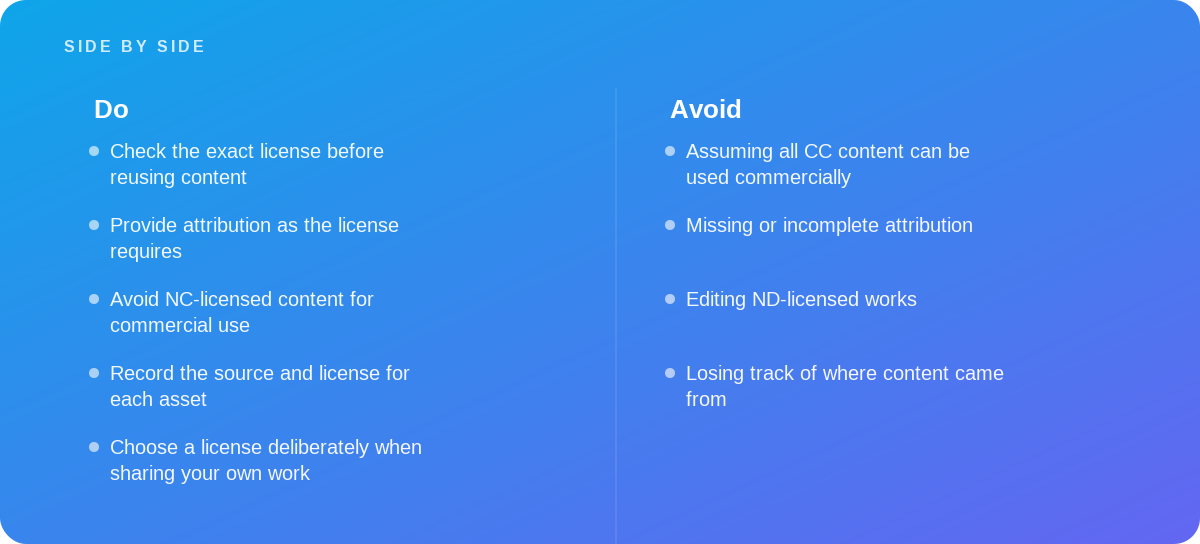
- Assuming all CC content can be used commercially
- Missing or incomplete attribution
- Editing ND-licensed works
- Losing track of where content came from
What good looks like instead
- Check the exact license before reusing content
- Provide attribution as the license requires
- Avoid NC-licensed content for commercial use
- Record the source and license for each asset
- Choose a license deliberately when sharing your own work
Why it matters
Creative Commons content can be reused legally, but only if the license terms, such as attribution and commercial restrictions, are followed.
The specs that matter
| Measure | Figure |
|---|---|
| Core element | attribution is required by all CC licenses except CC0 |
| NC | non-commercial use only |
| ND | no derivatives, meaning no modified versions |
| SA | share-alike, adaptations must use the same license |
| CC0 | a public domain dedication |
Knowing when to hand it over
Tip: Bring in help when reusing third-party content commercially or publishing your own work openly.
Where this comes from
- Creative Commons — About CC licenses
- U.S. Copyright Office — Frequently asked questions
The figures and practices above come from the sources listed.
Working on something like this?
We take on Content Strategy work for teams who want it done once, properly. Tell us what you are building and we will tell you honestly whether we are the right studio for it. Start a project.
Where to go next
Spotted something wrong? Report an error on this page. We correct on the page and say what changed.