Brand Positioning: The Decisions That Matter
Learn how to make the brand positioning decisions that matter: audience, category, difference and proof, tested against competitors and your real delivery.
 Priya Raghunathan

Brand positioning is the decision about who a business is for, what it offers them, and why that offer is different from the alternatives those people already have. It is not a tagline, a mission statement or a mood board. It is a strategic choice, usually expressed in a sentence or two, that every later decision about naming, visual identity, messaging, pricing, hiring and product scope depends on. When the choice has been made well, a marketer can look at a draft headline and say with confidence whether it belongs to the brand. When it has not, the business produces marketing that could belong to any competitor, and the team argues about taste because there is no strategy to argue about.
This field guide is for founders, marketing leads and in-house brand teams who need to make that decision deliberately, and for practitioners who want a working reference. It moves from fundamentals (what a position contains and how to test it) through the research that should ground it, to the harder calls: deciding who you are not for, checking the claim against what the operation can actually deliver, sequencing positioning ahead of identity work, and handling positioning inside larger brand families, mergers and refreshes.
The emphasis throughout is on decisions rather than vocabulary. A positioning statement is only useful if it forces trade-offs. If yours has never caused anyone to say no to a customer, a feature or a campaign idea, it is probably not a position yet.
- What it is The decision about who the business serves, what it offers them, and why that differs from the alternatives.
- Four components Audience, category, differentiation and reason to believe.
- The core test A competitor should not be able to claim the same thing truthfully.
- Evidence base Customer research and competitor analysis, not internal opinion.
- Relationship to identity Positioning is strategy; identity is its expression, so positioning comes first.
- Lifespan A position should outlast individual campaigns, typically by years rather than quarters.
What Brand Positioning Actually Decides
The simplest way to understand brand positioning is to look at what it removes. Before a position exists, a business can describe itself in dozens of plausible ways: fast, friendly, premium, affordable, innovative, trusted, local, global. Each of those words is defensible in isolation, and most teams can produce a slide listing all of them. A position picks a small number of these claims, attaches them to a specific audience, and deliberately gives up the rest. The value is in the giving up.
In practice, a position answers three linked questions. First, for whom: which buyers, in which situation, with which problem. Second, what: the category the business competes in, stated in the terms buyers use when they compare options. Third, why this and not that: the difference that matters to those buyers, plus the evidence that makes the difference believable. Those questions look simple, but each one hides a choice that some part of the organization will resist, because each choice narrows the addressable market on paper.
Positioning is also the decision every other brand decision depends on. A designer choosing between a restrained typographic identity and an expressive illustrated one cannot resolve that choice on aesthetics alone; it depends on whether the brand is positioned as the careful specialist or the approachable challenger. A copywriter cannot settle the tone of the homepage without knowing whether the reader is a procurement officer comparing five vendors or an owner-operator buying for the first time. When those downstream teams disagree endlessly, the root cause is often an unmade positioning decision rather than a creative problem.
What positioning is not
Three things are routinely confused with positioning. A tagline is a compressed public expression of a position, and many strong brands have none. A mission or purpose statement describes why the organization exists, which may be sincere but rarely distinguishes it from competitors with similar missions. A value proposition for a single product or campaign is narrower and shorter-lived; it should be consistent with the brand position but will change as products change. Keeping these separate prevents a common failure in which a team spends a workshop wordsmithing a tagline and believes it has done positioning work.
The Four Components of a Brand Position
Most working positioning frameworks reduce to four components: audience, category, differentiation and reason to believe. The labels vary between agencies and textbooks, but if any one of the four is missing the position will not hold up under pressure.
Audience
The audience is the group whose choice you are trying to win, described precisely enough that you could recognize them in a sales call. "Small businesses" is not an audience; "owner-managed firms with 10 to 50 staff that have outgrown spreadsheets but have no dedicated operations hire" is. Good audience definitions describe a situation and a trigger, not just demographics. The trigger matters because it tells you when the buyer starts looking, which shapes channel and message decisions later.
Category
The category is the frame of reference: the set of alternatives the buyer is comparing you with. This is more strategic than it looks. A meal-kit company can position itself against supermarkets, against restaurants or against takeaway apps, and each choice changes what "better" means. Choosing a category also tells buyers how to understand you quickly. Inventing a new category can work, but it carries the cost of educating the market, and most businesses are better served by picking an existing category and being clearly different within it.
Differentiation
Differentiation is the meaningful difference between you and the alternatives in that category, for that audience. Both qualifiers matter. A difference that the audience does not care about is trivia; a difference that exists only against a weak competitor is fragile. The strongest differentiators tend to be structural (how the business is built, what it refuses to do, where it has invested) rather than attitudinal (how much it cares).
Reason to believe
The reason to believe is the evidence that makes the differentiation credible: a process, a capability, a track record, a guarantee, a specialism, an ownership structure. Without it, differentiation is just an assertion. A useful discipline is to require that every differentiating claim is paired with at least one proof point that a skeptical buyer could verify.
Tip: Write each component on its own line before combining them into a sentence. Teams that start with the full statement tend to polish the prose and skip the choices. A reliable template is:
- For [specific audience in a specific situation],
- [brand] is the [category] that [meaningful difference],
- because [verifiable reason to believe].
The Competitor Test: Writing a Position No One Else Can Honestly Claim
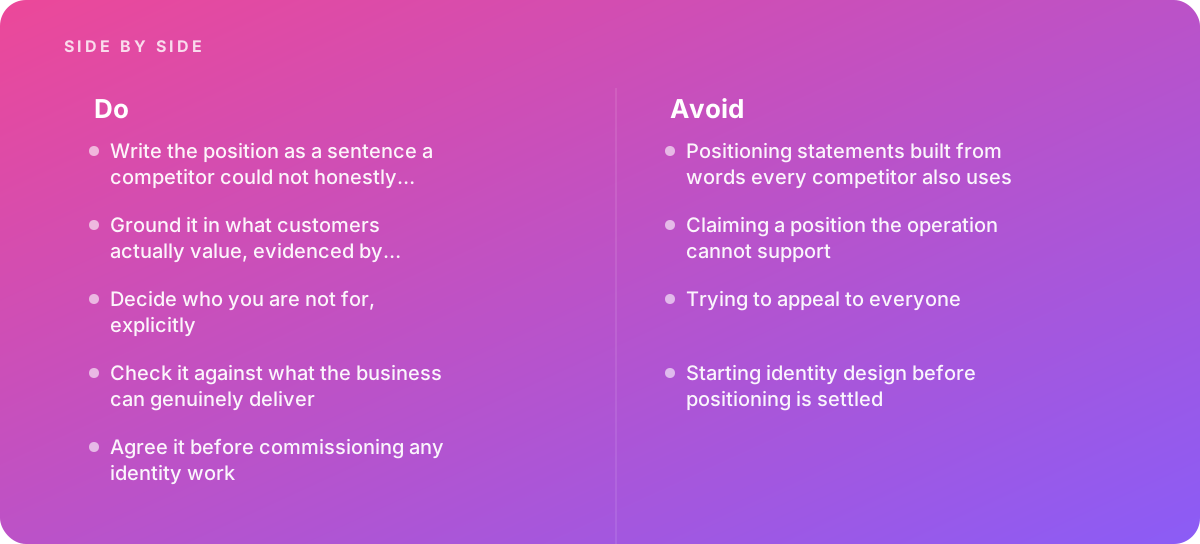
The single most useful test of a position is this: could a competitor claim the same thing truthfully? If the answer is yes, you do not have a position; you have a category description. "We deliver high-quality work on time with a personal touch" fails immediately, because every competent firm in almost every category can say it, and most already do.
Running the test properly takes more than a glance. Collect the homepages, about pages and sales decks of your five to ten most relevant competitors, and extract the claims they make about themselves. Then place your draft position alongside them with the brand names removed. If a colleague who does not know the market cannot pick yours out, the position is not yet distinct. This exercise is humbling, and it is supposed to be.
There is a second, subtler version of the test. Ask not only whether a competitor could say it, but whether a competitor would want to. A good position often describes a trade-off competitors have chosen not to make. A firm that positions itself as the specialist for a single regulated industry is claiming something that generalist competitors could technically copy, but will not, because it would mean walking away from their other clients. That reluctance is what makes the position defensible.
Common words that fail the test
Some words appear so often in positioning drafts that they should trigger an automatic rewrite: quality, innovative, passionate, customer-centric, trusted, end-to-end, bespoke, solutions, partner. None is wrong in itself. The problem is that they describe table stakes, the things buyers assume any credible option provides. Replace them with the specific behavior or structure that produces the outcome. Instead of "responsive," say "every client has a named lead who replies within one business day." That sentence can be checked, and a competitor cannot claim it unless they actually run that way.
| Draft claim | Why it fails the competitor test | Stronger rewrite (illustrative) |
|---|---|---|
| We are a trusted partner for growing businesses. | Every B2B service firm claims trust and partnership; no audience or difference is named. | For owner-managed manufacturers between 20 and 200 staff, we are the only finance team that also runs their ERP migration. |
| Innovative design solutions for modern brands. | "Innovative," "solutions" and "modern" are unfalsifiable and universal. | Identity systems for regulated health brands, built and tested for accessibility compliance before launch. |
| Premium quality at an affordable price. | Contradictory without a structural reason; competitors say the same. | Restaurant-grade coffee at supermarket prices, because we sell only three blends and roast to order weekly. |
| Customer-first service, every time. | Describes an attitude, not a verifiable behavior. | Every support request answered by a qualified engineer, never a script, within four working hours. |
Evidence First: Grounding the Position in Research
A position should be grounded in customer research and competitor analysis, not in what leadership believes about the business. Internal beliefs are a starting hypothesis, and often a good one, but they are systematically biased toward what the business is proud of rather than what customers actually value. The two overlap less often than founders expect.
Customer research that informs positioning
The most useful research for positioning is qualitative and focused on decisions. Interview recent customers, including some who nearly chose a competitor, and a handful of prospects who chose someone else. The questions that matter are about the moment of choice: what triggered the search, which alternatives they considered, what nearly made them pick another option, what tipped the decision, and how they would describe you to a peer. Listen for the words customers use, because those words often make better positioning language than anything written in a workshop.
How many interviews are enough depends on how varied your customers are. For a business with one clear customer type, a set of eight to twelve interviews often surfaces the recurring themes; for a business serving several segments, plan a similar number per segment. The signal you are looking for is repetition: when new interviews stop producing new reasons for choosing you, you have enough to work with. User-research practitioners such as Nielsen Norman Group publish extensive guidance on interview technique and on how brand perception shows up in the user experience, and it is worth reading before you run your first session.
Quantitative research has a role, but a later one. Once interviews have produced candidate differentiators, a short survey can test how widely each one is valued across a larger sample. Running a survey first, before you know what to ask, tends to measure the attributes you already assumed mattered.
Competitor analysis that informs positioning
Competitor analysis for positioning is not a feature comparison. It is a map of the claims each competitor makes, the audience each appears to prioritize, and the proof each offers. Plot competitors on two or three axes that buyers genuinely use to choose (for example, specialist versus generalist, self-service versus done-for-you, price-led versus outcome-led) and look for positions that are crowded and positions that are empty. An empty position is only an opportunity if buyers value it and you can credibly occupy it; some spaces are empty because nobody wants them.
If you already have an established brand, a structured brand audit is often the most efficient way to gather both kinds of evidence at once, because it collects how the brand currently shows up, how customers perceive it and where competitors sit, before any new position is drafted.
Warning: Do not treat a leadership workshop as research. Workshops are useful for surfacing hypotheses and building agreement, but a room of executives will reliably produce a position that flatters the business. Common signs that a position came from the room rather than the market:
- It uses internal jargon or product names customers never mention.
- Its differentiators are things staff are proud of but no customer raised unprompted.
- Nobody can point to an interview, review or lost-deal note that supports it.
Deciding Who You Are Not For
Trying to appeal to everyone is the most common reason positioning fails, and the fix is uncomfortable: decide, explicitly and in writing, who the business is not for. This is not an exercise in rejecting customers who show up. It is a decision about whom the brand, the product roadmap and the marketing budget are designed around.
The reason exclusion matters is that every audience wants something slightly different, and a business that tries to satisfy all of them ends up with messaging so general it persuades no one. A clear "not for" list lets teams make faster decisions. A sales lead can qualify out poor-fit prospects early. A product manager can decline a feature request that serves a non-target segment. A content team can write for one reader instead of hedging for five.
How to write the exclusion
Write two or three sentences describing the customers you will not optimize for, and why. Useful dimensions include company size or life stage, budget level, the complexity of the need, the level of support expected and the pace of decision-making. For example: "We are not for businesses that want the lowest possible monthly fee and are happy to self-serve; they are better served by larger platforms with lower prices and less support." Notice that the sentence is respectful. Good exclusions describe a mismatch, not a judgment.
Then check the exclusion against revenue. If the excluded group currently accounts for a large share of income, the position may be aspirational rather than practical, and the transition needs a plan. That is not a reason to abandon the position, but it is a reason to phase it: keep serving existing customers well while directing new marketing and product investment toward the target audience.
Checking the Position Against What the Operation Can Deliver
A position is a promise, and claiming one the operation cannot support is worse than having no position at all. Buyers experience the brand through the product, the service, the invoice, the support ticket and the renewal conversation. If those experiences contradict the position, the gap becomes the brand. A firm positioned on speed that routinely misses deadlines does not merely fail to benefit from its position; it teaches customers to distrust everything else it says.
The delivery check is best done as a structured walk through the customer journey. For each stage (discovery, evaluation, purchase, onboarding, delivery, support, renewal), ask what a customer would need to see for the position to feel true, and whether that happens today. Where it does not, decide whether to fix the operation, soften the claim or change the position. The public-sector discipline of defining a service proposition, described in the GOV.UK Service Manual, is a useful model here: it insists on understanding user needs and what the service can realistically deliver before committing to how it is described.
Questions for the delivery check
- Which teams have to behave differently for this position to be true, and have they agreed?
- What would it cost, in money and time, to close the largest gap between claim and reality?
- Which proof points can we show a prospect today, and which are still promises?
- If a competitor publicly tested our claim tomorrow, would it hold?
- Does our pricing support the position, or does it signal something else?
Pricing deserves particular attention because it is the most visible positioning signal a business sends. A brand positioned on expertise and depth that prices at the bottom of the market creates confusion; a brand positioned on simplicity that publishes a complicated rate card undermines itself. Positioning does not set prices, but it should constrain them.
- Brand positioning
- The strategic decision about who a business serves, what it offers them and why that differs from the alternatives they consider.
- Positioning statement
- An internal sentence or short paragraph recording that decision, used to guide teams rather than published as copy.
- Frame of reference
- The category or set of alternatives the buyer compares you with; changing it changes what counts as a difference.
- Point of difference
- An attribute or benefit that the target audience values and that competitors cannot credibly claim.
- Point of parity
- An attribute buyers expect from any credible option in the category; necessary, but not differentiating.
- Reason to believe
- Verifiable evidence (a capability, process, record or guarantee) that makes the point of difference credible.
- Brand architecture
- The structure governing how a parent brand, sub-brands and products relate, and how positions are shared or separated among them.
Positioning Before Identity: Getting the Sequence Right
Positioning is strategy; identity is its expression. The logo, typography, color system, photography style, tone of voice and naming conventions are all ways of making the position visible and memorable. That relationship dictates the order of work: agree the position before commissioning any identity work.
Starting identity design before positioning is settled is one of the most expensive mistakes a business can make with its brand. Designers are then forced to guess at the strategy, and the review process becomes a debate about personal preference because there is no agreed standard to judge concepts against. Rounds of revision multiply. Often the project ends with an identity that is attractive but generic, or one that expresses a position the leadership team later decides it does not hold, which means the work has to be redone.
When the position is settled first, the creative brief becomes sharper and the evaluation of concepts becomes objective. Each concept can be judged by asking whether it expresses the audience, category and difference that were agreed. Our guide on presenting brand concepts covers how to structure those reviews so that feedback stays anchored to strategy rather than taste. The same logic applies to voice: once the position is clear, you can write voice principles that follow from it and then validate them, as described in our practical guide to testing brand voice.
What the identity team needs from positioning
A positioning handover to designers and writers should include the positioning statement itself, the audience description with the trigger situation, the category and main competitors, the ranked differentiators with their proof points, the explicit "not for" description, and the research highlights in customers' own words. With that pack, an identity team can make choices on purpose. Without it, they are reverse-engineering strategy from a brief that says "modern, trustworthy and bold."
Tip: Hold a short sign-off meeting for the position itself, separate from any creative review, and record the decision. When identity concepts arrive weeks later, the first question in the review should be "which of these best expresses the position we signed off?" rather than "which do we like?"
Worked Example: Repositioning a Regional Accounting Practice
The following example is illustrative, not a client story. It shows how the components, tests and checks fit together with realistic numbers.
Imagine an accounting practice with 18 staff, serving roughly 400 clients across a mid-sized region. Its website describes it as "a friendly, professional accountancy offering a full range of services to individuals and businesses." Revenue is split, in round numbers, as follows: about 35 percent from personal tax returns for individuals, about 25 percent from bookkeeping and compliance for very small businesses, and about 40 percent from advisory and compliance work for around 60 established owner-managed companies, mostly in construction and trades.
Step one: research
The partners interview 10 of the 60 company clients and 4 prospects that chose another firm. A pattern appears quickly. Company clients stay because the practice understands construction: retention payments, subcontractor tax schemes, project-based cash flow and the seasonal pattern of the industry. Several say, unprompted, that their previous accountant "didn't get how building firms get paid." The prospects that went elsewhere chose firms that seemed more specialized or more digital.
Step two: competitor map
The partners review eight local competitors. All claim to be friendly, professional and full-service. None claims a specialism in construction, although one large national firm has a construction team that serves much bigger contractors.
Step three: draft and test the position
The draft reads: "For owner-managed construction and trade businesses with 5 to 100 staff, we are the accountancy practice that specializes in how building firms actually get paid, because two-thirds of our advisory team came from the industry and we handle subcontractor tax and retention accounting every week." Tested against the competitor map, no local firm can claim this truthfully. The national firm could claim a construction specialism, but not for this size of business and not with a local team.
Step four: the not-for decision and the delivery check
The practice decides it is not for individuals who need only a personal tax return, and not for very small businesses outside construction that want the lowest-cost bookkeeping. Those segments represent about 60 percent of client count but a smaller share of profit, because they require high volume at low fees. The plan is to keep existing clients in those groups, stop marketing to them, and gradually refer new inquiries to partner firms. The delivery check reveals one gap: the practice has no published guidance on industry-specific tax topics, so the proof points exist only in conversation. The fix is a set of explainer articles and a single-page summary of how the firm handles retention accounting.
Step five: sequence the identity work
Only once the partners sign off the position does the practice brief an identity refresh. The brief now includes the audience, the category, the differentiator and the proof, and the designers can make choices, such as a practical, plain-spoken tone and imagery drawn from real job sites, that express the position rather than generic professionalism.
In this illustrative scenario, the business has not changed what it does. It has changed what it chooses to be known for, and it has aligned marketing, referrals and content with that choice.
Positioning Inside Brand Families, Mergers and Sub-Brands
Positioning gets harder when there is more than one brand involved. A parent company with several product lines, a business launching a new offer for a different audience, or two firms that have merged all face the question of how many positions they need and how those positions relate.
Parent brands and sub-brands
The relationship between a parent position and its sub-brands is governed by brand architecture. In a branded house, one master position covers everything, and each product expresses a facet of it. In a house of brands, each brand holds its own position and may even compete with siblings. Most businesses sit somewhere between. The practical test is whether a new offer serves the same audience with the same core difference. If it does, it probably belongs under the existing position. If it serves a different audience or makes a contradictory claim, it may need its own, which is the situation covered in our guide to launching a sub-brand properly.
Mergers and acquisitions
A merger often produces two incompatible positions: one firm positioned as the premium specialist, the other as the accessible generalist, now operating under a single ownership. Leaving both positions in place indefinitely confuses staff and customers alike. The decision is usually one of three: adopt the stronger position and migrate the other brand toward it, create a new position that genuinely reflects the combined capability, or keep the brands separate with deliberately distinct positions. Each has costs, and the right answer depends on customer overlap and on what the combined operation can actually deliver. Our practical guide to brand transition after acquisition walks through the transition mechanics once the positioning decision is made.
Keeping a Position Durable Over Time
Positioning should outlast individual campaigns. Campaigns change every season; a position that changes every season is not a position. Durability does not mean rigidity, though. A position needs to be protected from casual drift and revisited deliberately when the market genuinely moves.
Protecting the position day to day
The biggest threat to a position is not a competitor but internal drift: the sales deck that adds a new claim to win one deal, the campaign that chases a trend, the product launch that quietly targets a different audience. The defense is governance. Make the positioning statement part of every creative brief template, include a positioning check in content and campaign sign-off, and assign someone the authority to say that a piece of work is off-position. Our guide to brand governance covers how to set up that authority without turning it into a bottleneck.
Knowing when to revisit
Review the position on a fixed cycle, commonly once a year, and on specific triggers in between. Triggers that justify a genuine review include a significant change in the target audience's needs, a new competitor occupying your claimed ground, a change in what the business can deliver (for example, after an acquisition or a major capability investment), and a sustained pattern of wins or losses that contradicts the position. Boredom inside the marketing team is not a trigger. Teams tire of their own positioning long before customers have absorbed it.
When a review does conclude that the position must shift, the identity may or may not need to change with it. A small shift in emphasis can often be expressed through messaging alone. A larger move, such as a new audience or category, usually needs visual and verbal changes too, and our article on when to refresh a brand helps decide how far to go.
Warning: Do not relaunch the position every time a new marketing lead arrives. Each relaunch resets whatever recognition the brand had built. If a new leader believes the position is wrong, ask for evidence from customers and competitors, the same standard the original position had to meet, before changing it.
When to Bring In Outside Help
Many businesses can do credible positioning work internally, especially with a disciplined process and honest research. Outside help earns its cost in three situations. First, when the business cannot articulate why customers choose it: the leadership team gives different answers, or everyone gives the same vague answer. Second, when competitors have become indistinguishable and the business needs someone without internal loyalties to find the real differences. Third, when a merger has produced two incompatible positions and the leadership of each side is invested in its own.
What an outside partner should bring is structure and independence: interview design and facilitation, competitor mapping, a process for making and recording decisions, and the willingness to tell leadership that a favorite claim does not survive the competitor test. Broad introductions to brand strategy methods, such as those from the Interaction Design Foundation, can help an internal team understand what a good process looks like before deciding whether to run it themselves.
How to evaluate a positioning partner
- Ask how they gather evidence. A credible answer involves talking to your customers, not only to your leadership.
- Ask what the output is. You want a decided position with its components, proof points and exclusions, not only a presentation of options.
- Ask how positioning connects to identity. The partner should insist on agreeing strategy before design begins.
- Ask to see how they test a draft position. Look for something like the competitor test and a delivery check.
If you want support with the strategic groundwork, our brand strategy service is built around these steps, from research through to a signed-off position ready to brief into identity work.
Verdict Brand positioning is the decision everything else in the brand depends on, so make it deliberately and early. Name a specific audience, choose the category you compete in, state a difference that customers value and competitors cannot honestly claim, and back it with proof. Ground every part in customer research and competitor analysis, write down who you are not for, and check the claim against what the operation actually delivers. Agree the position before any identity work begins, then protect it through governance so it outlasts the campaigns built on it.
Where this comes from
- Nielsen Norman Group — Brand and user experience
- Interaction Design Foundation — Brand strategy
- GOV.UK Service Manual — Defining a proposition
The figures and practices above come from the sources listed.
Working on something like this?
We take on Brand & Identity Design work for teams who want it done once, properly. Tell us what you are building and we will tell you honestly whether we are the right studio for it. Start a project.
Where to go next
Spotted something wrong? Report an error on this page. We correct on the page and say what changed.