Healthcare SEO, Done Properly
An expert briefing on healthcare SEO: how search judges health content, author and reviewer models, review cadences, local listings, schema and measurement.
 MediaScaleUp Editorial Team

Healthcare SEO is search optimization for providers, clinics and health information sites: hospitals and health systems, independent practices, specialty clinics, telehealth services, and the publishers and nonprofits that explain health topics to the public. It uses the same machinery as any other SEO program, including crawling, indexing, relevance, links and local listings, but it operates under a stricter standard. Health content is held to higher quality expectations in search, because a wrong answer about a symptom, a medication or a treatment can hurt someone. Accuracy and expertise signals matter more here than in almost any other category.
This briefing is written for three readers. Executives and practice leaders get a summary of what healthcare SEO requires and what it costs to get wrong. SEO specialists, content leads and developers get the technical depth: how quality expectations are expressed, how to build author and review processes that search engines and patients can see, how local search works for multi-location organizations, and how to mark up medical organizations and services with structured data. The final sections return to the business: how to staff the work, how to measure it, and when to bring in outside help.
The central argument is simple. In health, the practices that make a page trustworthy to a patient are the same practices that make it competitive in search. There is no shortcut that works for one and not the other, and most of the failures we see come from treating clinical accuracy as someone else's job.
Executive summary: what healthcare SEO requires
Search engines treat health topics as high-stakes content. Google's documentation on creating helpful, reliable, people-first content asks site owners to consider whether content is produced by people with real expertise, whether it is clear who created it, and whether it would be trusted by someone looking for accurate information. For a health organization, that translates into a short list of commitments that leadership has to fund and enforce, not just an SEO team to execute.
These are our working standards, not external benchmarks, and they map directly onto the good practice set out below. The four areas that decide performance are consistent across the sector:
- Quality expectations. Health topics are treated as high-stakes content. Thin, generic or unattributed pages struggle, and pages with clear expertise and careful sourcing compete.
- Expertise. Author credentials and review processes matter. A page should say who wrote it, who reviewed it clinically and when.
- Local search. Clinics compete in local results, where accurate listings, reviews and location pages decide who appears in the map results for "near me" searches.
- Structured data. Medical organizations and services can be marked up, which helps search engines understand who you are, where you are and what you offer.
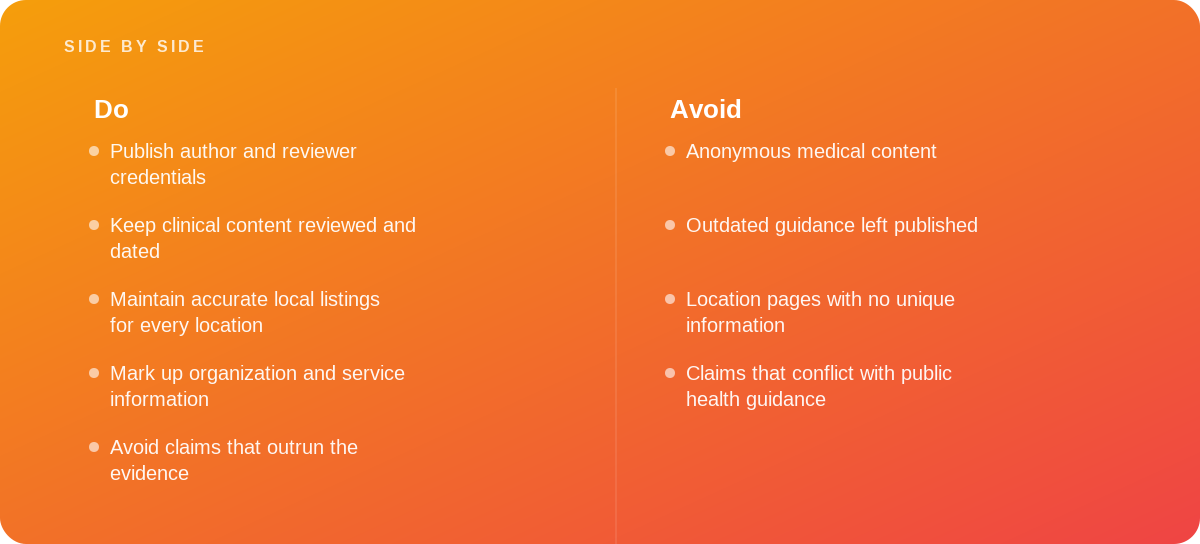
The mistakes that do the most damage are equally consistent: anonymous medical content, outdated guidance left published, location pages with no unique information, and claims that conflict with public health guidance. Each of these is a governance failure before it is an SEO failure, which is why this briefing spends as much time on process as on technique.
In health, the practices that make a page trustworthy to a patient are the same practices that make it competitive in search.
How search engines judge health content
Search engines do not publish their ranking systems, and anyone who claims to know the exact weight of a signal is guessing. What is public is the direction of travel. Google's guidance repeatedly emphasizes content created for people rather than for search engines, demonstrated experience and expertise, clear authorship, and trustworthiness. Its search quality rater guidelines, used to evaluate search results rather than to rank pages directly, describe topics that could significantly affect a person's health, finances or safety as "Your Money or Your Life" topics and apply a higher standard to them. Medical content sits squarely in that group.
What "higher quality expectations" means on the page
For practitioners, the useful question is not how the algorithm works but what a page that meets the standard looks like. In our experience, strong health pages share several traits:
- They answer the question the searcher asked, near the top, in plain language.
- They show who is responsible: a named author with relevant qualifications, a named clinical reviewer, and dates for publication and last review.
- They distinguish established evidence from emerging findings and say when the answer depends on the individual.
- They are consistent with authoritative public health guidance, such as that published by the Centers for Disease Control and Prevention, and when they differ in emphasis they explain why.
- They tell the reader when to seek care, including when a symptom needs urgent attention.
- They belong to an organization that is easy to identify, with a clear about page, contact details, and policies on editorial standards and medical review.
Why generic content struggles
Health is a crowded search space. Large publishers, government agencies, academic medical centers and major health systems already cover common conditions in depth. A clinic that publishes a five-hundred-word overview of a common condition, written without a named expert and indistinguishable from dozens of others, adds nothing a search engine needs. The opportunity for most providers lies elsewhere: in content only they can write (how their clinic approaches a procedure, what the patient experience is like, what their specialists see locally), in local visibility, and in service pages that answer the practical questions patients ask before booking.
Insight: Most providers cannot outrank national health publishers on broad condition queries, and do not need to. Their search value is concentrated in service, location and "what happens at this clinic" queries, where no national publisher can compete with first-hand detail.
Expertise you can see: authors, reviewers and dates
Anonymous medical content is the first mistake on the list for good reason. A page with no author, no reviewer and no date gives the reader nothing to judge it by, and gives a search engine no evidence of expertise. Fixing it is not complicated, but it requires a process that outlasts the launch of any one page.
Building the author and reviewer model
Separate the two roles. The author writes the page and may be a clinician, a health writer or a content specialist. The reviewer is a qualified clinician in the relevant field who checks the page for accuracy, confirms it is consistent with current guidance, and approves it for publication. On some pages they are the same person; on most, they are not, and making the distinction visible is part of the point.
Each author and reviewer should have a profile page with their name, credentials, specialty, relevant licensure or board certification as they are permitted to describe it, role at the organization, and a short description of their experience. Link the byline on every page to that profile. Keep credentials accurate and current; an out-of-date title or a lapsed affiliation undermines the trust the profile is meant to build.
Dating content honestly
Show two dates on clinical pages: when the page was first published and when it was last medically reviewed. Update the review date only when a qualified reviewer has actually reviewed the page, not when someone fixes a typo or changes a layout. A "last reviewed" date that moves every time the site is redeployed is worse than no date, because it misleads readers and weakens the signal for every page on the site.
The editorial policy page
Publish a page that explains how clinical content is produced: who writes it, who reviews it, how often it is reviewed, how sources are chosen, how corrections are handled and how readers can report an error. This page is for patients, journalists and partners as much as for search engines. It also forces the organization to agree on a process, which is often the harder part.
Keeping clinical content current
Outdated guidance left published is the second common mistake, and it is often invisible to the organization that makes it. Health guidance changes: screening recommendations shift, vaccine schedules are updated, drug approvals and warnings change, and clinical practice evolves. A page that was accurate when it was written can become wrong without anyone touching it.
A review cadence that scales
Assign every clinical page a review tier. We typically use three:
- High-change pages covering topics where guidance moves often, such as vaccines, screening, infectious disease and medications. Review at least every six months and whenever an authoritative body updates its guidance.
- Standard clinical pages covering conditions, procedures and treatments. Review at least every twelve months.
- Stable pages such as anatomy explainers or patient experience pages. Review at least every eighteen to twenty-four months, and whenever the service itself changes.
Track every page in a content inventory with its tier, author, reviewer, last review date and next review date. A spreadsheet works for a few hundred pages; larger organizations usually build review workflows into their content management system. The inventory also exposes orphaned pages: content written for a campaign years ago that nobody owns and nobody has reviewed since.
The table below summarizes how each tier is handled. The intervals are our recommended defaults, and a clinical reviewer can shorten any of them.
| Review tier | Typical topics | Recommended maximum interval | Extra trigger for review |
|---|---|---|---|
| High-change | Vaccines, screening, infectious disease, medications | 6 months | An authoritative body updates its guidance |
| Standard clinical | Conditions, procedures, treatments | 12 months | The organization changes how it delivers the service |
| Stable | Anatomy explainers, patient experience, what to expect | 18 to 24 months | A location, team or process changes |
Update, consolidate or retire
When a page comes up for review, it has three possible outcomes. It is updated and re-reviewed. It is consolidated into a stronger page on the same topic, with a permanent redirect from the old URL. Or it is retired, because the service is no longer offered or the topic is covered better elsewhere, with a redirect to the most relevant remaining page or a clear removal where no good equivalent exists. Retiring content feels like losing traffic, but an outdated clinical page is a liability, and consolidation often improves the performance of the page that remains.
A "last reviewed" date that changes without a clinician reviewing the page is worse than no date at all.
Local search for clinics and multi-location providers
Clinics compete in local results. For most providers, the searches that lead to appointments are local: a service plus a place, or a service plus "near me." Those results are dominated by map listings, and the listing that appears depends on relevance, distance and prominence. The organization controls relevance and prominence through accurate listings, good location pages and a steady flow of genuine reviews.
Accurate listings for every location
Maintain accurate local listings for every location. That means one verified business profile per physical site, with the correct name, address, phone number, hours, categories, services and appointment link. Holiday hours, temporary closures and changes to services should be updated before they take effect. Where individual practitioners have their own listings, as is common in healthcare, they should be accurate too, and should point to the correct location. Inconsistent names, old addresses and duplicate listings confuse patients and dilute the organization's local signals.
Location pages with unique information
Location pages with no unique information are the third mistake. A health system with twenty clinics that publishes twenty identical pages, differing only in the address, gives search engines no reason to rank any of them and gives patients no help. Each location page should contain information specific to that site:
- Services offered at this location, which often differ between sites.
- Practitioners based there, linked to their profiles.
- Hours, including any evening or weekend clinics, and holiday schedules.
- Directions, parking, public transit and accessibility details.
- Insurance accepted, where it differs by site.
- What to expect on arrival: check-in, forms, what to bring.
- Photos of the actual site, and any site-specific news.
The structure of multi-location SEO is similar across sectors, and our guide to getting franchise SEO right covers the governance of central templates and local detail in more depth.
Reviews and privacy
Reviews influence local prominence and patient choice. Healthcare organizations have to handle them with care, because responding publicly in a way that confirms someone is a patient, or discusses their care, can create a privacy problem under HIPAA even when the patient raised the topic. The safe pattern is a response that thanks the reviewer, does not confirm or discuss any care, and invites them to contact the organization privately. This is general guidance, not legal advice; organizations should confirm their approach with their privacy officer or counsel.
Structured data for medical organizations and services
Medical organizations and services can be marked up with structured data. The schema.org vocabulary includes types for medical organizations, clinics, hospitals, physicians and medical procedures, alongside the general types for organizations, local businesses, people and web pages. Markup helps search engines connect entities: this organization operates these locations, these practitioners work at this location, this page describes this service.
What to mark up
- The organization, with its legal name, logo, contact details and links to its official profiles.
- Each location, using the most specific appropriate type, with address, geo-coordinates, phone, hours and the parent organization.
- Practitioners, with name, specialty and the location or locations where they practice.
- Services, describing the procedures or services offered and where.
- Articles and web pages, with author, reviewer where supported, publication date and modification date consistent with what the page shows.
Realistic expectations
Structured data is not a ranking shortcut. Only some types produce visible enhancements in search results, and search engines decide when to show them. The value lies in clarity and consistency: markup that matches the visible page and the business listings reinforces the same facts everywhere. Markup that contradicts the page, such as a review date in the code that differs from the date shown, or hours that disagree with the listing, does the opposite. Validate markup before release and after template changes, and treat it as part of the page, owned by the same process that owns the content.
Where health sites are built on JavaScript frameworks, check that key content and markup are present in the rendered output search engines see. Our JavaScript SEO service covers rendering, hydration and markup injection, which are common failure points on modern patient portals and appointment tools.
Technical foundations specific to health sites
Most technical SEO for healthcare is ordinary technical SEO done carefully: crawlable architecture, clean internal linking, fast pages, mobile usability, secure connections and sensible canonicalization. A few issues come up more often in healthcare than elsewhere.
Portals, scheduling tools and third-party platforms
Patient portals, online scheduling, bill pay and telehealth are often hosted by vendors on subdomains or separate domains. These should usually be kept out of the index where they contain nothing useful to a searcher, while their public entry points are clearly linked from the main site. Check that scheduling links carry through correctly from location and practitioner pages, because a broken booking path wastes the local visibility that brought the patient there.
Tracking technology and privacy
Analytics and advertising pixels on health websites need deliberate design. The U.S. Department of Health and Human Services has issued guidance on online tracking technologies for organizations covered by HIPAA, and parts of that guidance have been challenged in court, so the position is best confirmed with counsel. The practical SEO implication is to design measurement that captures the events you need, such as appointment requests and calls, without sending health information to third parties. This is not legal advice.
Redesigns and migrations
Health systems merge, rebrand and replatform often, and each change risks the search visibility built up over years. Mapping every old URL to its new equivalent, carrying over authorship and review metadata, and preserving location pages are the priorities. Our article on protecting SEO in a redesign sets out the full procedure. For an audit of crawl, indexing, rendering and site architecture, see our technical SEO work.
Insight: On health sites, technical problems often hide in the vendor-hosted pieces: the scheduling tool, the provider directory, the portal login. Audit the journey from search result to booked appointment, not just the pages your team built.
Claims, evidence and public health guidance
The fourth mistake, claims that conflict with public health guidance, is the one with the highest stakes. It covers overt problems, such as promoting unproven treatments, and subtler ones: overstating the success rate of a procedure, implying a treatment is suitable for everyone, or describing a service in ways that suggest guaranteed outcomes. Avoiding claims that outrun the evidence is both a patient safety issue and a search quality issue.
A practical claims standard
- Every factual claim about effectiveness, safety or outcomes should be supportable by a source the clinical reviewer accepts.
- Where the organization's own data is cited, it should be described accurately, with the period and population it covers.
- Language should reflect uncertainty honestly: "may help," "is often recommended for," "depends on," where that is the truth.
- Where the organization's position differs from mainstream public health guidance, the page should acknowledge the guidance and explain the difference, or the claim should not be published.
- Service pages should avoid superlatives and guarantees, which can also run into advertising rules set by regulators and professional boards.
Worked example (illustrative)
Consider an illustrative orthopedic group, not a real client, with four clinics. Its site has a page on knee replacement that reads, "Our patients are back to normal in two weeks." The clinical reviewer flags the sentence: recovery varies widely, and the group has no data supporting the claim. The revised page explains the typical stages of recovery as the surgeons describe them, notes the factors that make recovery faster or slower, and links to the group's pre-surgery education program. It adds a named author, a named reviewing surgeon, and publication and review dates. The group's location pages are rewritten so that each lists which surgeons operate from which site and which have physical therapy on-site. The group is not promised any particular ranking outcome. What it has gained is a set of pages that a patient, a regulator and a search engine can all trust, and that is the only foundation on which health content reliably competes.
Service pages that earn their place in search
For most providers, the pages that produce appointments are service pages: a procedure, a specialty clinic, a diagnostic test, a program. These pages have to satisfy two readers at once. The patient wants practical answers before committing to a visit. The search engine wants evidence that the page is the most useful result for someone searching that service in that area. The same content serves both.
What a strong service page covers
Build service pages around the questions patients ask the front desk and the clinicians ask in consultations. A useful structure covers:
- Who the service is for, including common reasons for referral and what might make someone unsuitable.
- What happens, step by step, from the first appointment through follow-up, with realistic timing the clinical team confirms.
- How to prepare, including anything the patient must do or avoid beforehand, and what to bring.
- Risks and recovery, described plainly and consistently with the clinical reviewer's view of the evidence.
- Access, meaning which locations offer the service, whether a referral is needed, insurance considerations and how to book.
- The people, with links to the practitioners who provide the service and their profiles.
Pages built this way tend to attract the long, specific queries that patients type when they are close to a decision, such as what to expect at a particular procedure or whether a referral is needed. They also give the organization a natural place to link from condition content to action, which is where most health information sites lose their readers.
First-hand experience as a differentiator
Google's guidance gives weight to experience as well as expertise, and providers have something national publishers do not: direct knowledge of how care is delivered at their sites. A page that explains how a specific clinic runs its pre-operative education, how long a typical visit lasts, or what the recovery suite looks like offers first-hand detail that cannot be copied. That detail must still be reviewed for accuracy, and it must never identify patients, but it is often the most distinctive content an organization can publish.
Condition content: when it is worth writing
Condition pages are worth writing when the organization has a genuine specialty in the condition, when the page will connect clearly to services the organization offers, and when the organization can sustain the review cadence the topic requires. They are rarely worth writing to chase broad informational traffic. A modest library of well-reviewed condition pages linked to strong service pages usually outperforms a large library of generic articles that nobody has the capacity to keep current.
Internal linking that follows the patient journey
Link condition pages to the relevant services, services to the locations that offer them, locations to the practitioners based there, and practitioners back to their services. This structure mirrors how patients move from a question to a booking, and it helps search engines understand how the organization's content fits together. Avoid sprawling link blocks in footers and sidebars; contextual links within the body of a page carry the clearest meaning.
Glossary for healthcare SEO teams
Health SEO programs bring together clinicians, marketers, developers and compliance teams who do not always share vocabulary. The terms below come up in almost every engagement.
- YMYL
- "Your Money or Your Life," a term from Google's quality rater guidelines for topics that could significantly affect a person's health, finances or safety, which are held to a higher standard.
- E-E-A-T
- Experience, expertise, authoritativeness and trustworthiness, the qualities Google's guidance describes when discussing how helpful, reliable content is evaluated.
- Clinical reviewer
- A qualified clinician who checks a page for accuracy and consistency with current guidance before it is published or re-dated.
- Content inventory
- A record of every page with its owner, author, reviewer, review tier and review dates, used to keep clinical content current.
- Local listing
- A business profile on a search or map platform for a physical location or practitioner, showing address, hours, phone and reviews.
- Structured data
- Machine-readable markup, usually using the schema.org vocabulary, that describes the organization, locations, practitioners, services and pages.
- Canonical URL
- The preferred version of a page that search engines should index when similar or duplicate versions exist.
Business implications: staffing, budget and measurement
For leadership, the implication of everything above is that healthcare SEO is an operating discipline, not a campaign. It needs clinical time, content capacity, technical ownership and local operations to work together.
Who does what
- Clinical reviewers need protected time. A realistic review load for a busy clinician is a few pages a week, which determines how fast new content can be published and how large an inventory can be kept current.
- Content leads own the inventory, the editorial policy, the review schedule and the brief for each page.
- Technical owners own templates, structured data, performance, redirects and the integration with scheduling and portal vendors.
- Location or operations managers own listing accuracy: hours, closures, services and practitioner changes, reported before they happen.
What drives cost
The cost of a healthcare SEO program is driven by the number of locations and practitioners, the size of the clinical content inventory, the rate at which guidance changes in the organization's specialties, the state of the technical platform, and whether the organization has in-house clinical review capacity. Organizations with many locations and a large legacy content library usually need a substantial first phase of consolidation and cleanup before new content pays off. Similar dynamics apply in other regulated sectors, as our guides to legal SEO and insurance SEO describe.
How to measure it
Measure outcomes that matter to the organization: appointment requests, calls and bookings from organic search and local listings, broken down by service line and location. Supporting measures include visibility for a fixed set of service and location queries, local listing actions such as calls and direction requests, indexed page counts against the inventory, and the share of clinical pages within their review window. That last measure is unusual for SEO reporting, but it is one of the best leading indicators of content quality in health, and it gives leadership a direct view of governance.
When to bring in help
Bring in help when health content must compete in search. In practice, that usually means one of four situations: the organization is launching new service lines or locations and needs them visible quickly; a redesign, merger or platform migration puts existing visibility at risk; a content inventory has grown beyond what the internal team can keep reviewed and current; or local visibility has stalled despite good care and good reviews.
Look for a partner who asks about your clinical review process before proposing content volume, who treats listings and location pages as operational work, and who can explain structured data and tracking decisions in terms your compliance team accepts. Our SEO services cover audits, content programs, local search and technical work for health organizations, and an SEO retainer suits organizations that need ongoing review cycles, listing management and reporting rather than a one-time project.
Whatever the arrangement, the standard stays the same: named experts, reviewed and dated content, accurate listings for every location, markup that matches the page, and no claim that outruns the evidence. Organizations that hold to that standard build search visibility that survives algorithm changes, because it rests on the same qualities patients look for when they decide whom to trust with their health.
Where this comes from
- Google Search Central — Creating helpful, reliable, people-first content
- Centers for Disease Control and Prevention — Health communication
The figures and practices above come from the sources listed.
Working on something like this?
We take on SEO Services work for teams who want it done once, properly. Tell us what you are building and we will tell you honestly whether we are the right studio for it. Start a project.
Where to go next
Spotted something wrong? Report an error on this page. We correct on the page and say what changed.