A Practical Guide to Googlebot and Crawler Verification
Google's crawlers, how they identify themselves, and how to verify that a visitor claiming to be Googlebot really comes from Google.
 MediaScaleUp Editorial Team

Where most projects go wrong
The usual mistakes:
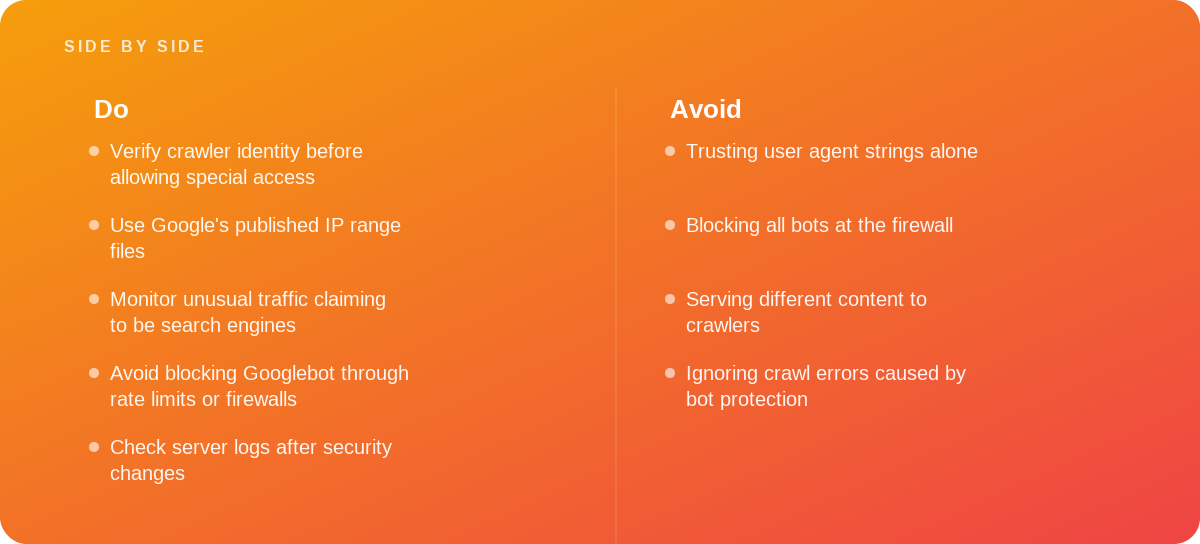
- Trusting user agent strings alone
- Blocking all bots at the firewall
- Serving different content to crawlers
- Ignoring crawl errors caused by bot protection
What good looks like instead
- Verify crawler identity before allowing special access
- Use Google's published IP range files
- Monitor unusual traffic claiming to be search engines
- Avoid blocking Googlebot through rate limits or firewalls
- Check server logs after security changes
Why it matters
Scrapers often pretend to be Googlebot, and blocking or trusting the wrong traffic can hurt both security and search visibility.
The specs that matter
| Measure | Figure |
|---|---|
| Main crawler | Googlebot, with smartphone and desktop variants |
| Verification methods | reverse DNS lookup to googlebot.com or google.com, or matching Google's published IP ranges |
| User agent | can be faked, so it is not proof on its own |
| Other crawlers | Google also runs special-case crawlers and user-triggered fetchers |
Knowing when to hand it over
Tip: Bring in help when bot protection may be blocking search engines, or when log analysis shows suspicious crawler traffic.
Where this comes from
- Google Search Central — Verifying Googlebot and other Google crawlers
- Google Search Central — Overview of Google crawlers and fetchers
The figures and practices above come from the sources listed.
Working on something like this?
We take on SEO Services work for teams who want it done once, properly. Tell us what you are building and we will tell you honestly whether we are the right studio for it. Start a project.
Where to go next
Spotted something wrong? Report an error on this page. We correct on the page and say what changed.