A Practical Guide to Competitor and Market Analysis
Understanding what competitors are doing in search, paid media, content and positioning.
 MediaScaleUp Editorial Team

What is at stake
Competitive analysis is useful for finding gaps and misleading when used as a template, because you cannot see their results.
The playbook
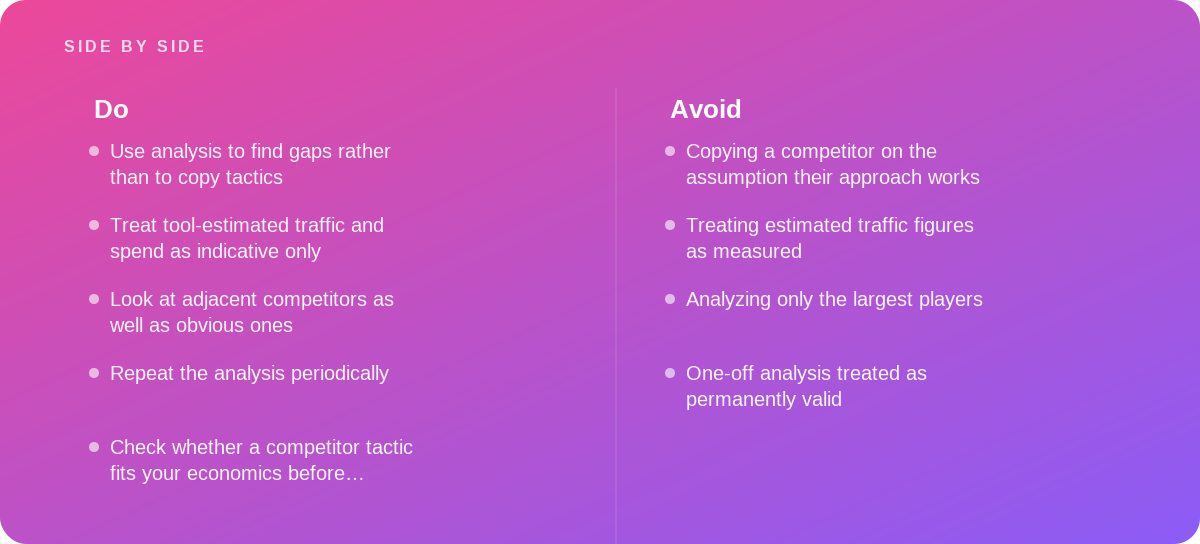
- Use analysis to find gaps rather than to copy tactics
- Treat tool-estimated traffic and spend as indicative only
- Look at adjacent competitors as well as obvious ones
- Repeat the analysis periodically
- Check whether a competitor tactic fits your economics before adopting it
Where it goes wrong
Avoid:
- Copying a competitor on the assumption their approach works
- Treating estimated traffic figures as measured
- Analyzing only the largest players
- One-off analysis treated as permanently valid
The numbers behind it
| Measure | Figure |
|---|---|
| Visible | what competitors publish and bid on |
| Not visible | whether any of it works for them |
| Tool estimates | traffic and spend figures are modeled, not measured |
| Gap analysis | the most useful output — what nobody is covering |
| Refresh | competitive positions change |
Getting outside help
When to hand it over: Bring in help when entering a new market, when a competitor has changed approach significantly, or when strategy is being set from competitor imitation.
Where this comes from
- Google Search Central — Understanding search competition
- Google Ads Help — Auction insights
- Nielsen Norman Group — Competitive analysis
The figures and practices above come from the sources listed.
Working on something like this?
We take on Digital Marketing & CRO work for teams who want it done once, properly. Tell us what you are building and we will tell you honestly whether we are the right studio for it. Start a project.
Where to go next
Spotted something wrong? Report an error on this page. We correct on the page and say what changed.